Welcome to Module 8: Advanced Swing Dynamics and Diagnosis. Over the past several modules, we have built a solid foundation by focusing on specific types of shots—from setting up correctly to hitting solid irons, powerful drives, and executing crucial recovery shots from bunkers. We are now going to shift our perspective from the what to the why. This module will equip you with the analytical tools to understand the underlying mechanics of your swing, diagnose your own faults, and make intelligent corrections.
In this first lesson, we will establish the single most important geometric concept in the golf swing: the swing plane. Our goal is to define what the swing plane is and, more importantly, to explain its fundamental role in building a consistent and repeatable swing. Think of it as learning the blueprint of your swing's architecture.
What is the Swing Plane?
At its core, the swing plane is the imaginary, tilted, flat surface that your club travels along during the swing. Visualizing this plane is the first step to understanding its function.
A great way to start is with a simple analogy.
Ball Flight Laws: Clubface vs Swing Path (Face-to-Path)
This article from Stryper Golf provides a clear and intuitive introduction to the swing plane.
Read the section under the heading "And what about swing plane?" Focus on the "hula hoop" analogy. This is a powerful mental image to grasp the basic geometry of the swing.
The hula hoop analogy gives you a great starting point. Another classic image, famously described by the legendary golfer Ben Hogan, is the "plane of glass." Imagine a large pane of glass resting on your shoulders, extending down through the ball. The goal in this model is to swing your arms and club underneath this pane of glass without shattering it.

The following video provides a dynamic explanation of this concept, tying together the different elements that rotate on a plane during the swing.
Golf Swing Plane Explained (Golf Swing Basics 2020)
In this video, "Golf Swing Plane Explained," from US GOLF TV, the instructor breaks down the concept and references the classic Ben Hogan imagery.
Watch the initial part of the video from the beginning of the explanation. Notice how he points out that "swing plane" can refer to the angle of movement of not just the club, but also the shoulders and hips. This highlights that the swing is a system of rotating parts.
One Size Doesn't Fit All: Steeper vs. Flatter Planes
A common misconception is that there is one single, "correct" swing plane. In reality, the ideal plane changes depending on the club you are using. The length of the club shaft and your resulting posture are the primary drivers of this change.
- With a short iron (like a 9-iron), you stand closer to the ball. This creates a more upright posture, leading to a more vertical or steeper swing plane.
- With a long club (like a driver), you stand farther from the ball. This creates a more bent-over posture, leading to a more horizontal or flatter swing plane.
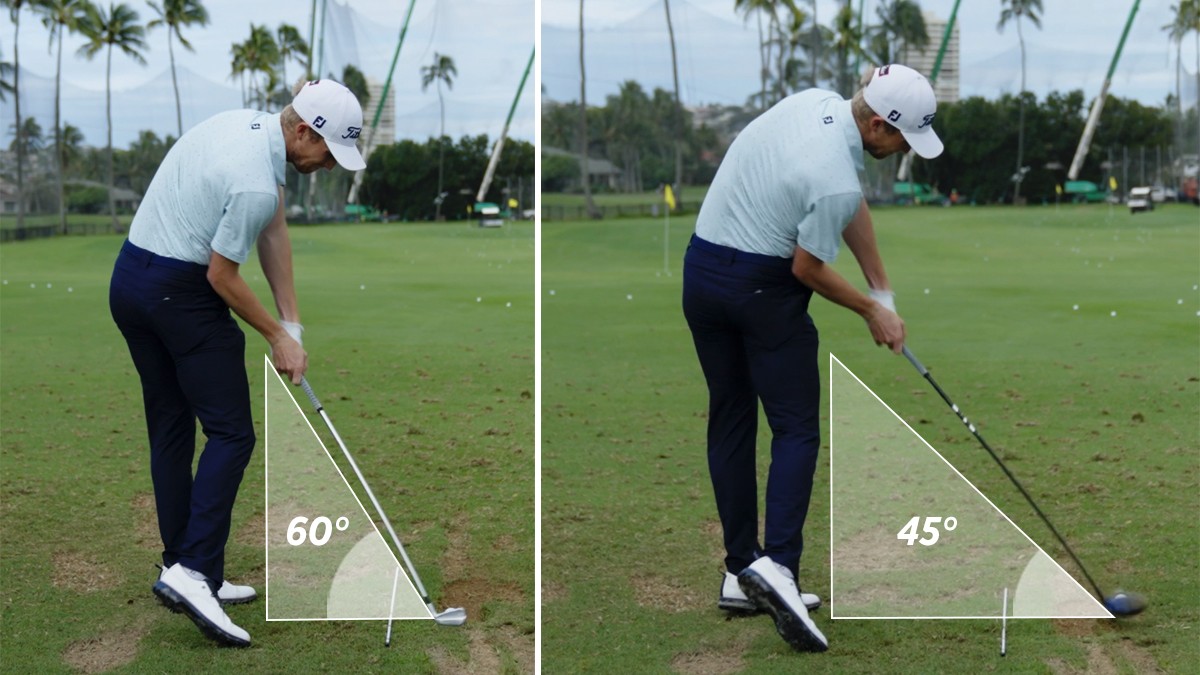
The US GOLF TV video also provides a helpful demonstration of these terms.
Golf Swing Plane Explained (Golf Swing Basics 2020)
Let's return to the same video to see a visual definition of "steep" and "shallow" (or flat) planes.
Watch the segment from this point. The instructor demonstrates what a steep plane (more vertical motion) and a shallow plane (more horizontal, around-the-body motion) look like.
Understanding that the plane changes for each club is vital. It's why your swing with a wedge feels different from your swing with a driver—you're not just swinging a different club, you're swinging on a different geometric plane.
Swing Plane vs. Swing Path: A Crucial Distinction
As an analyst, you know the importance of precise definitions. In golf, "swing plane" and "swing path" are often used interchangeably, but they describe different things. Confusing them can make it difficult to diagnose your shots.
- Swing Plane is the tilt or angle of the entire swing's orbit. It's a property of the overall motion.
- Swing Path is the horizontal direction the clubhead is moving at the single moment of impact (e.g., in-to-out, out-to-in).
The following reading provides a perfectly clear distinction.
Ball Flight Laws: Clubface vs Swing Path (Face-to-Path)
The table in this Stryper Golf article is an excellent reference for differentiating these two key terms.
Read the section "Swing Plane vs Swing Path — Why Plane Matters." Pay close attention to the definitions in the table. The key takeaway is that the plane influences the geometry of the swing, while the path helps determine the ball's flight.
The Role of the Swing Plane: The Path to Consistency
This brings us to the most important question: why does the swing plane matter?
The swing plane is the key to repeatability. A swing that stays relatively "on plane" is geometrically simpler and has fewer moving parts that can go wrong. When your arms and club travel along a consistent plane, it becomes far easier to deliver the clubhead back to the ball in a predictable way. As the Stryper Golf article noted, a consistent plane makes it easier to repeat your low point, path, and face delivery.
However, this doesn't mean you need a "perfect" or robotic swing plane. In fact, very few elite golfers stay perfectly on a single plane throughout their swing. The real secret to consistency lies in being able to return the club to a consistent plane at impact. This is a more advanced concept, but one you'll appreciate: the backswing can have some variation, but the best players have an almost identical downswing plane and club position at impact, swing after swing. Their motion is repeatable where it counts most.
A Note on Swing Philosophies
As you explore golf instruction, you will inevitably encounter the terms "one-plane" and "two-plane" swing. This can be a source of significant confusion, so let's briefly demystify it. These terms describe different philosophies about how the club and arms should move relative to the swing plane.
PLANE PRINCIPLES: The Real Truth, Part 2 | Swing Surgeon - Don Trahan Peak Performance Golf Swing
This article from instructor Don Trahan provides a detailed look into the "one-plane" vs. "two-plane" debate, using Ben Hogan's "Plane of Glass" as a reference. This is a very specific viewpoint, but it's useful for understanding the terminology.
First, read the author's definitions of path and plane. Notice his emphasis on the arms swinging on the plane. Next, read his description of the rotational "1 Plane swing" and the so-called "2 plane" Vertical Swing. The goal here is not to adopt his philosophy, but simply to see how these terms are used to describe different swing styles and the confusion that can arise from them.
In simple terms:
- A "one-plane swing" generally refers to a swing where the arms and club try to remain on or parallel to the initial plane established at address. The shoulders tend to turn on a steeper angle, and the arms swing more around the body.
- A "two-plane swing" typically involves the arms swinging on a steeper plane while the shoulders turn on a flatter plane. At the top of the backswing, the arms are in a higher, more upright position.
Both approaches can and do produce world-class golf. The key is not which philosophy you choose, but that you build a motion that is mechanically sound and, most importantly, repeatable for you.
Conclusion
You now have a foundational model for understanding the architecture of the golf swing. By grasping the concept of the swing plane, you've moved beyond simply trying to hit the ball and can now start analyzing the system that produces the strike.
Key Takeaways:
- The swing plane is the tilted, imaginary surface (like a hula hoop or pane of glass) that the club travels on.
- The plane's angle is not fixed; it becomes steeper with shorter clubs and flatter with longer clubs.
- Swing plane (the tilt of the swing's orbit) is distinct from swing path (the club's direction at impact).
- A consistent swing plane is the foundation for a repeatable swing, as it simplifies the geometry and makes it easier to deliver the club to the ball in the same way every time.
Now that we have this geometric framework, our next lesson will explore what happens at the most critical moment: impact. We will examine the ball flight laws, which explain precisely how your swing path and clubface angle combine to create every possible shot shape—from a perfect straight shot to a slice or a hook. This will be your first major step in learning to read your ball flight and diagnose your own swing.