Hello! Welcome to the seventh module of our course.
In our last lesson, we built a complete, secure password reset flow. That was a complex feature with multiple steps, database interactions, and email sending. If you were to change a small part of it—say, update the email template—how could you be absolutely sure you didn't accidentally break the token validation logic? Manually re-testing every possible scenario (valid email, invalid email, expired token, used token) would be tedious and error-prone. This is where automated testing becomes indispensable.
This lesson introduces the strategic framework for automated testing: the testing pyramid. We will explore the different types of tests, their specific purposes, and how they fit together to form a robust safety net for your application. Understanding this strategy is the first and most critical step before writing a single line of test code.
By the end of this lesson, you will be able to explain the testing pyramid and the purpose of unit, integration, and end-to-end tests.
1. The Need for a Testing Strategy
Before automated testing became widespread, developers often relied on a large suite of tests that simulated a user clicking through the application's user interface (UI). This approach seems intuitive—test the application the same way a user uses it. However, it leads to significant problems.
To understand why, let's start with an article by Martin Fowler, a key figure in software development, who explains the concept of the Test Pyramid and the problems it solves.
Please read the first five paragraphs of the article, starting from the beginning and ending just before the sentence 'Most importantly such tests are very brittle...'. Focus on the description of UI-driven tests and the initial problems they present.
As Fowler points out, relying solely on these high-level, UI-driven tests is problematic because they are:
- Slow: Driving a browser or an entire application stack takes a lot of time, which slows down development feedback cycles.
- Expensive: They are costly to write and often require special tools or environments.
- Brittle: A small, unrelated change in the UI (like renaming a button's ID) can break dozens of tests, creating a maintenance nightmare.
This over-reliance on slow, brittle tests is often called the "Ice Cream Cone" anti-pattern—it's top-heavy and unstable. The solution is to invert this approach, which leads us to the Testing Pyramid.
2. The Testing Pyramid: A Strategic Framework
The testing pyramid is a model that helps us think about how to balance different types of automated tests to create an effective and maintainable test suite.
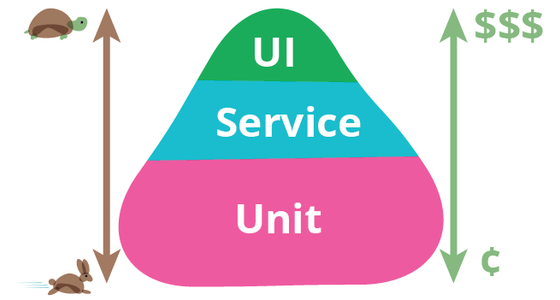
The fundamental idea is that you should have many more low-level, granular tests than high-level, broad tests. Let's explore the three primary layers of this pyramid.
The testing pyramid: Strategic software testing for Agile teams
The article from CircleCI provides a clear and concise breakdown of the three main layers of the pyramid.
Please read the section titled 'What is the testing pyramid?'. This will give you a formal definition of each layer: Unit tests, Integration tests, and End-to-end (E2E) tests.
Now, let's dive into each of these layers in more detail.
3. The Layers of the Pyramid
We'll examine each layer's scope, purpose, and how it relates to the Django applications we've been building.
a) Unit Tests: The Foundation
- Scope: Unit tests form the wide base of the pyramid. They test the smallest possible "unit" of your code—a single function or a method on a class—in complete isolation from other parts of the system.
- Purpose: To verify that a specific piece of business logic works correctly. Because they are isolated, they can pinpoint the exact location of a bug with high precision. If a unit test fails, you know the problem is within that specific function, not somewhere else.
- Characteristics:
- Fast: They run in milliseconds.
- Numerous: You'll write more unit tests than any other type.
- Isolated: To achieve isolation, they use "test doubles" like mocks or stubs to replace external dependencies (e.g., database calls, network requests, file system access). In your AI work, you're familiar with creating controlled environments to evaluate a model; mocking serves a similar purpose in testing by providing predictable, controlled behavior from dependencies.
5 Types of Testing Software Every Developer Needs to Know!
This video provides a great overview of different test types. Let's focus on its definition of unit tests.
Watch from 00:21 to 01:36. Pay attention to how it describes the goal of testing individual methods and the concept of 'testability'.
Example in our Django Project:
Imagine you have a utility function that checks if a user's chosen password meets your security policy (e.g., at least 8 characters, one number, one special character). A unit test would call this function directly with various inputs ("short", "goodpassword", "greatpassword123!") and assert that it returns False or True as expected, without ever touching a user model or a database.
b) Integration Tests: The Middle Ground
- Scope: Integration tests sit in the middle of the pyramid. They verify that two or more units or components of your application work together correctly. This is where you test the "glue" that holds your system together.
- Purpose: To catch errors that occur at the boundaries between components. These could be issues like schema mismatches with the database, misconfigured API calls, or incorrect data serialization.
- Characteristics:
- Slower: They are slower than unit tests because they involve multiple parts of your application stack, often including a real database or network communication.
- Fewer: You'll have fewer integration tests than unit tests.
- Integrated: They use real components instead of mocking everything.
5 Types of Testing Software Every Developer Needs to Know!
Let's return to the video to see how integration tests are defined. Note the distinction between testing with real dependencies versus mocked ones.
Watch from 02:22 to 03:00. This section clearly explains that the goal is to make sure integrations with external systems, like a database, actually work.
Example in our Django Project:
For our password reset feature, an integration test would not just call a single function. Instead, it would make a simulated HTTP POST request to our /api/password-reset/ endpoint. The test would then assert that:
- The API returns a
200 OKstatus code. - A user with the specified email exists in the test database.
- Django's email sending service was called with the correct parameters (we can check the "outbox" without actually sending an email).
This test verifies that the URL routing, the view, the serializer, and the email backend are all integrated and functioning correctly together.
c) End-to-End (E2E) Tests: The Peak
- Scope: E2E tests are at the narrow top of the pyramid. They test the entire application from start to finish, simulating a complete user journey. This is the highest level of testing and covers the full stack, from the UI in the browser to the database and back.
- Purpose: To provide confidence that the system as a whole meets the business requirements and that user flows are not broken. A passing E2E test is the strongest signal that your application is working correctly from a user's perspective.
- Characteristics:
- Very Slow: Can take seconds or even minutes per test.
- Brittle: Prone to breaking due to minor UI changes.
- Fewest: You should have only a small number of these, covering your most critical user journeys.
Example in our Django Project:
An E2E test for the password reset flow would use an automation tool (like Selenium or Playwright) to:
- Launch a real web browser.
- Navigate to your application's login page.
- Click the "Forgot Password" button.
- Enter an email into the form and submit it.
- Programmatically access a test email account to find the reset email and click the link.
- Enter and confirm a new password on the reset page.
- Finally, try to log in with the new password to confirm success.
Test your understanding!
Imagine you are testing the "user registration" feature of your API. Classify each of the following test scenarios as a Unit Test, Integration Test, or End-to-End Test.
- A test that calls your
is_email_valid()function with "test@example.com" and asserts it returnsTrue. - A test that starts a browser, navigates to
/register, fills in the username, email, and password fields, clicks "Submit", and checks if the text "Registration successful" appears on the next page. - A test that makes an HTTP
POSTrequest to your/api/registerendpoint with valid JSON data and then queries the test database to confirm that a new user row was created with the correct, hashed password.
Show answer
- Unit Test: It tests a single, isolated function's logic.
- End-to-End Test: It simulates a full user journey through the UI in a browser.
- Integration Test: It tests the interaction between the API endpoint (view/serializer) and the database, verifying that these two components work together correctly.
4. Benefits and Overall Strategy
Following the pyramid model provides a balanced testing portfolio.

The strategy provides several key benefits:
- Fast Feedback: The vast majority of your tests are fast unit tests, allowing developers to run them constantly and get feedback in seconds.
- Precise Debugging: When a unit test fails, you know exactly where the bug is. When a higher-level test fails, it takes more work to pinpoint the cause.
- High Confidence: The combination of all three layers gives you high confidence. Unit tests ensure the building blocks are solid, integration tests ensure they fit together, and E2E tests ensure the final product works for the user.
As Martin Fowler says, if a bug is caught by a high-level test, it signifies a missing unit test. The best practice is to first write a failing unit test that reproduces the bug, then fix the code to make that test pass.
Conclusion
You now have a conceptual map for how to approach automated testing. You understand that a good test suite isn't just a random collection of tests, but a strategically balanced portfolio designed for speed, reliability, and confidence.
Key Takeaways:
- The Testing Pyramid is a strategic guide for balancing different types of automated tests.
- Unit Tests form the base. They are fast, numerous, and test small pieces of code in isolation to verify specific logic.
- Integration Tests form the middle layer. They are slower and test how multiple components (like your API and database) work together.
- End-to-End Tests are at the peak. They are very slow, brittle, and test a complete user journey through the entire application stack.
- A healthy test suite has a large number of unit tests, a smaller number of integration tests, and very few end-to-end tests.
Preview of the Next Lesson:
With this theoretical foundation in place, we are ready to get practical. In the next lesson, you will write your first unit tests for a Django application. We will start at the base of the pyramid, learning how to test our model logic and business functions using Python's built-in unittest framework and Django's testing tools.