Hello! In our last lesson, we worked on giving your sentences better rhythm and balance using parallel structure. We're continuing that theme today by focusing on another technique to make your writing more powerful and direct.
This lesson is all about the active and passive voice. You'll learn what they are, why choosing the active voice often makes your writing stronger (especially for the short stories and monologues you're interested in), and how to transform passive sentences into active ones. This is the final step in our module on sentence fundamentals before we move on to telling stories.
What is Active vs. Passive Voice?
At its simplest, the difference between active and passive voice is about what you put at the start of the sentence: the person or thing doing the action, or the person or thing receiving the action.
- Active Voice: The subject (the "doer") performs the action. It's direct and clear.
- Example: Shona cleans the house. (Shona is the subject doing the cleaning).
- Passive Voice: The subject is acted upon. The "doer" might be mentioned at the end or not at all.
- Example: The house is cleaned by Shona. (The house is the subject being acted upon).
This image provides a great visual breakdown of how the sentence parts move around.

In the active sentence, the order is Subject -> Verb -> Object. In the passive sentence, the order changes to Object -> Verb -> Subject.
To see this in action with another fun example, let's watch a very short video.
Active vs. Passive Voice | Grammar Lessons
This quick video from Howcast uses a great example with Batman and the Joker to clearly show the difference in structure and impact between the two voices.
Watch these two short clips: First, see the breakdown of the active voice, where the sentence moves in a logical, energetic way. Then, watch the explanation of the passive voice to see how the sentence construction is reversed.
As you saw, the active sentence feels more energetic and straightforward. The passive sentence is a bit slower and less direct.
Why Choose Active Voice for Creative Writing?
While the passive voice has its uses (which we'll touch on later), the active voice is usually the better choice for storytelling. Why? Because it's more engaging for the reader. It puts the action front and center and clearly shows who is doing what. This helps your reader build a clear picture in their mind.
Let's explore this idea from the perspective of a storyteller.
Using Active vs. Passive Voice when Storytelling
This video from communication coach Alexander Lyon is fantastic because it's all about using active voice specifically for storytelling.
Please watch these parts: First, the section on why active voice works so well in stories. He explains how it helps the reader visualize the action. Next, learn how passive voice can create a "visualization gap," making your story feel vague or distant. Finally, listen to the powerful comparison of a short story told first in passive voice and then rewritten in active voice. Notice how much more personal and clear the second version is.
The difference in that story example is huge, right? The active version connects you to the people in the story. The passive version feels like a distant, impersonal report. When you're writing a character monologue or a short story, you want your reader to feel connected, not distant.
How to Transform Passive into Active
Now for the practical part: how do you spot a passive sentence and change it? It’s a straightforward process.
- Spot the Passive: Look for a passive verb construction. This is usually a form of the verb "to be" (is, are, was, were, been, being) followed by a past participle (e.g., was thrown, is being built, was seen).
- Find the Doer: Ask yourself, "Who or what is performing the action?" In many passive sentences, the doer is at the end of the sentence, introduced by the word "by".
- Rewrite the Sentence: Start your new sentence with the doer. This becomes your new subject. Then, use the active form of the verb.
Let's look at a clear guide on this from the BBC.
How to use the active or passive voice - BBC Bitesize
This article from BBC Bitesize provides clear, simple steps for making this transformation.
Please scroll down to the heading "Active versus passive". Read the short section called "Converting sentences to active voice" to see the strategy explained with an example. You'll see the "look for the 'by' phrase" tip in action.
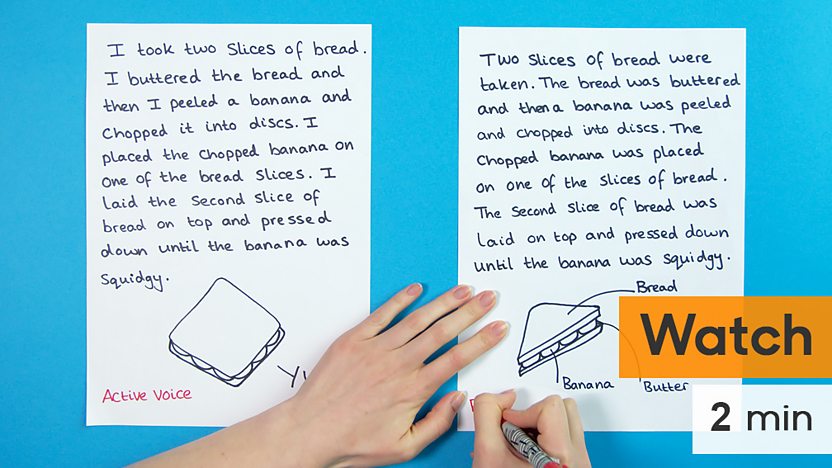
Here is a great visual example comparing instructions written in active versus passive voice. Notice how the active voice version on the left feels more like a person telling you what they did, while the passive version on the right sounds more like a scientific report.
Creative Writing Task: Sharpening a Scene
It's your turn to practice. Imagine you are editing a short, suspenseful scene for a story. The first draft was written using a lot of passive voice, which makes it feel slow and a bit clumsy.
Your task is to rewrite the entire paragraph below, changing all the passive sentences into active ones to make the scene more immediate and exciting.
The Passive Draft:
The rusty lock was forced open by the old key. The heavy door was pushed inward, and a cloud of dust was disturbed by the movement. A single chair was seen in the middle of the room. A small, leather-bound book was placed on it. Suddenly, a floorboard was creaked on upstairs. A gasp was let out by me.
Take your time to rewrite this paragraph. Try to make it feel like we are experiencing the events through the character's eyes.
...
Suggested Rewrite:
How did you do? Here is one way the paragraph could be rewritten in active voice. Your version might be slightly different, but it should follow the same principles.
The old key forced the rusty lock open. I pushed the heavy door inward, disturbing a cloud of dust. I saw a single chair in the middle of the room. Someone had placed a small, leather-bound book on it. Suddenly, a floorboard creaked upstairs. I let out a gasp.
Notice the difference? In the active version, the character ("I") is performing the actions, making the reader feel like they are right there in the room. The action is clearer and the tension is higher.
Conclusion
Great work today! You've learned one of the most important skills for creating clear, direct, and engaging writing. By choosing active voice, you put the energy of your sentences where it belongs: with the character or element making things happen.
Key Takeaways:
- Active Voice: The subject performs the action (e.g., "The cat chased the mouse."). It's direct and clear.
- Passive Voice: The subject receives the action (e.g., "The mouse was chased by the cat."). It can be indirect and wordy.
- Why Active is Better for Stories: It helps the reader visualize the action and feel more connected to the characters.
- How to Transform: Find the "doer" (often after "by") and make it the subject of your new sentence.
This was the last lesson in our module on sentence fundamentals. You've learned how to fix fragments and run-ons, combine sentences, and use parallelism and active voice to improve your style.
In our next lesson, we will begin a new module, Narrating the Past. We'll start by exploring how to use the past simple and past continuous tenses to set a scene and describe actions—the building blocks of any good story.