Welcome to our new lesson! In our last session, we focused on making your sentences grammatically correct by ensuring subjects and verbs agree, even when separated by tricky phrases. Today, we'll shift from correctness to style. We'll explore a technique called parallel structure, which is one of the secrets to making your writing not just clear, but also rhythmic, balanced, and powerful.
This lesson is all about learning to "balance" your sentences. You'll learn how to apply parallel structure to lists and series, a skill that will make your creative writing—from character descriptions to action sequences—flow much more smoothly and effectively.
What is Parallel Structure?
At its core, parallel structure is about balance and consistency. It means that when you list two or more items in a sentence, you should express them using the same grammatical form.
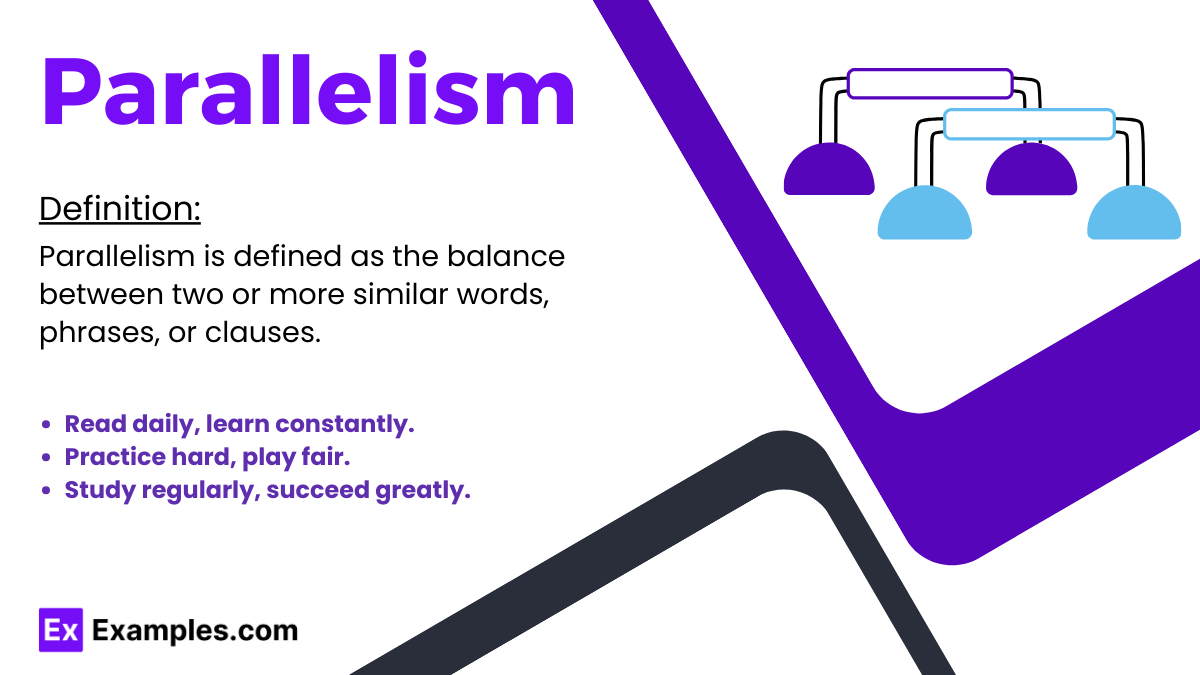
This might sound a little abstract, so let's look at it in action. Let's say you want to list a character's hobbies.
- Not Parallel: Mary likes hiking, biking, and to go running.
- Parallel: Mary likes hiking, biking, and running.
In the first sentence, the list mixes verb forms (hiking, biking, to go running). The second sentence corrects this by making all items in the list follow the same "-ing" pattern. This consistency is what we call parallel structure. It makes the sentence sound more natural and organized.
To get a better feel for this, let's watch a short video that breaks down the concept with clear examples.
PARALLEL STRUCTURE | English Lesson
This video by Kevin Spaans provides a great, quick introduction to parallel structure. He uses an analogy of parallel lines in math to explain the grammatical concept.
Watch the following segments to see how parallel structure works with different types of words: The introduction, which explains the basic idea. The example with gerunds (words ending in -ing). The example with verb phrases. The example with nouns. Finally, the example showing how to maintain the same verb tense in a list of actions.
Why Does Parallelism Matter?
Using parallel structure does more than just fix a grammatical "error." It elevates your writing. Sentences with parallel structure are:
- Clearer: They are easier for the reader to understand because the pattern is predictable.
- More Rhythmic: They create a pleasing flow and cadence, making your writing more enjoyable to read.
- More Emphatic: They can be used to build drama or emphasize a point, which is especially useful in creative writing.
Let's watch another video that explains why this technique is considered a "secret to great writing."
Parallelism: The secret to great writing
In this video from engVid, the instructor, Rebecca, explains the benefits of using parallel structure and shows how it applies to different parts of speech.
First, watch the introduction from the beginning of the video. Pay attention to the benefits she lists, like adding weight, rhythm, and clarity to your sentences. Then, watch the next section with simple examples showing parallel verbs, gerunds, adjectives, adverbs, and nouns.
How to Spot and Fix Faulty Parallelism
Now that you know what parallel structure is and why it’s important, let's focus on how to identify and correct sentences that lack it. The key is to look at any list in your sentence and ask: "Are all the items in the same grammatical format?"
This infographic provides a fantastic visual guide for comparing non-parallel and parallel sentences.

The "Verifying Parallelism" section is particularly helpful. When you have a list, imagine putting each item on a new line. Do they match in form?
Example from the infographic:
The salesman said the car was:
- fast
- sporty
a lot of gas(This doesn't match!)
The corrected version uses three adjectives:
- fast
- sporty
- economical (This matches!)
Now, let's practice this together. The best way to learn is by seeing how errors are corrected in real-time.
Parallelism: The secret to great writing
Let's return to the engVid lesson with Rebecca. The second half of her video is an interactive quiz where she presents sentences with faulty parallelism and walks through how to fix them.
Watch the section from where the quiz begins. Follow along as she analyzes each sentence. Try to spot the error yourself before she explains the correction. This will be great practice for training your ear to hear when a sentence is "unbalanced."
Creative Writing Task: Polishing a Character Monologue
It's your turn to apply what you've learned. Imagine you are writing a short story, and a character is thinking about their frustrating day. Below is a draft of their inner monologue. The draft has three sentences with faulty parallel structure.
Your task is to rewrite the three incorrect sentences to make them parallel.
The Draft Monologue:
"What a terrible day. First, my alarm didn't go off, I missed the bus, and forgetting my homework on the table. At school, I had to give a presentation, answer questions, and was writing a summary on the spot. My plan for the evening was to watch a movie, eat some popcorn, and relaxing. I just want to lie down, to forget everything, and sleeping for ten hours. I hope tomorrow will be calmer, quieter, and a bit more fun."
Identify the sentences with errors and correct them. The last sentence is already correct and can be used as a model!
...
Corrections and Explanations:
How did you do? Let's review the corrections.
-
Original: "First, my alarm didn't go off, I missed the bus, and forgetting my homework on the table."
- Problem: This list mixes a clause (
I missed the bus) with a gerund phrase (forgetting my homework...). - Corrected: "First, my alarm didn't go off, I missed the bus, and I forgot my homework on the table." (Now it's a list of three parallel clauses).
- Problem: This list mixes a clause (
-
Original: "At school, I had to give a presentation, answer questions, and was writing a summary on the spot."
- Problem: This list mixes base verb forms (
give,answer) with a past continuous verb (was writing). - Corrected: "At school, I had to give a presentation, answer questions, and write a summary on the spot." (Now it's a list of three parallel base verbs).
- Problem: This list mixes base verb forms (
-
Original: "My plan for the evening was to watch a movie, eat some popcorn, and relaxing."
- Problem: This list mixes base verbs (
watch,eat) with a gerund (relaxing). - Corrected: "My plan for the evening was to watch a movie, eat some popcorn, and relax." (Now it's a list of three parallel base verbs).
- Problem: This list mixes base verbs (
By making these simple changes, the character's thoughts become much clearer and more rhythmic, making the monologue more effective.
Conclusion
Excellent work today! You've learned how to use parallel structure to add balance, rhythm, and power to your writing. This is a subtle but incredibly effective tool that will make your sentences sound more polished and professional.
Key Takeaways:
- Parallel structure means using the same grammatical pattern for all items in a list or series.
- Items can be single words (nouns, verbs, adjectives), phrases, or clauses.
- Using parallelism makes your writing clearer, more rhythmic, and more emphatic.
- To check for parallelism, ensure all items in a list match in form (e.g., all are
-ingverbs, or all areto + verbinfinitives).
In our next lesson, we will continue our journey to make your writing more powerful by exploring the difference between active and passive voice. You'll learn how to transform passive sentences into active ones to make your writing more direct and engaging.