Welcome to the fifth lesson in our module on the Foundations of Investment Banking. In our last session, we mapped out the lifecycle of a deal, tracing the "marathon" of an M&A transaction and the "sprint" of an IPO. You now have a chronological framework for how banks execute deals and generate fees.
This lesson drills down from the process to the people. We will explore the "who" behind the deal: the key roles and the well-defined hierarchy within an investment banking division. Understanding this structure is essential, not just for navigating office politics, but for grasping how responsibilities are divided and how your own potential career path would unfold. For someone with your goal of mastering the practical skills of the industry, knowing who does what, and when, is fundamental.
By the end of this lesson, you will be able to identify each key role from Analyst to Managing Director, describe their primary responsibilities, and understand how they interact during the deal process we've already discussed.
The Investment Banking Pyramid
The career path within an Investment Banking Division (IBD) is famously structured and hierarchical. Think of it as a pyramid, with a broad base of junior bankers supporting progressively fewer, more senior bankers at the top. Each level has a distinct function, set of responsibilities, and expected skillset.
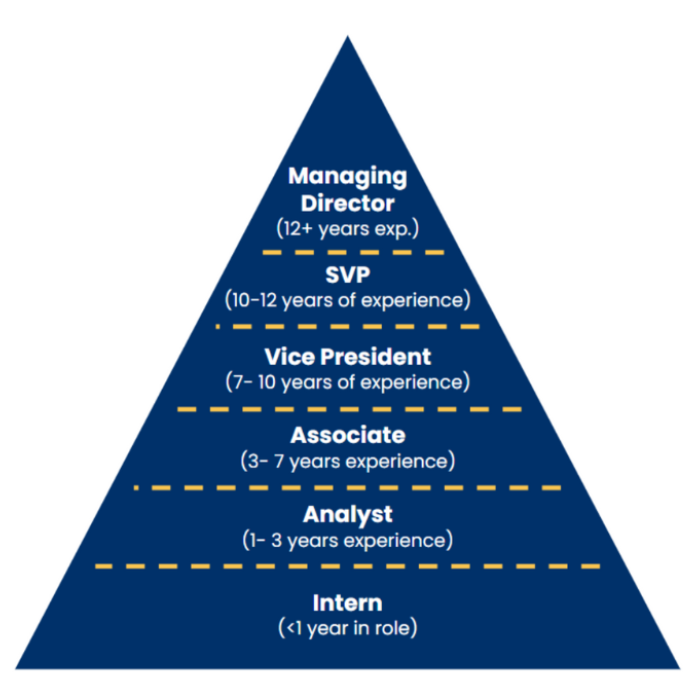
This hierarchy can be broadly grouped into three categories:
- Junior Bankers (The "Engine Room"): Analysts and Associates are responsible for the hands-on analytical work.
- Mid-Level Bankers (The "Project Managers"): Vice Presidents manage the deal process and the junior team.
- Senior Bankers (The "Rainmakers"): Directors and Managing Directors are focused on client relationships and business generation.
Let's break down each level, starting from the bottom, which is where you would enter the industry. For a detailed and practical guide to these roles, we'll turn to a classic resource from the website Mergers & Inquisitions.
Investment Banking Career Path: Roles, Salaries & Promotions
This article provides an excellent, no-nonsense breakdown of the investment banking hierarchy. It's written by former bankers and gives you a real sense of the culture and expectations at each level.
First, read the introduction from the basic overview of the hierarchy. Then, carefully review the summary table. This table is particularly relevant to your financial motivations, as it clearly lays out the compensation structure at each level of the pyramid.
Now, let's dissect the responsibilities at each stage of this career path.
The Junior Bankers: Analysts and Associates
These are the roles that execute the day-to-day work of a deal. For someone with your engineering and coding background, the rigorous, analytical, and detail-oriented nature of the junior banker's job will feel familiar, albeit in a financial context.
The Analyst
The Analyst is the entry-level position for undergraduates. This is the role you would be targeting. Analysts are the workhorses of the bank, responsible for the foundational analysis that underpins every transaction.
Key Responsibilities:
- Financial Modeling: Building the 3-statement, DCF, LBO, and M&A models that are the core of valuation and deal analysis. This is where your quantitative skills will be directly applied.
- Presentations: Creating the pitch books and other presentations used to communicate ideas to clients. This involves heavy use of PowerPoint and a keen eye for detail.
- Administrative & Logistical Tasks: Managing data rooms during due diligence, tracking potential buyers, and coordinating meeting schedules.
The Analyst role is an intense apprenticeship, characterized by long hours but an incredibly steep learning curve and exposure to high-stakes transactions.
Investment Banking Career Path: Roles, Salaries & Promotions
Let's continue with the Mergers & Inquisitions article to get the full picture of the Analyst role.
Read the section titled Analyst Job Description. Pay close attention to the description of the work, the hours, and especially the "Exit Opportunities," as the Analyst skillset is a springboard to many other areas of finance.
The Associate
An Associate is one step above an Analyst. Bankers typically become Associates in one of two ways: either by being promoted directly after 2-3 years as an Analyst, or by being hired directly after completing an MBA program.
The Associate's role is a blend of execution and management. They are responsible for reviewing the Analyst's work and serve as the primary link between the junior and senior banking teams.
Key Responsibilities:
- Managing Analysts: Assigning tasks to analysts and checking their models and presentations for accuracy and quality.
- Deal Process Management: Helping the VP manage the flow of a transaction and ensuring deadlines are met.
- Client Communication: While still primarily in a supporting role, Associates have more direct contact with clients than Analysts do.
Investment Banking Career Path: Roles, Salaries & Promotions
Now, let's look at the next step up the ladder.
Read the section on the Associate Job Description in the same article. Notice how the focus begins to shift from pure "doing" to "managing and checking."
The Mid-Level Banker: The Vice President (VP)
The Vice President is the "project manager" of the deal team. VPs are responsible for the day-to-day execution of a transaction and serve as the main point of contact for the client. They translate the strategic vision of the senior bankers into actionable tasks for the junior team.
Key Responsibilities:
- Deal Quarterbacking: VPs coordinate all the moving parts of a deal—the junior team, lawyers, accountants, and the client—to ensure a smooth process.
- Client Relationship Management: They are responsible for maintaining a strong working relationship with the client throughout the deal.
- Quality Control: Ultimately, the VP is responsible for the quality of all analytical work and documentation presented to the client and senior bankers.
The VP level is a critical inflection point in a banker's career, as it demands a difficult balance between flawless execution and the beginning of business development.
Investment Banking Career Path: Roles, Salaries & Promotions
The VP role is arguably one of the most challenging.
Read the section on the VP Job Description. The article makes an interesting point about the VP title being common at banks; this is a valuable piece of cultural context.
The Senior Bankers: Directors and Managing Directors
At this level, the focus shifts almost entirely from executing deals to originating them. Senior bankers are the "rainmakers." Their value to the bank is measured by the amount of fee revenue they can generate by winning mandates from clients.
The Director (or Senior VP)
A Director is a "rainmaker-in-training." This role is a bridge between the project management of a VP and the pure client-relationship focus of a Managing Director. Directors are expected to begin sourcing their own deals and cultivating a network of client contacts.
The Managing Director (MD)
The Managing Director sits at the top of the pyramid. Their primary, and often sole, responsibility is to leverage their deep industry knowledge and extensive network of relationships to win business for the bank. They are the face of the bank to C-suite executives and corporate boards. The entire deal team structure we've discussed exists to support the MD in originating and closing deals.
Investment Banking Career Path: Roles, Salaries & Promotions
Finally, let's examine the top of the pyramid.
Read the final three sections, covering the Director, the Managing Director, and the brief note on roles beyond MD. Note the singular focus on "making it rain" at the MD level.
For an alternative perspective that reinforces these roles, you can skim this overview from Wall Street Oasis.
Typical Hierarchy of Investment Banks - Overview and Description
This article from Wall Street Oasis covers the same ground with slightly different descriptions, which can help solidify your understanding.
Quickly read through the descriptions for each role, from IB Analyst to Managing Director. Compare the responsibilities outlined here with what you read in the Mergers & Inquisitions article.
The Hierarchy in Action
To bring this all together and connect it to our previous lesson on the deal lifecycle, let's watch a video that illustrates how these roles collaborate on a typical project: preparing a pitch for a potential client.
Investment Banking Career Path - Complete Guide (2021)
This video from Financeable Training does a great job of showing how the different roles interact in a real-world scenario.
First, watch the brief introduction that outlines the three tiers of bankers. Then, skip to the practical example starting from the day-to-day operation of a pitch project. This segment perfectly demonstrates how an idea from an MD flows down the chain of command to the Analyst for execution, and then back up for presentation.
As you can see, the MD originates the opportunity, the VP quarterbacks the project, the Associate manages the Analyst, and the Analyst builds the materials. It's a highly efficient, if demanding, system for producing high-quality work under pressure.

Conclusion
In this lesson, we have dissected the investment banking career ladder, from the first rung to the very top. You now have a clear understanding of the titles, responsibilities, and progression within an IBD.
Here are the key takeaways:
- A Structured Path: Investment banking has a rigid hierarchy: Analyst → Associate → VP → Director → MD.
- From Execution to Origination: A banker's career evolves from pure technical execution (Analyst) to project management (VP) and finally to relationship-based business generation (MD).
- The Analyst's Role: As an aspiring banker, your initial focus will be on the Analyst role, which involves intensive financial modeling, presentation building, and process support.
- Team Dynamics: Each role is a distinct cog in the deal-making machine. The efficiency of the team relies on each member flawlessly executing their specific function.
In our previous lesson, we covered the process of a deal. Now, you know the people who execute that process. In our final lesson for this module, we will explore a critical component of that process in more detail: Due Diligence. This is the investigative work that happens in the second round of an M&A deal, and it's a phase where the entire deal team, from Analyst to VP, is heavily involved.