Welcome to the final lesson in our introductory module on the Foundations of Investment Banking. Over the last few lessons, we've mapped out the deal lifecycle and the hierarchy of professionals who execute it. You now have a solid framework for the "what" and the "who" of a transaction. Today, we'll zoom in on a critical stage in that process: due diligence.
This lesson focuses on the purpose and importance of due diligence. This is the investigative phase where a potential buyer, with the help of its bankers, scrutinizes a target company to verify its value and uncover any potential risks. For you, as someone aiming to master the technical side of banking, understanding due to diligence is paramount. It is the "why" behind much of the financial modeling and analysis you will learn to perform.
By the end of this lesson, you will be able to describe the purpose and importance of due diligence within a transaction process, setting the stage for the detailed financial analysis we will begin in the next module.
What is Due Diligence and Where Does It Fit?
At its core, a merger or acquisition involves a fundamental imbalance of information. The seller knows everything about the company—its strengths, its weaknesses, its hidden problems. The buyer starts with very little information. Due diligence is the process designed to correct this imbalance.
Due Diligence in M&A | Process + Checklist Examples
This article from Wall Street Prep provides a concise definition of due diligence.
Read the introductory section. Note the term "information asymmetry"—this is the central problem that due diligence aims to solve.
Due diligence is not a standalone activity but an integrated phase of the M&A process. It typically begins in earnest after a buyer has expressed serious interest, often by submitting a non-binding Indication of Interest (IOI) or a more formal Letter of Intent (LOI).
Let's look at where it fits in the overall timeline.
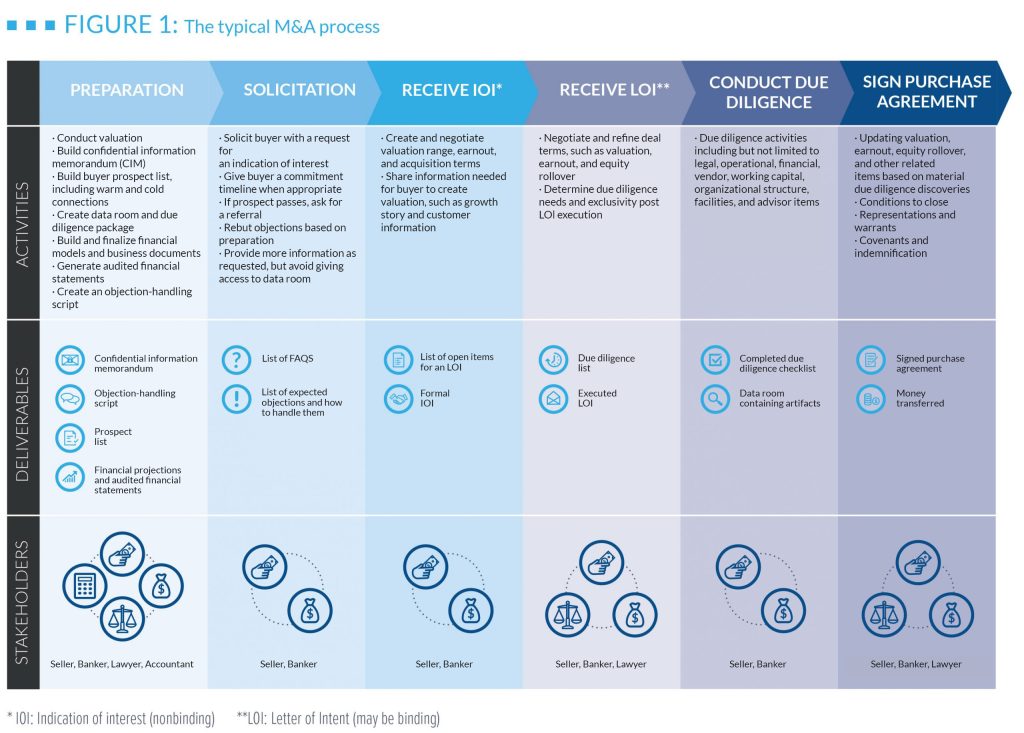
As you can see, the due diligence phase is where the buyer gets to "look under the hood." To facilitate this, the seller grants the buyer access to a secure online repository of confidential documents, known as a virtual data room (VDR). As we discussed in our last lesson, managing this VDR is a key responsibility for junior analysts on the deal team.
The "Why": Purpose and Importance of Due Diligence
Conducting due diligence is an intense, expensive, and time-consuming process. So why is it so critical? The primary purpose is to vet the target company and validate the assumptions that underpin the proposed purchase price. It's about making an informed decision and avoiding costly surprises.
A great way to think about it is that financial due diligence is like an MRI for a company. A quick look at the public financials might seem fine, but the DD process reveals the hidden structural flaws.
Corporate Finance Explained | Financial Due Diligence
This video from the Corporate Finance Institute offers a powerful analogy for understanding the purpose of due diligence.
Watch the segment from the core goals to the MRI analogy. Pay attention to the three primary objectives: understanding revenue quality, cash flow sustainability, and uncovering hidden liabilities.
The importance of this "corporate MRI" can be broken down into three key benefits for the buyer.
Financial Due Diligence: Process, Checklist & Tips - Grata
The website Grata provides an excellent summary of why a systematic due diligence process is so important.
Read the section titled Importance of a Comprehensive Financial Due Diligence Checklist. Focus on these key outcomes: risk mitigation, enhanced decision-making, and improved negotiation leverage.
To summarize, the key purposes of due diligence are:
- Risk Mitigation: Identifying potential "red flags" and hidden liabilities—like pending lawsuits, unrecorded debts, or customer concentration issues—that could destroy value post-acquisition.
- Valuation and Negotiation: Verifying the seller’s financial claims and assumptions. Any negative findings can be used as leverage to negotiate a lower price or better terms.
- Informed Decision-Making: Ultimately, the findings from due diligence help the buyer decide whether to proceed with the transaction, restructure it, or walk away entirely.
As the Corporate Finance Institute video highlights, strong due diligence is the only real defense against a "billion-dollar mistake."
The "What": Types and Key Areas of Investigation
Due diligence is not a single activity but a collection of investigative streams run by different experts. While the investment bankers coordinate the overall effort, they rely on specialist firms to scrutinize various aspects of the target's business.
Due Diligence in M&A | Process + Checklist Examples
Let's return to the Wall Street Prep article to see the different facets of a thorough due diligence process.
Read the section under the Investment Banking Checklist. Notice the breakdown into Financial, Business, Legal/Accounting/Tax, and Integration/Operational due diligence.
While all these areas are important, the one most central to the investment banker's role is Financial Due Diligence (FDD). This is where your future skills in financial statement analysis and modeling will be directly applied. FDD goes far beyond simply checking the math on an income statement; it's a deep, forensic analysis.
Let's explore the core pillars of FDD.
Corporate Finance Explained | Financial Due Diligence
The CFI video provides a clear framework for what FDD teams scrutinize in the data room.
Watch the section that breaks down the five pillars of FDD. As you watch, think about how each pillar tests the fundamental health and future potential of the business.
Here are those five pillars of financial due diligence:
- Quality of Earnings (QoE): This is the bedrock. The goal is to determine the company's core, repeatable, and sustainable profits by adjusting for any one-time or non-recurring items. This normalized profit figure (often Adjusted EBITDA) is a key input for valuation.
- Revenue and Customer Analysis: Digging into revenue sources to check for sustainability. A major red flag is customer concentration, where a large percentage of revenue comes from a single client.
- Working Capital and Cash Flow: Analyzing if profits are actually converting into cash. A company can look profitable on paper but be burning through cash due to poor management of receivables or inventory.
- Debt & Off-Balance Sheet Items: Searching for "landmines" like hidden debts, pending lawsuits, or other contingent liabilities that the buyer would inherit.
- Forecast Assessment: Stress-testing the seller's growth projections. This involves building independent financial models to assess the probability of the seller's story actually coming true.
It's also important to recognize that the seller may perform their own sell-side due diligence before even starting the sale process. This allows them to identify and fix issues upfront, preparing a clean and compelling story to maximize their valuation. The buyer's investigation is called buy-side due diligence.
Due Diligence in Action: A Case Study
To see how these concepts play out in a real transaction, let's look at a case study from a former investment banker. He describes a complex "carve-out" deal where his private equity client was trying to buy a business division from a larger corporation.
One of the toughest M&A deals I did in investment banking
This video from Defiant Gatekeeper offers a raw, practical look at how due diligence findings directly impact a deal.
First, watch the initial setup from the deal introduction to understand the context and the different advisors involved. Next, focus on the core of the investigation from the key issues found. The banker details specific problems uncovered during the financial, commercial, and legal due diligence streams. Finally, see how these findings were put to use from building the model. This section perfectly illustrates how an analyst incorporates DD findings into the financial model to test the deal's viability and inform the negotiation strategy.
This case study is a perfect example of due diligence in action. The issues uncovered—excessive debt allocation, future market disruption risk, and unfavorable employment terms—were not obvious from a surface-level review. It was the rigorous DD process that brought them to light, directly impacting the valuation model and the ultimate decision-making of the client.
The consequences of getting this wrong can be catastrophic, leading to massive write-downs and failed acquisitions. The history of M&A is littered with examples like HP's acquisition of Autonomy, where a failure to detect accounting irregularities cost shareholders billions. Conversely, successful due diligence, as seen in deals like Disney's acquisition of Pixar, validates the strategic rationale and paves the way for tremendous value creation.
Conclusion
In this lesson, we have explored the critical role of due diligence in the M&A process. It is the mechanism by which buyers overcome information asymmetry to make sound investment decisions.
Here are the main takeaways:
- Purpose: Due diligence is a systematic investigation to verify a seller's claims, identify risks, and validate a company's value before an acquisition.
- Importance: It is essential for mitigating risk, informing valuation and negotiation, and ultimately making the "go/no-go" decision on a deal.
- Scope: It is a multi-faceted process covering financial, legal, commercial, and operational aspects of the target business, coordinated by the investment bank.
- Practical Impact: The findings from due diligence directly influence the financial models, valuation, and negotiation strategy managed by the deal team.
This lesson concludes our foundational module on investment banking. We've covered the role of banks, their structure, the deal lifecycle, the people involved, and now, the critical process of due diligence. You have the "big picture."
Now, we will start building the technical toolkit required to perform this work. In the next module, we'll dive into the language of business and the foundation of all financial analysis: The Three Financial Statements.