Welcome to the second module of our course, where we shift from high-level concepts to the practical work of keyword research. In our last lesson, we organized SEO into three pillars: on-page, off-page, and technical. We established that for your Shopify store, our main focus will be on on-page SEO—the optimizations you make directly to your site's content.
This lesson marks the very first step in that process. Before you can choose the right keywords for your products, you must first understand the reason or motivation behind a person's search. This concept is called search intent. Today, we'll explore the different types of search intent and learn how to identify them. Mastering this will ensure that the content you create—whether it's a product page or a blog post—perfectly matches what your potential customers are looking for.
What is Search Intent?
Imagine someone runs into a room and shouts, "manual!" You might not know if they need an instruction manual for a new appliance, a car with a manual transmission, or something else entirely. The word itself isn't enough; you need to understand the intent behind it.
Search engines face this same challenge billions of times a day. Search intent is simply the "why" behind a search query. When you understand why a user is searching for a particular term, you can create a page that gives them exactly what they need. This is the cornerstone of successful on-page SEO. If you create a page that doesn't match the searcher's intent, Google is unlikely to rank it highly, even if it contains the right keywords.
To get a formal definition and understand why this is so critical for SEO, let's turn to an article from Shopify's own blog.
Search Intent: What It Is and Why It's Important for SEO - Shopify
This article from Shopify provides a clear, beginner-friendly introduction to the concept of search intent.
Please read from the beginning of the section on search intent and its importance. Pay attention to the "fiddle leaf fig" example, as it clearly illustrates how a single keyword can have multiple potential intents.
The Four Main Types of Search Intent
Now that we have a foundational understanding, let's break search intent down into four primary categories. Almost every search query you encounter will fall into one of these buckets. Understanding them is key to deciding what kind of page to create for a given keyword.
The following video from Semrush provides excellent, e-commerce-focused explanations for each of the four types, using the online pet supply store Chewy.com as a running example. This will help you see exactly how these concepts apply to an online store.
SEO in 2025: How to Use Keyword Search Intent for SEO Success
This video defines the four types of search intent and illustrates each one with a practical e-commerce example.
Please watch the following four segments. For each one, notice the type of keyword used and the corresponding type of page Chewy.com created to rank for it. Informational Intent: Users wanting to learn. Watch the segment from this explanation. Commercial Intent: Users researching before they buy. Watch from this explanation. Transactional Intent: Users ready to take an action, like making a purchase. Watch from this explanation. Navigational Intent: Users looking for a specific website or brand. Watch the segment from this explanation.
To help solidify these concepts, here is a chart that visually summarizes the four intent types, their meaning, examples, and the most common types of content created to satisfy them.
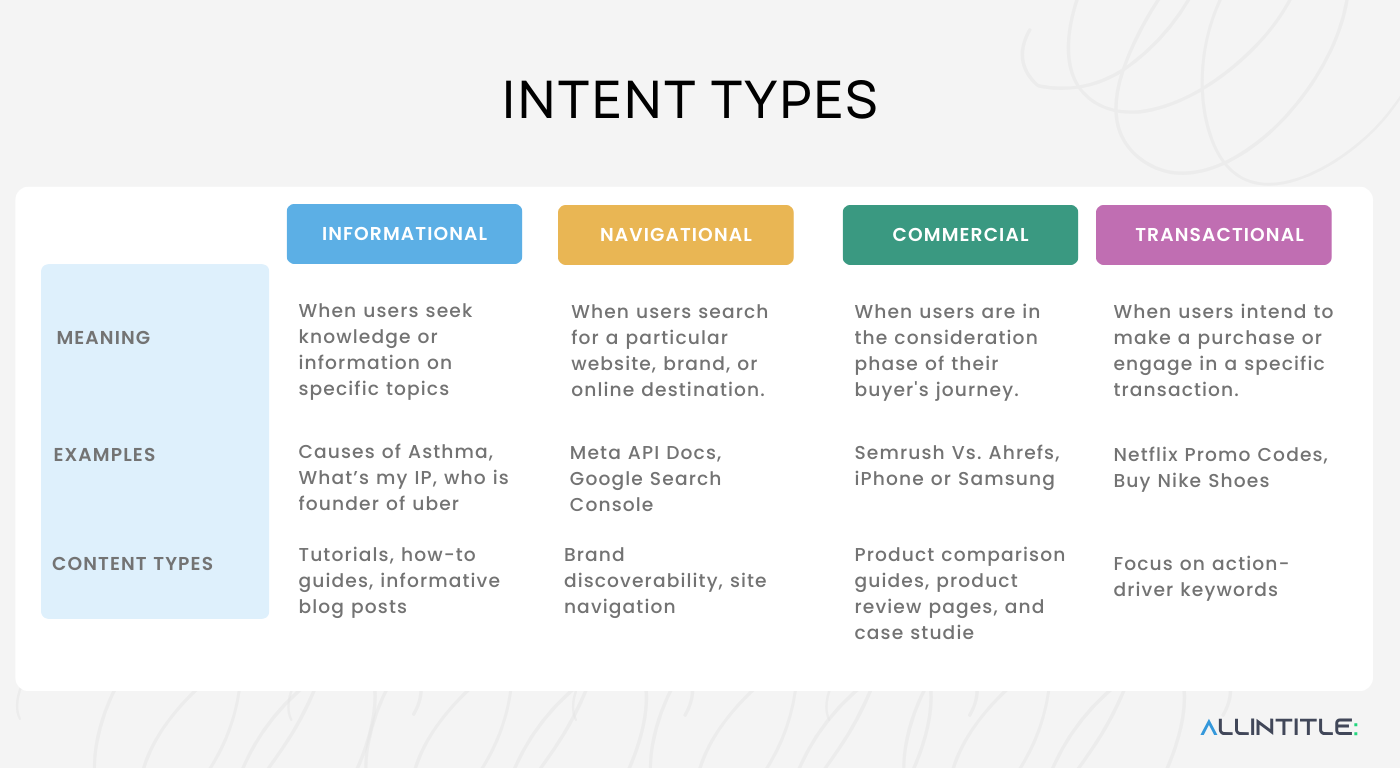
For your Shopify store, the most critical distinction to master is between transactional intent and informational/commercial intent.
- Transactional keywords ("buy Nike shoes") are best targeted with your product and collection pages.
- Informational ("how to clean shoes") and commercial ("best running shoes") keywords are best targeted with blog posts or buying guides.
How to Identify Search Intent in Practice
Understanding the theory is one thing; applying it is another. So, how do you figure out the intent of a keyword you want to target? The answer is simpler than you might think: you look at the search results.
Google's entire business model relies on accurately identifying user intent and showing the most relevant results. Therefore, the top-ranking pages for any given keyword are your best guide to understanding its intent.
The Ahrefs video below introduces a simple but powerful framework for analyzing these results, which they call the "Three C's of Search Intent." This structured approach involves looking at:
- Content Type: Are the top results blog posts, product pages, videos, or category pages?
- Content Format: If they are blog posts, are they how-to guides, listicles, or reviews?
- Content Angle: What is the main hook or unique selling proposition? (e.g., "for beginners," "in 2024," "on a budget").
This method provides a systematic way to deconstruct the search results page and determine what you need to create to compete.
Keyword Research Pt 1: How to Analyze Searcher Intent - 1.2. SEO Course by Ahrefs
This video from Ahrefs teaches a practical, analytical method for determining search intent by looking at the search engine results page (SERP).
Watch this video to learn the "3 C's" framework. First, watch the introduction to the framework from the "3 C's" explanation. Then, see how it's applied to an informational query ("how to swing a golf club") and a transactional query ("golf clubs").
By simply searching for your target keyword and applying the "3 C's" analysis, you can confidently determine the search intent. If the results are all e-commerce category pages, that's a clear signal of transactional intent. If they are all "Best of" listicles, the intent is commercial. This analysis removes the guesswork and tells you exactly what kind of page to build.
Conclusion
In this lesson, we've established the fundamental concept of search intent, which is the crucial first step in any keyword research strategy. Understanding the "why" behind a search allows you to create content that truly serves the user, which is what search engines are designed to reward.
Here are the key takeaways:
- Search intent is the reason or purpose behind a user's search query.
- The four main types are Informational, Navigational, Commercial, and Transactional.
- For an e-commerce store, the most valuable keywords typically have commercial and transactional intent, as they attract users who are close to making a purchase.
- The best way to determine a keyword's intent is to analyze the top-ranking pages on Google, looking at the content type, format, and angle.
- Matching your page type to the dominant search intent is critical: use product/collection pages for transactional intent and blog posts/guides for informational or commercial intent.
Now that you understand how to analyze the type of keyword you should be looking for, our next lesson will get even more practical. We will dive into how to use a free tool to actually find and evaluate relevant keywords for one of your products.