Hello! In our previous lesson, we worked through the method of completing the square. You saw how it could solve any quadratic equation by systematically transforming it, but also that it involves quite a few algebraic steps. As we hinted at the end of that session, there is a more direct route to the solution.
Today, we will explore the quadratic formula. This formula is the direct result of applying the "completing the square" method to the general quadratic equation, . Think of it as a pre-packaged algorithm: you input the coefficients of your equation, and it outputs the solutions. Your goal in this lesson is to master its application, so you can solve any quadratic equation efficiently and accurately, a vital skill for your IGCSE exam and a great example of procedural thinking that is fundamental in software development and AI.
The Quadratic Formula: Your Universal Tool
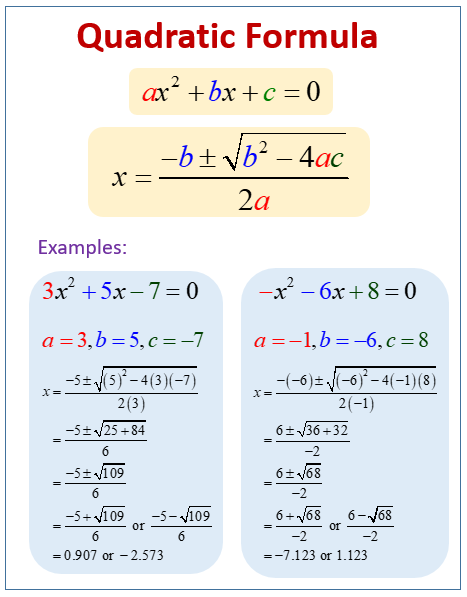
For any quadratic equation written in the standard form , the solutions for are given by the formula:
The '±' symbol means that there are typically two solutions: one where we add the square root term, and one where we subtract it.
The most critical first step, before you do anything else, is to ensure your equation is in that standard form. This allows you to correctly identify the coefficients a, b, and c.
The image below shows the formula and two fully worked examples. Pay close attention to how the a, b, and c values are identified from the equation, including their signs, and then substituted into the formula.
The following video provides an excellent introduction to the formula and why the equation must equal zero.
How to Use the Quadratic Formula | Grade 6-9 Maths Series | GCSE Maths Tutor
This video from The GCSE Maths Tutor explains where the a, b, and c values come from and provides a great visual analogy for why we solve for when the equation equals zero.
Watch from the beginning until this point. The instructor explains the standard form of a quadratic, introduces the formula, and discusses what the solutions represent on a graph.
Applying the Formula: A Step-by-Step Guide
Let's walk through an example. As per your preference, try to solve this equation first before reading the explanation:
Solve , giving your answer to 3 significant figures.
...
Here is the process:
-
Identify
a,b, andc: The equation is already in standard form.a = 1(the coefficient of )b = 5(the coefficient of )c = 3(the constant term)
-
Substitute into the formula:
-
Simplify and Calculate:
-
Find the two solutions: Now, we split the calculation for the '+' and '-' cases.
The video you just previewed walks through this exact problem. It's a great demonstration of how to use your calculator effectively.
How to Use the Quadratic Formula | Grade 6-9 Maths Series | GCSE Maths Tutor
This segment shows a complete, calculator-based solution for the problem above.
Watch the section from this timestamp to see how to identify the coefficients and input the formula into a calculator to get both solutions, including rounding.
Avoiding the Pitfalls: Common Mistakes
The quadratic formula is powerful, but it has several points where small mistakes, especially with signs, can lead to the wrong answer. This is where your focus on avoiding arithmetic errors will pay off.
The most common errors are:
- Not rearranging the equation into standard form (
ax^2 + bx + c = 0) first. - Sign errors with
-b, especially whenbitself is negative (e.g., ifb = -5, then-b = -(-5) = 5). - Errors squaring a negative
bvalue. Remember that(-b)^2is always positive (e.g.,(-5)^2 = 25, not -25). Using brackets in your calculator is essential here. - Sign errors with the
-4acterm, especially whenaorcis negative.
The following resource is structured perfectly for you. It presents four problems with flawed solutions. First, try to solve the equations yourself. Then, analyze the provided solutions to find the errors. This will actively train you to spot these common mistakes.
9.7.2 Common Calculation Errors When Using the Quadratic Formula - Algebra 1 | OpenStax
This activity from OpenStax is designed to help you identify and correct common errors when using the quadratic formula.
Focus on the first four equations in the activity section. For each one: Solve it yourself on paper. Compare your work to the "worked solution with errors" and identify the mistake(s). The errors will likely relate to signs, substitution, or simplification. Check your answer against the correct "Compare your answer" section. After trying the activity, review the explicit list of common pitfalls in the section titled "Common Errors". This will formalize what you just practiced.
To further solidify your understanding of handling negative coefficients, which is often the trickiest part, the following video segment is extremely helpful.
How to Use the Quadratic Formula | Grade 6-9 Maths Series | GCSE Maths Tutor
The GCSE Maths Tutor demonstrates how to handle negative c and negative b values, emphasizing the importance of brackets when substituting into a calculator.
First, watch the example with a negative c value from this timestamp. Then, pay close attention to the crucial example with a negative b value, from this timestamp. This directly addresses a major source of sign errors.
Non-Calculator Questions and Surd Form
On the IGCSE non-calculator paper, you may be asked to give your answer in "exact form" or as a "simplified surd". This means you won't use a calculator to find a decimal approximation. Instead, you'll simplify the expression algebraically as much as possible.
The process involves two main stages of simplification:
- Calculate the value under the square root (
b^2 - 4ac), which is called the discriminant. - Simplify the resulting surd (e.g.,
sqrt(48)becomes4*sqrt(3)). - Simplify the entire fraction, if possible.
The following guide and video will show you exactly how this is done.
[PDF] CIE IGCSE Maths: Extended - Save My Exams
This PDF from Save My Exams provides a concise overview, including guidance on when to use the formula and an example of giving an answer in simplified surd form.
On page 6, review the section "How do I use the quadratic formula?". Then, on pages 8-9, study the worked example that results in a simplified surd answer. Finally, on page 17, read the section "When should I use the quadratic formula?" to understand the exam context.
The video below demonstrates this non-calculator process from start to finish.
How to Use the Quadratic Formula | Grade 6-9 Maths Series | GCSE Maths Tutor
This final segment from The GCSE Maths Tutor shows how to tackle a quadratic formula problem without a calculator, leaving the answer in the required surd form.
Watch the detailed walkthrough from the start of the non-calculator section. This covers simplifying the discriminant, simplifying the surd, and finally simplifying the entire fractional expression.
Conclusion
You have now learned the most powerful and reliable method for solving quadratic equations. The quadratic formula provides a direct path to the solution for any quadratic, but its power comes with the responsibility of careful and accurate substitution.
Key Takeaways:
- The quadratic formula, , solves any equation in the form .
- Accuracy is paramount. Always start by writing the equation in standard form to identify
a,b, andccorrectly. - Be extremely careful with negative signs, especially for the
-bterm and when squaring a negativeb. Use parentheses when substituting into your calculator. - For non-calculator papers, you must be able to simplify surds to give an exact answer.
In our next lesson, we will begin to combine our algebraic skills. We will tackle systems of simultaneous equations where one equation is linear and the other is quadratic. You will find that solving these systems often requires using the quadratic formula or one of the other methods we've learned in this module.