Welcome to our next lesson. In our previous session, you mastered the quadratic formula, a powerful tool for finding the roots of any quadratic equation. You learned how to apply it accurately, handle tricky negative coefficients, and present your answers in both decimal and exact surd form.
Today, we will combine that knowledge with your proficiency in linear equations. Our goal is to solve systems of simultaneous equations where one equation is linear and the other is quadratic. You'll discover that the core strategy involves substituting the linear equation into the quadratic one, which transforms the problem into a single quadratic equation that you already know how to solve. This technique of finding intersection points is fundamental in many areas, including collision detection in game development, where you might need to determine if a linearly moving object intersects with a curved path.
The Graphical Interpretation
Before we dive into the algebra, let's visualize what we're trying to find. A system of one linear and one quadratic equation represents a straight line and a curve (like a parabola or a circle) on a graph. The solutions to the system are the coordinates of the points where the line and the curve intersect.
As you can see in the image below, there are three possibilities:
- Two solutions: The line cuts through the curve at two distinct points.
- One solution: The line is a tangent to the curve, touching it at exactly one point.
- No solution: The line and the curve never intersect.

The Algebraic Method: Substitution
The main algebraic method for solving these systems is substitution. The process breaks down into a clear, logical sequence of steps. Since you prefer to build intuition first, let's start with a problem.
Your turn: Try to solve the following system of equations. The graph for these equations is also shown, so you can see the solution you are aiming for.
- Equation 1 (Quadratic):
- Equation 2 (Linear):
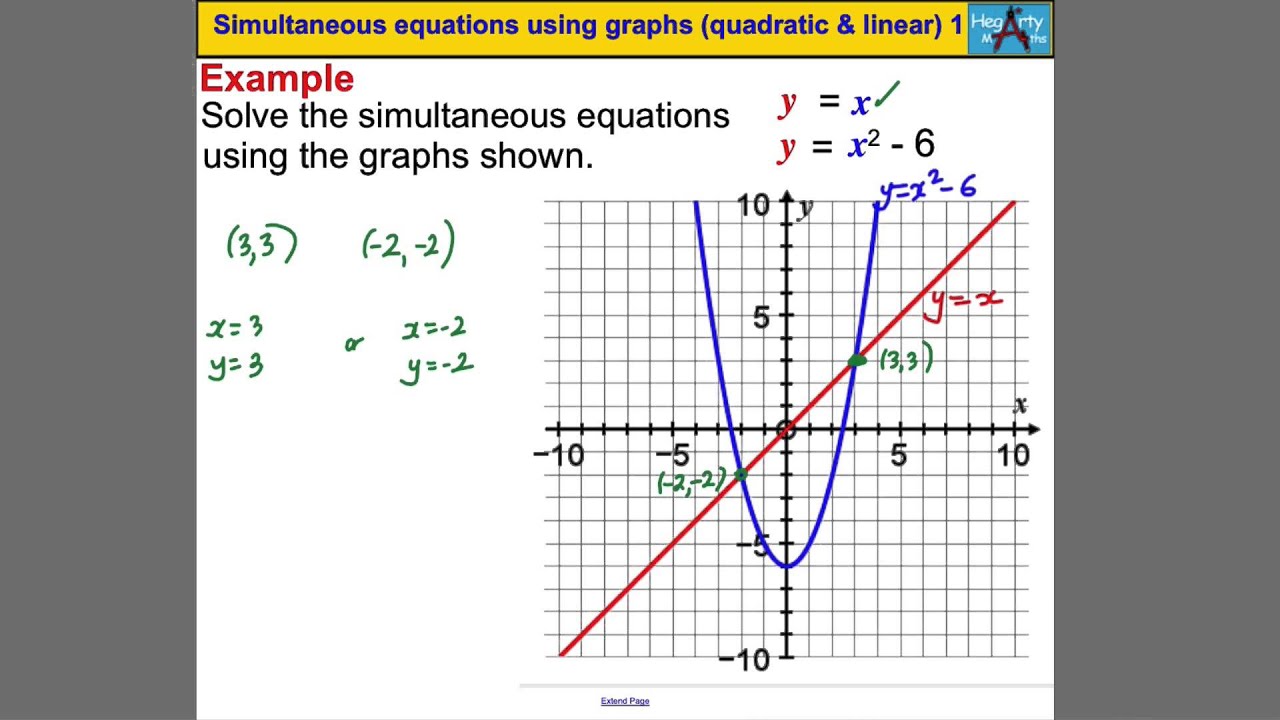
...
The Solution Path:
Let's walk through the algebraic solution. The core idea is to merge the two equations into one.
-
Substitution: Since both equations are equal to
y, we can set them equal to each other: -
Form a Quadratic Equation: Now, we rearrange this into the standard quadratic form
ax^2 + bx + c = 0. -
Solve the Quadratic: You can now solve this using your preferred method. Factorisation works well here, which is good practice for you.
This gives us two possible values for
x: or . -
Find Corresponding
yValues: We now substitute eachxvalue back into the simple linear equation, , to find the correspondingyvalue for each solution.- When , . This gives the solution pair (3, 3).
- When , . This gives the solution pair (-2, -2).
These are the two intersection points you can see on the graph. This five-step process forms the foundation for solving all linear-quadratic systems. The following resource provides a clear summary of these steps and a worked example.
Quadratic Simultaneous Equations - Steps, Examples, Worksheet
This guide from Third Space Learning formalizes the step-by-step process we just used and walks through another example. This will solidify the core procedure in your mind.
First, read the five steps listed under the section "How to solve". Then, carefully follow "Example 1," which demonstrates the full process for a system where both equations are already set equal to y.
Handling More Complex Cases
Often, the linear equation won't be conveniently arranged for you. You'll need to make either x or y the subject of the formula before you can substitute. This is where your strength with linear equations comes into play.
The following video demonstrates a case where the linear equation must be rearranged first. It's a great example of the standard workflow you'll encounter in IGCSE questions.
Quadratic Simultaneous Equations | Grade 9 Maths Series | GCSE Maths Tutor
This video from The GCSE Maths Tutor, a channel you've seen before, tackles a problem where rearrangement is the necessary first step.
Watch the second example in the video, from this section. Pay close attention to how the linear equation x - y = 2 is rearranged to y = x - 2 before it is substituted into the quadratic equation x^2 + y^2 = 34.
A crucial point arises after you've found your x values: why should you substitute back into the linear equation and not the quadratic one? While both are technically possible, substituting back into the linear equation is simpler and safer. The following short explanation from Mathsaurus explains the graphical reason for this, which should appeal to your desire to understand the "why".
Simultaneous Equations: One Quadratic, One linear
This video offers a concise, visual explanation of why substituting back into the linear equation is the correct and most efficient approach.
Watch the segment from this point. The presenter uses the graphs of an ellipse and a line to show how substituting into the quadratic equation can introduce "phantom" solutions that don't lie on the line.
When Factorising Isn't an Option
The most challenging IGCSE questions combine this topic with the previous one. After substitution, you might end up with a quadratic equation that cannot be easily factorised. An exam question will often signal this by asking for answers to a certain number of significant figures or decimal places. In these cases, you must use the quadratic formula.
Let's put everything together. Have a go at this problem first. The prompt itself is a big clue!
Your turn: Solve the simultaneous equations, giving your answers to 3 significant figures.
...
This problem is designed to be solved with the quadratic formula. The next video segment walks through this exact type of question, showing you how to combine substitution with the formula and how to use your calculator effectively to get the final decimal answers.
Quadratic Simultaneous Equations | Grade 9 Maths Series | GCSE Maths Tutor
This final segment from The GCSE Maths Tutor is the perfect capstone, as it connects the skills from today's lesson directly with what you learned about the quadratic formula.
Watch the section on calculator-based questions from this timestamp. Notice how the problem is set up, the a, b, and c values are identified for the quadratic formula, and the final x and y values are calculated and rounded.
As you work through these problems, be especially mindful of the common pitfalls. Expanding brackets with negative terms, like (3 - 2x)^2, is a frequent source of sign errors. Always take your time and, if needed, write out the double brackets explicitly: (3 - 2x)(3 - 2x). Also, remember that quadratic systems usually yield two pairs of solutions, so ensure you find the corresponding y value for each x value you calculate.
Conclusion
You've now learned how to solve a system of one linear and one quadratic equation by combining several of your algebraic skills. This process is a great example of a multi-step algorithm, similar to what you might encounter in scripting or AI, where one procedure's output becomes the input for the next.
Key Takeaways:
- The solutions to a linear-quadratic system are the intersection points of a line and a curve. There can be two, one, or no solutions.
- The primary method is substitution:
- Rearrange the linear equation to isolate one variable (e.g.,
y = ...). - Substitute this expression into the quadratic equation.
- Simplify to get a single quadratic equation in the form
ax^2 + bx + c = 0. - Solve this quadratic using factorisation or the quadratic formula.
- Substitute the resulting value(s) back into the rearranged linear equation to find the corresponding values of the other variable.
- Rearrange the linear equation to isolate one variable (e.g.,
- Be vigilant about sign errors during expansion and always state your final answers as corresponding pairs.
In our next lesson, we will shift our focus from equations, which have specific solutions, to linear inequalities, where the solutions are a range of values. We will explore how to solve them and represent these solution sets on a number line.