Hello! Welcome back to your course on becoming a better UX Designer.
Introduction
In our last lesson, we focused on identifying and prioritizing the key people involved in a project. You learned how to use stakeholder maps to understand who has power and interest, and who you need to engage with most closely. We answered the question, "Who should we talk to?"
Now, we move from who to how. This lesson is dedicated to the practical skill of conducting a stakeholder interview to effectively gather the information you need. This is where your strategic mapping turns into actionable intelligence.
Today's learning outcome is to conduct a stakeholder interview to gather project requirements and constraints.
We will cover the entire lifecycle of a stakeholder interview:
- Why these interviews are a cornerstone of UX strategy.
- How to prepare by setting goals and crafting a focused interview guide.
- How to conduct the interview itself, using techniques to build rapport and elicit valuable information.
- What to do after the interview to begin making sense of your findings.
This is a crucial skill that allows you to uncover the business goals, technical limitations, and hidden assumptions that will define your project's success.
The Strategic Value of Stakeholder Interviews
Before diving into the "how," let's solidify the "why." Stakeholder interviews are not just a friendly chat; they are a primary research method for de-risking a project. By talking to key players at the beginning, you uncover critical information that prevents misunderstandings, aligns expectations, and ensures your design work is grounded in business reality.
To start, let's ground ourselves in why stakeholder interviews are so critical. They are a strategic tool for aligning the project vision and preventing costly mistakes down the line.
Watch the first part of this video from the Nielsen Norman Group (from 00:20 to 01:19). Pay attention to the four key benefits they outline: gathering context, identifying business goals, aligning vision, and increasing buy-in.
As the video explains, these conversations are your best tool for gathering historical context, defining success metrics, creating a shared vision, and building the political capital needed to see your project through.
Phase 1: Planning and Preparation
A successful interview is won long before you sit down with the stakeholder. Thorough preparation is essential for a focused, productive conversation. This involves defining your goals and creating a structured but flexible interview guide.
Creating Your Interview Guide
An interview guide, or moderator guide, is your roadmap for the conversation. It ensures you cover all your key topics while still allowing for natural, free-flowing discussion. A typical guide has four parts:
- Introduction: Introduce yourself, state the project's purpose, explain the interview format, and ask for permission to record.
- Warm-up: Start with easy, general questions about the stakeholder's role and responsibilities to build rapport.
- Project-Specific Questions: This is the core of the interview, where you dig into goals, requirements, and constraints.
- Closing: Thank the stakeholder, ask if they have any final thoughts, and, crucially, ask who else you should speak with.
The following resource provides a fantastic, in-depth guide to preparing for and structuring these interviews, including a rich library of sample questions.
Internal Stakeholder Interviews for User Research
The article 'Internal Stakeholder Interviews for User Research' from UserInterviews.com is an excellent, detailed walkthrough of the entire interview process. We'll use it to understand how to build a robust moderator guide.
Please read two key sections from this article: Start at 'How to conduct internal stakeholder interviews' and read through step 4, 'Create a moderator guide'. This covers the core planning steps. Then, jump to the section 'Examples of stakeholder interview questions' and review the categorized lists. You don't need to memorize them all, but get a feel for the types of questions you can ask to uncover project vision, business goals, and constraints.
Crafting Questions to Uncover Requirements and Constraints
As you saw in the article, your questions should be open-ended and designed to probe different facets of the project. When your goal is to gather requirements and constraints, focus your questions around these key areas:
- Project Vision & Goals:
- "From your perspective, what is the main objective of this project?"
- "Imagine we're a year from now and this project has been a huge success. What does that success look like?"
- Business Context:
- "How does this project support our company's overall business goals?"
- "What key metrics will you be using to measure the success of this project?"
- Users & Customers:
- "Who do you see as the primary user for this product/feature?"
- "What is the single most important problem we are solving for them?"
- Constraints, Risks & Challenges:
- "What are the biggest challenges or constraints we should be aware of (e.g., budget, timeline, technical limitations)?"
- "What are your biggest concerns about this project?"
This image provides a great example of what this looks like in practice.

Phase 2: Conducting the Interview
With your guide prepared, you're ready for the interview itself. Your role is to be a curious, neutral facilitator. You want to create a comfortable atmosphere where the stakeholder feels they can speak openly.
Your demeanor during the interview is just as important as your questions. This clip from the NNgroup provides excellent practical advice on how to build rapport and listen effectively.
Watch from 02:24 to 03:54. Focus on the tips for creating an informal atmosphere, using active listening, and how to properly close the interview.
Here are some key techniques to practice during the interview:
- Build Rapport: Frame the interview as an informal "coffee chat." Start with the introduction you prepared to set a professional yet relaxed tone.
- Practice Active Listening: Acknowledge what you're hearing with phrases like "I see" or "That's helpful." Use silence to your advantage; people will often fill it with more detailed thoughts.
- Dig Deeper with Follow-ups: Don't just stick to your script. When you hear something interesting, ask clarifying questions like, "Could you tell me more about that?" or "Why do you think that is?"
- Stay Neutral: Avoid interjecting your own opinions or solutions. Your job is to understand their perspective, not to defend a design.
These logistical best practices will also help ensure your interview runs smoothly.
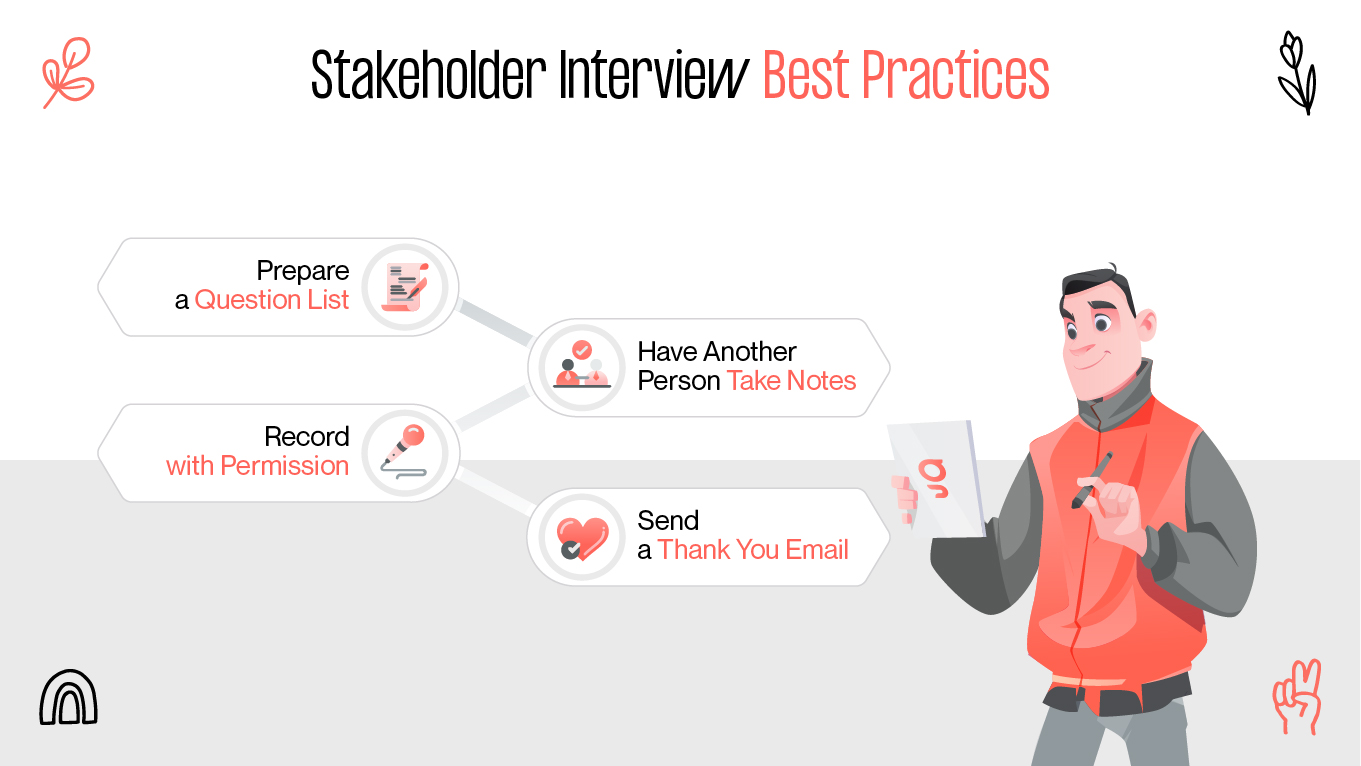
Phase 3: After the Interview - Synthesizing Findings
The value of an interview is realized only when you process the information you've gathered. While we will cover research synthesis in great detail in a future module, the immediate next step is to make your notes usable.
The interview isn't over when you hang up the call. The final step is to process what you've learned and make it actionable. This brief clip explains what to do with your findings.
Watch from 03:54 to 04:29. Notice how the analysis can range from informal to robust, and how the insights inform all future aspects of the project.
Immediately after your interview, you should:
- Transcribe or Clean Up Notes: While the conversation is fresh, review your notes (or a recording transcript). Add context, clarify shorthand, and pull out key quotes.
- Write a High-Level Summary: For each interview, create a brief summary that captures the most important takeaways: key goals, stated requirements, major constraints, and any surprising insights.
- Identify Patterns: As you interview multiple stakeholders, start looking for areas of alignment and, just as importantly, areas of disagreement. These misalignments are critical risks you'll need to address.
Conclusion
In this lesson, you've learned the end-to-end process of conducting a stakeholder interview. It’s a foundational research activity that bridges the gap between your design work and the strategic imperatives of the business.
Key Takeaways:
- Stakeholder interviews are a strategic tool for aligning expectations, mitigating risk, and gathering project requirements.
- Success depends on thorough preparation, centered around a well-structured moderator guide with open-ended questions.
- During the interview, your role is to build rapport and practice active listening to uncover deep insights, not just surface-level answers.
- The work isn't done until you've summarized your findings and identified key themes, requirements, and constraints.
You now have a repeatable process for systematically gathering business and project context. This skill is fundamental to ensuring your design solutions are not only user-centered but also viable and valuable to the business.
In our next lesson, we will zoom out from the individual project to the organization itself. We'll learn how to analyze a product's current UX maturity level, which will give you another layer of strategic context for your work.