Hello! Let's continue our journey into UX strategy.
Introduction
In our last lesson, you learned how to conduct stakeholder interviews to gather project-specific requirements and constraints. This is a crucial skill for understanding the immediate context of your work.
Today, we're going to zoom out from the project level to the organizational level. A designer's effectiveness is often determined not just by their individual skills, but by the environment in which they work. This lesson will equip you to understand that environment strategically.
Our learning outcome is to analyze a product's current UX maturity level using established frameworks.
We will explore:
- What UX maturity is and why it's a vital concept for strategic designers.
- The industry-standard Nielsen Norman Group (NN/g) framework, including its six stages and four core factors.
- A practical process for assessing an organization's maturity level, so you can identify its strengths, weaknesses, and opportunities for growth.
Understanding your organization's UX maturity helps you set realistic expectations, tailor your arguments for maximum impact, and create a roadmap for improving not just your products, but the entire practice of UX at your company.
What is UX Maturity and Why Does It Matter?
UX maturity refers to an organization's ability to consistently and effectively deliver user-centered design. It's a measure of how deeply UX principles are integrated into a company's culture, strategy, and processes.
For a designer with your background in product design, moving beyond the execution of wireframes and into a more strategic role requires this kind of organizational awareness. Knowing your company's maturity level helps you understand what's possible, what battles to fight, and how to advocate for the resources and processes needed to do great work.
Let's start by exploring the concept and its direct link to business success.
This article from the Interaction Design Foundation provides an excellent introduction to UX maturity and makes a strong case for why it's so important.
Please read the first two sections of the article: 'What is UX Maturity?' and 'Why UX Maturity Matters'. As you read, focus on the connection between a high level of UX maturity and tangible business benefits like increased revenue, efficiency, and competitive advantage.
As the article highlights, mature organizations don't just create better products; they are more efficient, make more informed decisions, and ultimately achieve greater business success.
Frameworks for Understanding UX Maturity
Several models exist to help us evaluate UX maturity. While they have slight differences, they all describe a similar journey from a complete lack of UX awareness to a state where user-centeredness drives every decision.
We will focus on the Nielsen Norman Group (NN/g) UX Maturity Model, as it is one of the most well-documented and widely used in the industry. This model is built on two key components:
- The 6 Stages: These describe an organization's overall level of maturity.
- The 4 Factors: These are the dimensions you analyze to determine which stage an organization is in.
The 6 Stages of UX Maturity
The NN/g model outlines a progression through six distinct stages. Understanding these stages gives you a ladder to climb, helping you identify where you are and what the next step looks like.
Let's get a quick overview of the six stages. This video from NN/g walks through each level, from UX being completely absent to being the core driver of the company.
Watch the full video. As you watch, try to mentally place organizations you've worked for within these stages. What characteristics did you observe that support your assessment?
To help you visualize this progression, here is a summary of the stages discussed in the video.
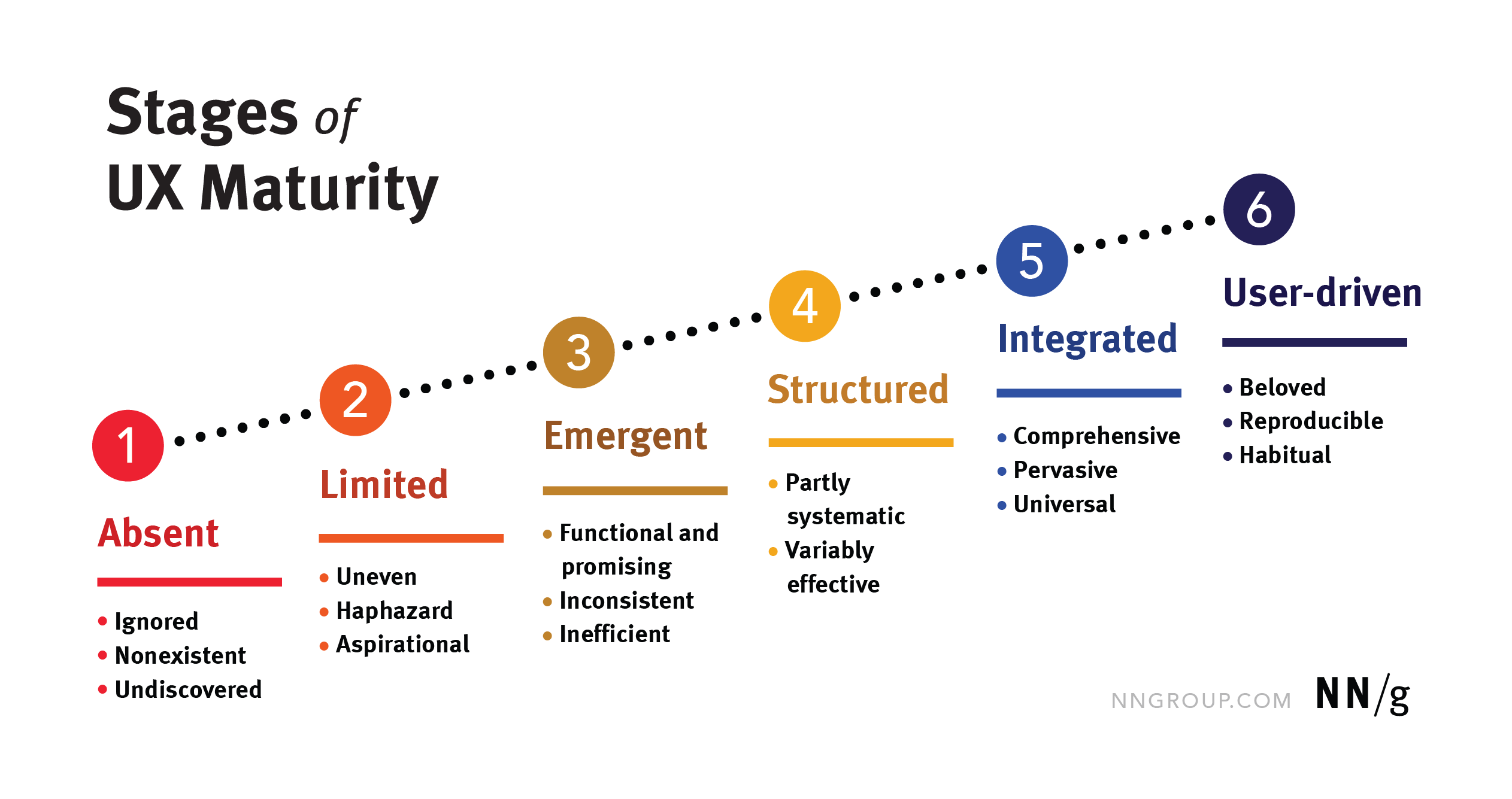
As you can see, maturity isn't just about having designers; it's about how the entire organization thinks about and integrates user-centricity.
The 4 Factors of UX Maturity
So, how do you determine which of the six stages an organization is in? You conduct an analysis across four key factors. These factors are the "what" you look for, the evidence you gather.
This second video from NN/g breaks down the four factors that contribute to an organization's maturity score: Strategy, Culture, Process, and Outcomes.
Watch the entire video. Pay close attention to the subfactors mentioned (e.g., Budget, Competency, Methods, Measurement), as these give you specific, concrete things to look for in your analysis.
To summarize the video, your analysis should investigate:
- Strategy: High-level planning and decision-making.
- Vision: Is there a user-centered objective?
- Planning & Prioritization: Is UX work accounted for and valued?
- Budget: Are there dedicated resources (time, people, money) for UX?
- Culture: The organization's understanding and appreciation of UX.
- Awareness: Is UX and its value widely known?
- Appreciation & Support: Is UX championed by non-designers?
- Competency: Are there dedicated UX roles and hiring practices?
- Adaptability: Is the organization willing to change based on user feedback?
- Process: The operational aspects of doing UX work.
- Methods: Is user research and design thinking used throughout the product lifecycle?
- Collaboration: Do UX teams work effectively with other departments?
- Consistency: Are there shared tools and systems (like a design system)?
- Outcomes: The results and impact of UX work.
- Impact of Design: Is the final product effective and high-quality?
- Measurement: Are user-centered metrics defined and tracked?
How to Analyze a Product's UX Maturity
Now we'll combine the stages and factors into a practical assessment process. To analyze a product's (and by extension, its organization's) maturity, you use the four factors as a diagnostic lens to determine its position along the six stages.
This article provides a practical, step-by-step guide on how to conduct a maturity assessment.
Please read the section titled 'How to Assess an Organization’s UX Maturity Level'. This section serves as a playbook, covering methods like self-assessment surveys, reviewing processes, and evaluating strategic alignment.
Your UX Maturity Audit Checklist
Based on the resources, you can create a simple audit by asking questions across the four factors. This is something you can do informally by observing and asking questions, or formally through surveys and interviews with colleagues.
Think about your current organization or a recent project and consider these questions:
1. Strategy:
- Can leaders articulate a clear vision for the user experience?
- Is there a separate, protected budget for user research?
- When a deadline is tight, is UX work often the first thing to be cut?
2. Culture:
- Do engineers and product managers ask for user research findings?
- Are there clear career levels (e.g., Junior, Senior, Principal) for designers and researchers?
- Have you ever seen a major project decision change because of a usability test finding?
3. Process:
- Is user research conducted at the beginning of projects (generative) or only at the end (evaluative)?
- Does your company have a mature, widely adopted design system? (Your background in design systems is very relevant here!)
- How often do designers, product managers, and developers collaborate in shared workshops or meetings?
4. Outcomes:
- Do product teams track metrics like Task Success Rate or System Usability Scale (SUS) scores?
- How is the ROI (Return on Investment) of design work communicated to leadership?
- Are design-driven improvements celebrated publicly within the company?
By answering these questions, you can start to build a picture. For example, an organization with a strong design system (Process) but no dedicated UX budget (Strategy) and where leaders ignore research findings (Culture) might be in the Emergent (Stage 3) phase.
For a deeper dive into the nuances of each stage, the full NN/g article is an invaluable resource to bookmark.
The 6 Levels of UX Maturity - NN/G
For the most detailed description of each stage, its variations, and the common obstacles, the primary NN/g article is the definitive text.
You don't need to read this word-for-word right now, but skim through the descriptions of each of the six stages. Pay particular attention to the 'Obstacles to Overcome' sections, as these provide a clear roadmap for how you can help an organization level up.
Conclusion
In this lesson, you've learned how to move beyond a project-centric view and analyze the broader organizational context for your work. This is a hallmark of a senior, strategic designer.
Key Takeaways:
- UX Maturity is a measure of an organization's ability to consistently deliver high-quality, user-centered design.
- The NN/g Maturity Model provides a framework for analysis, consisting of six stages of progression and four factors (Strategy, Culture, Process, Outcomes) to evaluate.
- Assessing your organization's maturity level is a strategic act. It helps you understand political realities, tailor your communication, and identify the most impactful opportunities for improvement.
- Knowing your stage isn't just a label; it's a diagnostic tool that tells you what to work on next to advance the practice of UX in your organization.
In our next lesson, we will build directly on this. Knowing your organization's maturity level provides critical context for the next step: formulating UX goals that align directly with business objectives. A team at Stage 2 will have very different goals (e.g., "get one successful case study") than a team at Stage 4 (e.g., "improve our user satisfaction metric by 10%").