Hello! Welcome to the final lesson of our first module, "Foundations of Dutch E-commerce."
Introduction
In our last lesson, we made a crucial strategic decision: to begin your e-commerce journey by selling on Bol.com. This approach allows you to leverage a massive, trusted platform to validate your products and generate initial revenue with minimal setup.
Now, we need to connect this sales strategy to your sourcing strategy. This lesson will focus on the practicalities of getting your products from Turkey to the Netherlands. The learning outcome is to explain the high-level process of importing from Turkey to the Netherlands, considering the EU-Turkey Customs Union.
We'll cover the key logistical steps, the critical documents you'll need, and the financial and legal responsibilities you'll have as an importer. Understanding this process is the final piece of the foundational puzzle before we dive into product selection in the next module.
1. The Strategic Advantage of Sourcing from Turkey
Your interest in sourcing from Turkey is a strategic asset. Beyond personal familiarity, Turkey offers distinct advantages for a new e-commerce business, especially when compared to sourcing from the Far East.
Product Sourcing in Turkey! - Week in the life of a Business Owner
To see why Turkey is an attractive sourcing location, let's watch a brief segment from a video by business owner James Sinclair. He discusses his own experience sourcing from Turkey and highlights some key benefits.
Please watch from the beginning to 02:40, and then from 10:30 to 11:45. Pay attention to his points on lower minimum order quantities (MOQs) and shorter lead times compared to China.
As the video illustrates, Turkey can offer:
- Lower Minimum Order Quantities (MOQs): This is crucial when you're starting out. You can test products with a smaller initial investment, reducing financial risk.
- Shorter Lead Times: Getting products in weeks rather than months significantly improves your agility and cash flow.
- Proximity: Being closer to the Netherlands simplifies logistics and makes it more feasible to visit suppliers, which is invaluable for building relationships and ensuring quality.
These benefits are amplified by a key economic agreement: the EU-Turkey Customs Union.

The Customs Union is the single most important factor to understand. For most industrial goods (like textiles, electronics, plastics, and machinery), it means that no import duties (tariffs) are charged when the goods enter the EU from Turkey. This gives you a significant cost advantage and directly supports your goal of achieving high profit margins.
2. The Import Process: From Supplier to Your Doorstep
At a high level, the international shipping process follows a clear sequence.
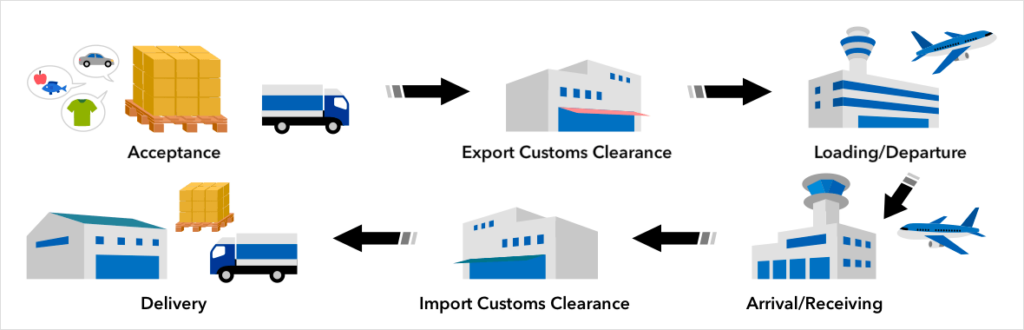
The most critical stage for you as the importer is Import Customs Clearance. This is where Dutch Customs (Douane) inspects the paperwork to ensure your shipment complies with all regulations and determines what, if any, duties and taxes are owed.
To navigate this smoothly, you and your Turkish supplier need to have the correct documentation.
The Dutch Chamber of Commerce (KVK) provides an excellent overview of the import process from Turkey. This will be our primary guide for understanding the necessary documents and rules.
Please read the sections 'EU customs union with Türkiye', 'Import VAT', and 'Import documents'. Focus on the roles of the A.TR certificate, the EUR.1 certificate, and the handling of VAT.
Based on this, let's break down the key elements for customs clearance.
The A.TR Certificate: Your Key to 0% Import Duty
The most important document for your imports will be the A.TR certificate.
- Purpose: It proves to Dutch Customs that your goods are in "free circulation" in Turkey.
- What is "free circulation"? This means the products were either made in Turkey or were previously imported into Turkey with all relevant duties paid.
- Responsibility: Your Turkish supplier is responsible for obtaining this valid certificate from Turkish customs. This is a non-negotiable point you must confirm with any potential supplier.
To solidify your understanding of this crucial document, the Dutch government's business portal offers a dedicated explanation.
Please read the sections 'Using an A.TR when importing from Türkiye' and 'Products for which you cannot use an A.TR'. This will reinforce what 'free circulation' means and clarify which products are exceptions to this rule.
Exceptions: As both resources note, most agricultural products and some coal and steel products are not covered by the Customs Union. For these, a different document, the EUR.1 certificate, might be used to claim a reduced tariff rate, but the A.TR certificate will cover the vast majority of consumer goods.
VAT (BTW) on Imports
Even with 0% import duty, you are still required to pay Dutch VAT (BTW) on the value of your imported goods.
- The standard rate is 21%.
- This VAT is paid at the moment of customs clearance.
- However, as a registered business, you can claim this amount back as input tax on your regular VAT return. In effect, it's a cash flow consideration, not a final cost.
- For regular importers, you can apply for an "Article 23 permit" from the Dutch Tax and Customs Administration (
Belastingdienst). This allows you to defer the VAT payment from the time of import to your periodic VAT return, greatly improving cash flow.
3. Your Responsibilities as an Importer
Beyond documents and taxes, bringing a product to market comes with legal responsibilities. As the importer, you are the first link in the EU distribution chain, and you bear the primary responsibility for the products you sell.
Let's refer back to the KVK article for the final points.
Please revisit the KVK article on 'Importing goods from Türkiye' one last time.
Now, read the sections 'Transportation agreements', 'Product requirements and product liability', and 'Parallel imports and counterfeit goods'.
Here are the key takeaways:
-
Transportation Agreements (Incoterms®): You must agree with your supplier on the Incoterms®. These are standardized international trade terms that define who is responsible for the goods at each stage of shipping. They determine who arranges and pays for transport, insurance, and when the risk of loss or damage transfers from the seller to you. For a software engineer, you can think of Incoterms as a well-defined API protocol that specifies the responsibilities and hand-off points between the two parties in the shipping process. We will cover specific Incoterms in Module 3.
-
Product Safety and Liability: Any product you sell must comply with all EU and Dutch safety standards (e.g., CE marking for electronics). As the importer, you are legally liable for any injury or damage caused by a faulty product. Product liability insurance is highly recommended.
-
Intellectual Property: You cannot simply import branded goods without permission from the trademark owner. Importing and selling counterfeit goods is illegal and carries severe penalties. Your focus should be on generic or white-label products where you can build your own brand.
Conclusion
You now have a high-level map of the import process from Turkey. This process is more than just logistics; it's a strategic advantage that can directly impact your profitability and business model.
Key Takeaways:
- The EU-Turkey Customs Union is your biggest financial advantage, eliminating import duties on most goods.
- The A.TR certificate is the essential document you must get from your Turkish supplier to benefit from the customs union.
- You must account for Dutch VAT (BTW) on imports, but this is reclaimable. An Article 23 permit can help manage cash flow.
- As the importer, you are responsible for product safety, liability, and compliance with all EU/Dutch regulations.
- Clear agreements with your supplier via Incoterms® are crucial for defining cost and risk.
Preview of the Next Module:
This lesson concludes our foundational module. We've defined the market, chosen a sales channel (Bol.com), and now understand the import corridor from Turkey.
In the next module, "Product Discovery and Market Validation," we will move from the "how" to the "what." The first lesson will equip you with a framework to identify high-margin product categories from Turkey that are well-suited for the Dutch market you're about to enter.