Welcome to the final lesson of our course on Philosophy for Content Creators. In our previous sessions, we identified the core branches of philosophy, analyzed thought experiments, and brainstormed three "everyday dilemmas" ripe for storytelling. You now have a set of powerful, relatable ideas. This lesson is the final step: turning one of those ideas into a structured outline for a short-form video.
Today, we will move from the 'what' to the 'how'. We'll explore the essential frameworks that make short-form videos compelling and learn how to apply classic storytelling principles to a 60-second format. Your background in English has given you a strong foundation in narrative structure; we will now compress those elements of setup, conflict, and resolution into a format designed for maximum impact on social media. By the end of this session, you will have a clear blueprint for scripting your first piece of philosophical content.
The Anatomy of a Short-Form Script
Successful short-form videos are not simply short; they follow a specific and deliberate structure designed to capture and hold attention in a fast-scrolling environment. While the exact terminology varies, most effective script frameworks share the same core components.
Take a look at these two common models for viral videos.
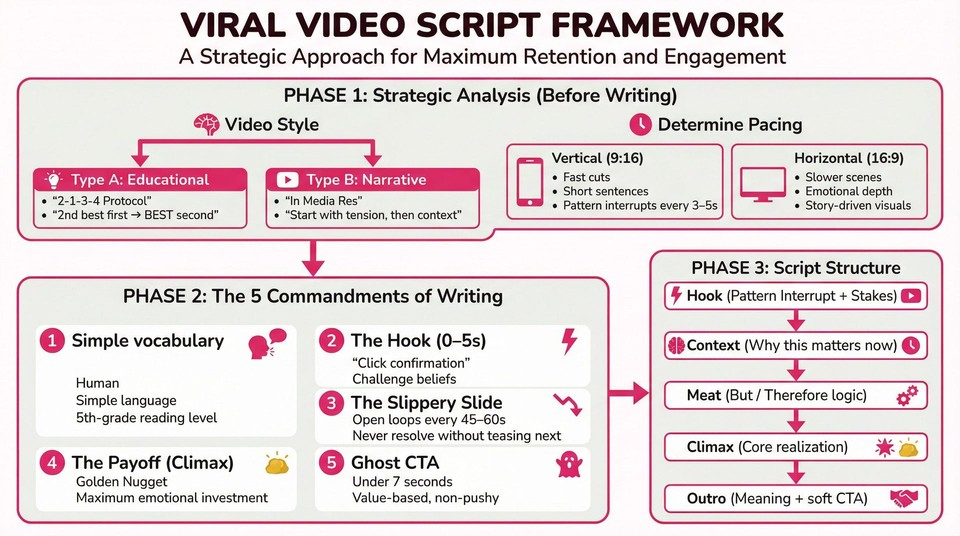

As you can see, both frameworks begin with a Hook and end with a Call to Action (CTA). The "Hook" is the most critical element—it's the first 1-3 seconds where you must give the viewer a compelling reason to stop scrolling. The "Call to Action" is your closing, where you invite the audience to engage by answering a question or sharing their thoughts.
What happens between the hook and the CTA is the story itself. This is where you present the dilemma, deliver value, or trigger an emotion. But a common mistake is to over-script this part. For short-form content, authenticity is key.
Short-Form Video Scripting: Hook, Deliver Value, Outline
This post by content strategist Alex Cattoni offers crucial, practical advice for scripting short-form videos. It emphasizes speed, clarity, and authenticity.
Read the main body of the post, focusing on the three core steps: the process. Pay special attention to the advice to write an outline, not a full script. Then, read the bonus tip, which reinforces the need for brevity.
Cattoni's advice is invaluable: start with a strong hook, get straight to the point, and use an outline of talking points rather than a rigid script. This allows for a more natural, conversational delivery that connects better with the audience.
Storytelling Formats for Philosophy
The "outline" you create is the skeleton of your story. Brendan Kane, a digital strategist, calls this a "format." A format is a repeatable structure that makes your content recognizable and effective. For the philosophical dilemmas we've brainstormed, a story-based format is perfect.
22 Minutes of Why Storytelling Wins On Social Media
In this video, Brendan Kane explains why storytelling works on social media and, most importantly, introduces the concept of 'formats'. He even provides a perfect example of a 'digital philosopher' using a specific format to discuss complex ideas.
First, watch the section from where he defines the four key elements of a story: setup, problem, attempt to resolve, and resolution. Next, watch from his explanation of a 'format', where he calls it the 'skeleton' for your story's 'soul'. This is a key concept for creating a sustainable content strategy. Finally, and most importantly, watch the segment on the "How Do You Know?" format. He showcases a university lecturer and 'digital philosopher' using this simple, low-production format to discuss abstract ideas like love and friendship. This is a direct model for the type of content you aim to create.
The "How Do You Know?" format is a powerful template for our purposes. It takes a big, abstract question and makes it personal and thought-provoking. It's direct, intimate, and doesn't require high-production value—it relies entirely on the strength of the idea.
To make the story within that format truly compelling, we can layer in narrative techniques that build tension and investment.
The Secret to Telling a Great Story — in Less Than 60 Seconds | Jenny Hoyos | TED
This TED talk by Jenny Hoyos breaks down how to tell a complete, engaging story in under 60 seconds. Her framework is about creating a journey for the viewer.
Watch how she builds her story piece by piece. Start with her explanation of the hook as a shocking question. Then, see how she creates constant progression to take the audience on a journey. Notice the importance she places on adding conflict to keep the audience invested. Finally, observe how she builds tension for a satisfying ending.
Outlining Your Philosophical Dilemma
Let's apply these principles by outlining a script for one of the dilemmas from our last lesson: "The Well-Meaning Share."
Dilemma Recap: Your uncle shares an article with medical misinformation. You know it's false and potentially harmful. Do you correct him publicly and risk embarrassment, message him privately, or say nothing and let the falsehood spread?
Here is a sample outline using the frameworks we've discussed. We'll aim for a video around 20-30 seconds.
Sample Script Outline: "The Well-Meaning Share"
Video Style: Direct-to-camera, like the "How Do You Know?" format.
-
The Hook (0-3 seconds):
- Narration: "Here's a moral dilemma almost everyone faces now."
- On-screen Text: The Unsend Dilemma
-
The Setup (3-8 seconds):
- Narration: "Someone you love posts something online that you know is completely false. A fake cure, a conspiracy theory..."
- Visual: Show a phone screen with a generic-looking "Miracle Cure!" article being shared.
-
The Problem & Conflict (8-18 seconds):
- Narration: "...You know they shared it from a good place. They're trying to help. But the information is harmful."
- Narration (cont.): "If you correct them in the comments, you publicly embarrass them. If you message them privately, they might ignore it. And if you do nothing..."
- Visual: Briefly show icons representing a public comment, a private DM, and a ghost (doing nothing).
-
The Resolution / Call to Action (18-25 seconds):
- Narration: "...you become complicit in spreading the lie. So, what is our responsibility here? To truth, or to the people we love?"
- On-screen Text: What's the right thing to do?
- Narration (Final CTA): "Let me know your thoughts in the comments."
This outline uses a hook, presents a relatable setup, clearly defines the conflict and the stakes, and ends with an open-ended question that serves as the call to action. It transforms the philosophical problem into a short, punchy narrative. For a concrete example of how such a script reads, you can review the simple structure of this educational short.
Educational YouTube Short script template - Type.ai
This template for a short about Krispy Kreme donuts provides a clear example of the writing style for short-form video: simple language, short sentences, and visual cues.
Read through the full script example. While the topic is very different, notice the pacing and how each sentence pushes the narrative forward efficiently.
Conclusion
This lesson, and this course, has been a journey from abstract philosophical inquiry to the practical art of modern storytelling. You have learned to:
- Identify the central questions of ethics, epistemology, and metaphysics.
- Analyze complex problems to find their philosophical core.
- Brainstorm relatable, everyday dilemmas full of narrative potential.
- Structure those dilemmas into a compelling short-form video outline using proven frameworks.
You now possess a unique and powerful toolkit. You have the philosophical lens to see the profound questions hidden in daily life and the storytelling craft to share those questions with a wide audience. The three dilemmas we brainstormed are just the beginning. The world is full of stories waiting to be told and questions waiting to be asked. Your task now is to choose one, film it, and start the conversation.