Welcome to the final lesson in our module on Application Innovation. In our previous discussion, we established a framework for choosing between pre-built AI services and custom-trained models, identifying a crucial middle ground: augmenting powerful foundation models with your own data. We highlighted Retrieval-Augmented Generation (RAG) as a key pattern for this purpose.
Today, we will perform a deep architectural dive into this pattern. Your objective is to explain the Retrieval-Augmented Generation (RAG) pattern using Azure AI Search and Azure OpenAI to ground models in custom data. For an aspiring Principal Engineer, understanding this pattern is not just about connecting two APIs; it's about designing a robust, scalable, and relevant information retrieval system that makes a general-purpose AI truly enterprise-ready.
We will deconstruct the RAG architecture, explore the sophisticated retrieval techniques that power it, and analyze the critical design decisions you'll face when implementing it on Azure.
The What and Why of Retrieval-Augmented Generation
Large Language Models (LLMs) like those in Azure OpenAI Service are incredibly powerful, but they have inherent limitations:
- Their knowledge is frozen at the time of their last training run.
- They have no access to your private, proprietary, or real-time data.
- Without specific, relevant context, they are more prone to "hallucinating" or fabricating information.
RAG is an architectural pattern designed to overcome these limitations. Instead of retraining or fine-tuning a model (which is expensive and time-consuming), RAG provides the model with relevant, "just-in-time" information as part of the prompt.
At its core, the RAG pattern involves two main stages:
- Retrieval: When a user submits a query, the system first retrieves relevant information from a custom knowledge base. This is the "R" in RAG. In Azure, this is the primary role of Azure AI Search.
- Generation: The retrieved information is then packaged with the original query and sent as an augmented prompt to an LLM. The LLM uses this context to generate a factual, grounded answer. This is the "G" in RAG, handled by Azure OpenAI.
The diagram below illustrates this fundamental flow.
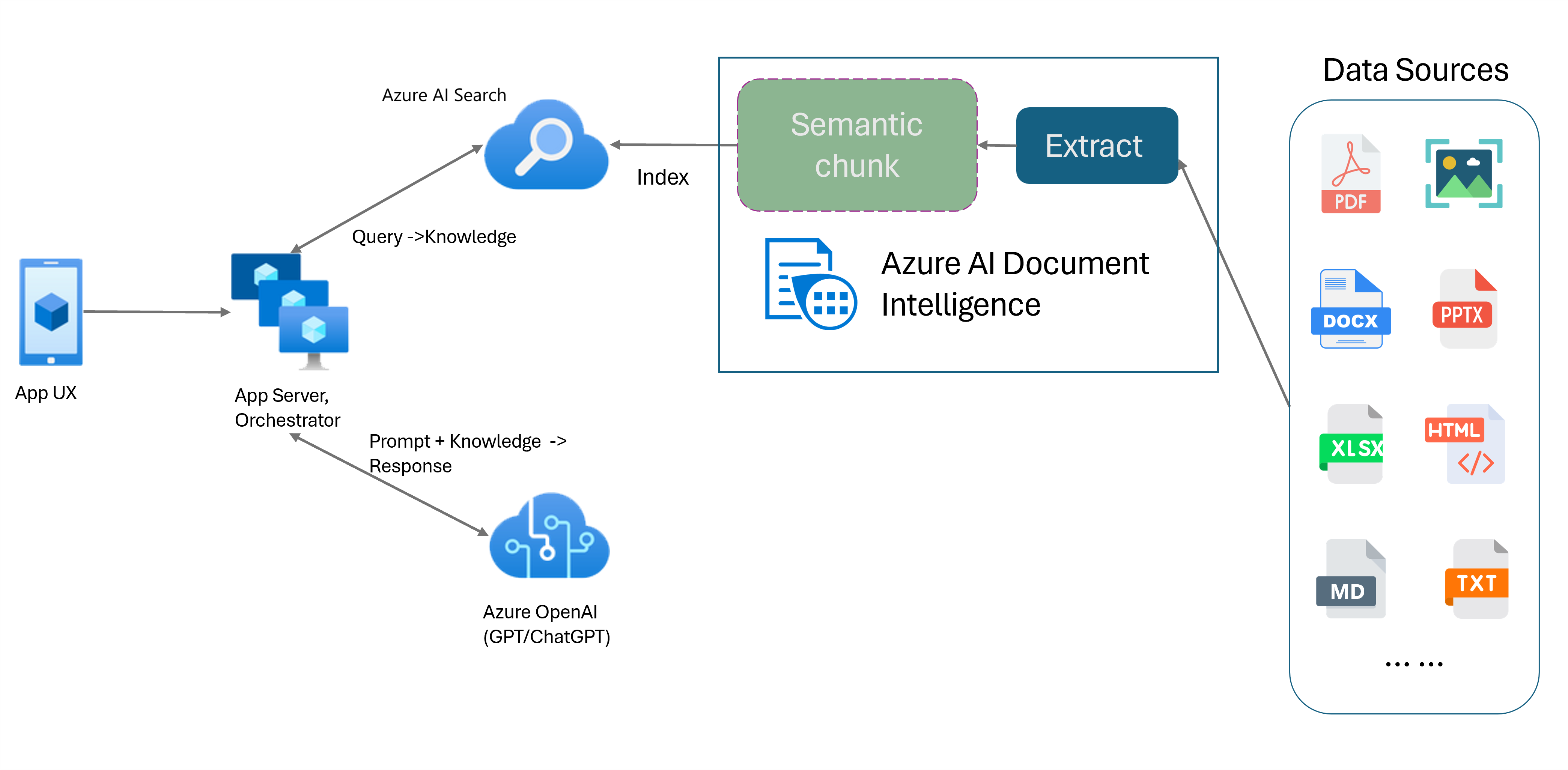
This seems simple, but designing the retrieval stage is a significant system design challenge. The quality of the final generated answer is almost entirely dependent on the quality and relevance of the retrieved information.
The Heart of RAG: The Retrieval Stack in Azure AI Search
A naive retrieval system might just perform a simple keyword search. However, to handle the nuances of human language and complex queries, a production-grade RAG system requires a much more sophisticated retrieval stack.
Let's start by building intuition with a video from Microsoft Mechanics that explains the different search strategies.
How vector search and semantic ranking improve your GPT prompts
This video provides an excellent visual introduction to the core concepts behind modern search, including vectors, hybrid search, and semantic ranking.
Please watch the following segments: Retrieval Methods (state-of-the-art re-ranking models): This explains the high-level approaches: keyword search, vector search, and the hybrid model that combines them. Understanding Vectors (how things can be written): This segment demystifies vector embeddings, showing how they capture conceptual meaning beyond just words. Hybrid and Re-ranking (a 22 point increase): This shows how a hybrid approach improves results and how a final re-ranking step further boosts precision.
The video introduces the key layers. Now, let's formalize this into the hybrid retrieval stack, which is the architectural backbone for state-of-the-art RAG on Azure. A recent blog post, "Next-Level RAG on Azure," breaks this down beautifully.
This article provides a detailed breakdown of the four layers that constitute Azure AI Search's hybrid retrieval stack. Understanding these layers is key to designing an effective retrieval system.
Please read the section titled Hybrid search: the retrieval backbone. Focus on understanding the role and purpose of each of the four layers: Keyword search (BM25): For exact-match precision. Vector search (HNSW): For conceptual, semantic similarity. Reciprocal Rank Fusion (RRF): The algorithm that intelligently merges the results from the two different search methods. Re-ranking (Cross-encoder): A final, powerful model that re-scores the merged results for maximum relevance.
This multi-layered approach—combining keyword for precision, vector for meaning, fusion for balance, and re-ranking for quality—is what allows Azure AI Search to deliver highly relevant context to the LLM, dramatically improving the quality of the final response.
Architectural Patterns: Classic RAG vs. Agentic Retrieval
Now that you understand the retrieval mechanism, the next architectural decision is how to orchestrate it. A simple query might work well with a single pass through the retrieval stack. But what about complex, multi-part questions like, "Compare our Q3 sales performance in the US with Q2 in Europe, and summarize the key takeaways from the latest board meeting minutes on international expansion."?
A single search query will likely fail. This leads to two primary architectural patterns for RAG in Azure. The official Microsoft Learn documentation provides an excellent framework for this decision.
Retrieval Augmented Generation (RAG) in Azure AI Search
This document contrasts the two main architectural patterns for implementing RAG and provides clear guidance on when to choose each.
Please read the following sections: Start with The challenges of RAG to understand the problems a robust RAG architecture must solve. Next, read how Azure AI Search addresses these challenges. Pay close attention to the introduction of the two approaches: Agentic retrieval and Classic RAG. Then, read the sections that break down the two patterns: Modern RAG with agentic retrieval and Classic RAG pattern for Azure AI Search. Finally, study the decision guide under the heading Choose between agentic retrieval and classic RAG.
Let's summarize the trade-offs:
-
Classic RAG: Your application code is the orchestrator. You are responsible for sending the query to Azure AI Search, getting the results, and then calling the LLM.
- Pros: Simpler architecture, lower latency, more direct control over the pipeline, uses generally available (GA) features.
- Cons: Struggles with complex, multi-step queries; you have to write more "glue code" to handle the logic.
-
Agentic Retrieval (via Knowledge Bases): You delegate the orchestration to Azure AI Search itself. An LLM-powered engine within the service analyzes the user's conversational intent, breaks down complex questions into multiple sub-queries, executes them in parallel across different data sources, and synthesizes the results.
- Pros: Handles complex, conversational queries far better; provides higher accuracy and relevance; returns structured responses with citations.
- Cons: Higher latency and cost due to the extra LLM reasoning step; currently in preview.
The comprehensive architecture diagram below shows how all these pieces fit together in a complete enterprise solution.

A Note on Scale and Cost Optimization
As a Principal Engineer, you must also consider efficiency at scale. Vector indexes can become very large and expensive. Azure AI Search includes advanced features specifically designed to manage this trade-off between cost, performance, and quality.
The following video from Microsoft Mechanics explains these cutting-edge techniques. While the details are deep, understanding their existence and purpose is critical for architecting large-scale AI systems.
How Azure AI Search Enables Retrieval-Augmented Generation (RAG) at Scale
This video dives into the mechanics of how Azure AI Search manages massive vector indexes efficiently.
Please watch the segment from cost, performance, and quality. It covers three key concepts for optimization: Vector Quantization (Scalar and Binary): Techniques to radically compress the size of vectors. Matryoshka Representation Learning (MRL): A training method that allows you to safely truncate vectors, further reducing their size. Oversampling with Rescoring: A clever trick to recover the quality lost during compression by querying a slightly larger initial set and re-ranking with full-precision vectors.
These techniques allow you to achieve massive scale—supporting billions of vectors—with cost reductions of up to 96x while maintaining near-original search quality. This is a powerful set of tools for architecting cost-effective, high-performance RAG solutions.
Conclusion
In this lesson, we dissected the Retrieval-Augmented Generation pattern, moving from a high-level concept to a detailed architectural analysis. You now have a framework for designing and evaluating RAG systems on Azure, grounded in the trade-offs that matter for a Principal Engineer.
Key Takeaways:
- RAG's Purpose: To overcome LLM limitations by providing factual, timely, and proprietary context at inference time, combining the Retrieval power of Azure AI Search with the Generation capabilities of Azure OpenAI.
- The Retrieval Stack is Crucial: Effective RAG relies on a sophisticated retrieval stack that uses a hybrid approach (keyword + vector), fuses results intelligently (RRF), and applies semantic re-ranking for ultimate relevance.
- A Key Architectural Choice: You must choose between Classic RAG, where your application orchestrates the flow, and Agentic Retrieval, where a managed, LLM-powered engine in Azure AI Search handles complex query decomposition and execution.
- Design for Scale: For large-scale implementations, Azure AI Search provides advanced features like vector quantization and oversampling that allow you to manage the critical trade-offs between cost, latency, and quality.
This lesson concludes our module on Application Innovation. We've explored the full spectrum of AI and ML services on Azure, from using pre-built models to building custom ones, and now, to augmenting them with your own data.
In our next module, we will shift our focus from what we build to how we build it. We'll enter the world of platform engineering and DevOps, exploring how services like Azure DevOps and GitHub are used to implement robust CI/CD pipelines and manage infrastructure as code.