Welcome. Earlier in the course, jurisdiction established the threshold question: whether a court has legal authority to hear a case. Standing adds a related requirement about who may bring a claim. This lesson turns to a different question: when a constitutional challenge is properly before the Supreme Court, how can the Court decide that a law or government action cannot stand? The answer is judicial review. You will see how the principle emerged from Marbury v. Madison and how it operates beyond that case.
Judicial review is not the same as hearing an appeal
Appellate jurisdiction concerns the Court’s authority to review a decision made by another court. Judicial review concerns what a court may decide about government action when resolving a case: it may determine whether a statute or an executive action conflicts with the Constitution. The Supreme Court can exercise judicial review in an appeal, but the two ideas are not interchangeable. An appeal might involve no constitutional challenge at all.
Judicial review also does not mean that the justices inspect every new law or issue advisory verdicts on policies they dislike. There must be a case properly before a court. If the Supreme Court reaches the constitutional issue in such a case, it can hold that a government action violates the Constitution and refuse to give the conflicting action legal effect. It can also reject the challenge and uphold the action.
The distinction matters because the Court’s authority is both powerful and bounded. Jurisdiction determines whether it may decide the case; judicial review describes its authority to resolve a constitutional conflict in the case.
How a dispute over one appointment became a constitutional case
In 1803, William Marbury sought an order requiring a government official to deliver his commission for a public office. The order he requested was a writ of mandamus: a judicial command directing an official to perform a legal duty. Marbury brought his request directly to the Supreme Court, relying on a provision of a congressional statute, the Judiciary Act of 1789.
The difficulty was jurisdictional. Article III of the Constitution specifies the categories of cases that the Supreme Court may hear originally, meaning as the court in which the case begins. Marbury’s suit did not fit those categories. Chief Justice John Marshall’s opinion read the statutory provision Marbury invoked as attempting to give the Court original jurisdiction beyond the constitutional limit.
Watch the focused account of how the Court confronted that conflict. The video includes discussion of Marshall’s political circumstances, but the legal point to retain is the difference between Marbury’s apparent entitlement to relief and the Supreme Court’s authority to grant it.
Marbury v. Madison | US government and civics | Khan Academy
In “Marbury v. Madison” from Khan Academy, the speakers work through why Marbury’s request raised a question about the Court’s own original jurisdiction.
Watch the jurisdiction analysis, from the discussion of whether Marbury was entitled to his commission through the conclusion that the Court could not issue the requested writ. Focus on the conflict between the statute Marbury relied on and Article III’s limit on original jurisdiction.
The outcome is easy to misremember: Marbury did not receive the order he requested. The Court concluded that it lacked constitutional authority to issue that order in this original action. At the same time, the Court held that a congressional enactment could not expand its original jurisdiction contrary to the Constitution. The decision therefore illustrates judicial review through a ruling about the Court’s own jurisdiction, not through an order compelling the executive branch to act.
Why the Constitution prevails over a conflicting statute
To understand the legal reasoning, imagine a judge deciding a case in which two rules seem to apply. An ordinary statute points toward one result, while the Constitution points toward another. The judge cannot apply both if they truly conflict. Marbury reasoned that the Constitution is superior to an ordinary statute, so the Constitution must govern the case.
Read the account in the Library of Congress’s Constitution Annotated. It supplies both the facts of Marbury and the reasoning behind the rule; the lesson then draws out what that reasoning does, and does not, authorize.
Marbury v. Madison and Judicial Review | Constitution Annotated | Congress.gov | Library of Congress
Read “Marbury v. Madison and Judicial Review” in the Library of Congress’s Constitution Annotated to follow the Court’s move from a jurisdictional dispute to a principle for deciding constitutional conflicts.
In the essay “ArtIII.S1.3 Marbury v. Madison and Judicial Review,” begin with the case account; it starts just below the quoted text of Article III and ends where the Court declines to issue the writ. Continue with Marshall's reasoning, from his discussion of a written constitution through his conclusion about which conflicting rule governs. Read the immediately following continuation, beginning “The Chief Justice then turned from the philosophical justification” and ending with the discussion of laws made “in pursuance” of the Constitution: constitutional support. Focus on the judicial task of deciding which rule applies, rather than memorizing the footnotes.
Marshall’s central claim was that interpreting and applying law is a court’s ordinary job. If a case presents incompatible legal rules, the court must decide which one controls. A written Constitution places limits on government that ordinary legislation cannot change. Article VI’s Supremacy Clause reinforces the Constitution’s superior status: federal laws are supreme when made in pursuance of the Constitution. A statute inconsistent with it cannot prevail simply because Congress enacted it.
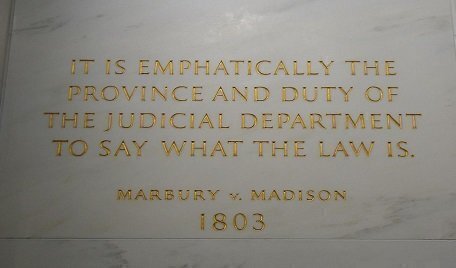
That familiar line does not mean judges can set aside laws on personal preference. It describes a legal responsibility exercised while deciding cases: interpret the relevant provisions, determine whether they conflict, and apply the higher law if they do. The Constitution does not expressly say that federal courts may declare government actions unconstitutional; Marbury established judicial review through this account of constitutional supremacy and judicial duty.
There is a subtle point about the jurisdictional setting. The Court did not need authority to grant Marbury’s requested order in order to determine whether it had that authority. It had to assess the asserted statutory basis for hearing his suit. Having found that basis inconsistent with Article III, it could not grant the requested writ. In an ordinary case that is within its jurisdiction, the Court can likewise examine a constitutional challenge to the law or action it is asked to apply.
What the power reaches—and what a ruling decides
Marbury involved a federal statute. Judicial review is not confined to acts of Congress. The Supreme Court has also examined state statutes and federal and state executive actions for consistency with the federal Constitution. The next short passage identifies that broader reach without requiring you to trace the later cases listed in its footnotes.
Marbury v. Madison and Judicial Review | Constitution Annotated | Congress.gov | Library of Congress
Return to the same Constitution Annotated essay for its concise description of the kinds of government action subject to judicial review after Marbury.
After the paragraph ending with laws made “in pursuance” of the Constitution, read the scope passage. Stop before the paragraph beginning “As Marbury’s doctrine of judicial review became settled law.” Notice both the expansion beyond federal statutes and the point that state courts can hear federal constitutional claims, sometimes subject to Supreme Court review.
Consider a hypothetical case to make the distinction concrete. Suppose a federal statute directs officials to deny a permit solely because an applicant published criticism of the government. The applicant is denied a permit, brings a constitutional challenge, and the case eventually comes before the Supreme Court through a proper appellate route. The Court would need to interpret the statute and the relevant constitutional protection. If it concluded that applying the statute in that way violated the Constitution, judicial review would permit it to hold the conflicting government action unconstitutional rather than enforce the statute as written.
Several features of that example do important work. A person affected by the denial has brought a case; the Court has an authorized route to hear it; and the constitutional question matters to resolving it. Without those conditions, the existence of a possible constitutional objection alone does not give the Supreme Court a free-standing power to issue a ruling.
Finally, holding an action unconstitutional is not the same as specifying every practical consequence of the decision. A judgment determines what happens in the case before the Court. Its reasoning may also guide later courts and government officials. Exactly what relief the parties receive, and what happens next in lower courts, depends on the ruling’s disposition and remedy. Those effects will receive closer attention later in the course.
The central distinction
Judicial review allows the Supreme Court, in a case it has authority to decide, to test a law or government action against the Constitution. Marbury v. Madison established the principle through a conflict between a statute purporting to enlarge the Court’s original jurisdiction and Article III’s limits. Because the Constitution is superior law, the Court would not give effect to the conflicting statutory provision—and Marbury did not obtain his requested writ.
The Court’s ability to decide a constitutional issue does not mean it must take every appeal that presents one. The next lesson examines how the Court chooses among petitions for review.