Welcome back. The previous lesson separated jurisdiction—the authority to hear a case—from judicial review—the power to decide a constitutional issue in a case properly before the Court. There is another step between those ideas and a Supreme Court ruling: even when the Court can review an appeal, it usually gets to choose whether it will.
This lesson is about making that selection judgment. You will use the Court’s own criteria to assess whether a hypothetical petition presents a compelling reason for review, rather than simply a disappointed party’s reason for wanting another appeal. Allow about 35–40 minutes, including the short video and readings.
A request for review, not another round of trial
A party seeking ordinary Supreme Court appellate review generally files a petition for a writ of certiorari, often called a cert petition. The petition identifies a legal question and explains why the Court should take the case. Granting certiorari means agreeing to review it; it does not mean agreeing with the petitioner or predicting who will win.
This short video introduces the petition and the rule of four: ordinarily, four justices must vote to grant review. Its example of a disagreement among appeals courts will become useful when we read the Court’s formal criteria.
How a case gets to the US Supreme Court
Watch “How a Case Gets to the US Supreme Court” from Vox for a quick account of the cert petition and the rule of four, followed by an example of conflicting appellate decisions.
Watch petitions and votes for the request for review and the four-vote threshold. Then skip to an appellate split. Focus on why inconsistent answers to a federal legal question might call for a single Supreme Court answer, rather than on the later outcome of the example case.
The rule of four describes the voting threshold, not a formula for selecting cases. For that, the starting point is Rule 10 of the Supreme Court’s Rules. It says review on certiorari is “not a matter of right, but of judicial discretion,” and that a petition will be granted only for “compelling reasons.” Its examples indicate what those reasons look like, while expressly leaving the Court room to exercise judgment.
RULES Supreme Court of the United States
Read Rule 10 in the Supreme Court’s own rules. It is the primary guide for assessing the strength of a cert petition.
Under Part III, find Rule 10, “Considerations Governing Review on Certiorari” (beginning on printed p. 5; the lettered clauses continue on p. 6). Read the full rule, stopping immediately before Rule 11. Track the kinds of decisions described in clauses (a), (b), and (c), and pay particular attention to the final sentence about factual findings and misapplied rules.
The final sentence is an important correction to a common expectation. A party might sincerely believe that a lower court got the case wrong. Yet the Supreme Court is generally not another court for routine error correction. Rule 10 says review is rarely granted when the asserted mistake is an erroneous factual finding or the misapplication of a correctly stated legal rule.
Why a conflict between courts matters
One prominent Rule 10 reason is a conflict over the same important federal legal question. Federal courts of appeals serve different circuits. The map shows those regional jurisdictions; the D.C. Circuit and the subject-matter-based Federal Circuit are identified separately.
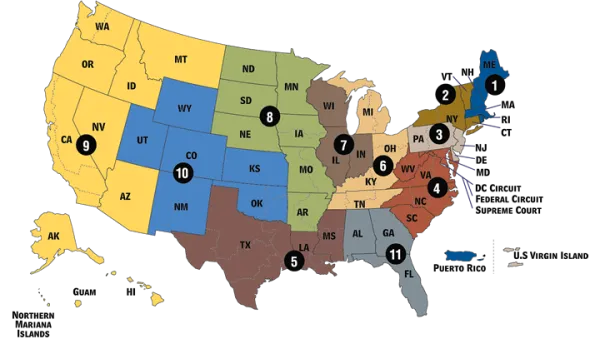
Suppose a federal statute requires a company to obtain “express consent” before sharing customer location data. In materially similar cases, one federal court of appeals holds that a particular click-to-consent process satisfies the statute, while another holds that it does not. A company subject to the second ruling petitions for review. Assuming the federal question was properly raised and is decisive in its case, this is a strong candidate: two appeals courts have given incompatible answers about the same federal requirement, so the rule differs across their jurisdictions.
That is different from two courts reaching different results because one company used a conspicuous consent notice and the other concealed its notice. Different facts might explain those outcomes without any disagreement about the legal rule. A genuine split requires more than a pair of contrary results; the petition must show conflicting answers to substantially the same legal question.
Rule 10 also recognizes conflicts involving a state court of last resort, such as a state supreme court, when it has decided an important federal question differently from another state court of last resort or a federal appeals court. The distinction between federal and state questions matters here. The Supreme Court’s role in this setting is not to make every state’s own law identical.
A conflict is not the only compelling reason. Rule 10 includes an important question of federal law that the Supreme Court has not yet settled but should settle, and a lower-court decision that conflicts with relevant Supreme Court decisions. It also mentions an exceptional departure from usual judicial proceedings that calls for the Court’s supervisory power. These are reasons to consider review, not promises that the Court will grant it.
Importance, timing, and the case used to present the issue
“National importance” needs a legal explanation. Widespread consequences may make an unsettled federal question worth resolving even without a split. By contrast, intense news coverage or the petitioner’s substantial personal stakes do not, on their own, show why the Supreme Court rather than a lower court should decide the issue.
Timing can matter too. The justices may prefer to let more lower courts consider a new question before choosing a case. The following short passage describes why a justice could decline review without endorsing the lower court’s ruling.
How Cases Get to the Supreme Court | Brennan Center for Justice
Read the Brennan Center for Justice’s account of the judgment involved in choosing cases. It adds a useful caution to Rule 10’s examples: a potentially important issue is not necessarily ready for review now.
In the section “Numerous factors go into whether the Court takes a case, but cert decisions rarely come with an explanation,” read the two paragraphs beneath that heading. Stop before the next section, on fast-tracked cases. Notice the distinction between thinking a decision was wrong and thinking this is the right case and time to review it.
A petition also needs to present a legal question the Court can actually resolve. Rule 14 requires the petitioner to state its questions presented concisely. The wording matters: it identifies the issue offered for review, rather than inviting the Court to reconsider every aspect of the dispute.
RULES Supreme Court of the United States
Return to the Supreme Court’s rules for the opening of Rule 14. This brief passage shows how a petitioner must define the issue it wants the Court to take.
Find Rule 14, “Content of a Petition for a Writ of Certiorari,” on printed p. 11. Read the opening and paragraph 1(a). Stop before paragraph 1(b), which begins the list of parties. Focus on the requirement for a concise, nonargumentative question presented.
For selection purposes, a usable case is one in which the proposed federal question was properly raised below and its answer matters to the judgment. If the outcome rests on an independent ground that the proposed answer would not affect, the petition is a poor vehicle for settling that question. Likewise, a claimed split becomes less persuasive if resolving it would first require the justices to redo disputed fact-finding. These concerns are distinct from the importance of the legal issue itself.
Comparing two petitions
Consider the consent-statute dispute again. The petitioner can identify the same statutory provision, two conflicting appellate answers under materially similar facts, and a judgment that depends on which answer is correct. That combination gives the Court a clear reason to intervene: settling a consequential federal rule that is currently applied inconsistently. It is a strong candidate, though a grant remains discretionary and requires the votes.
Now consider a different petition. The court of appeals states the governing federal rule correctly but, according to the petitioner, believed the wrong witness about whether consent was given. No other appellate court disagrees about the rule. The petitioner’s loss may be serious, and the factual finding may even be mistaken. Nevertheless, the petition is a weak candidate under Rule 10: it chiefly asks the Supreme Court to revisit the facts of one dispute.
Between those examples lies a harder case: one appeals court decides a novel federal question with broad consequences, but no other appellate court has addressed it. The lack of a split weakens the case for immediate review, yet does not rule it out. Rule 10 expressly allows review of an important federal-law question that should be settled by the Court. An assessment should state both the reason for review and the uncertainty about taking this case now.
This is why a cert denial must be read carefully. Denial leaves the lower court’s judgment in place, but it does not announce that the Supreme Court approves that judgment or has decided the legal question on its merits.
The selection judgment
A strong cert petition gives the justices a reason to spend a scarce place on their docket resolving a significant federal legal issue. The clearest examples include a genuine conflict among appellate courts or other courts identified in Rule 10, an important unsettled question that needs a nationwide answer, or a decision in tension with Supreme Court precedent. A cleanly presented question strengthens that case. A fact-bound complaint that the lower court got one dispute wrong generally does not.
The next lesson follows the selected case beyond the petition: how the parties’ briefs and amicus briefs frame the legal question for the Court.