Hello! Welcome back to our module on Core Reading Comprehension Skills.
In our last lesson, you learned how to skim a text to quickly grasp its main ideas and overall structure. This is your first step when you encounter a new passage in the IELTS Reading test. Today, we'll learn the essential skill that comes next: scanning.
This lesson will teach you how to scan texts to locate specific information quickly. While skimming gives you a map of the text, scanning is how you pinpoint the exact location of an answer. Mastering this skill is crucial for managing your time and answering questions accurately under exam pressure.
Let's begin by clearly separating these two important skills.
1. Skimming vs. Scanning: A Quick Recap
In the previous lesson, you learned that skimming is like looking at a map of a city to understand the layout of the main streets and neighborhoods. Scanning, on the other hand, is like using that map to find a specific address or landmark.

To deepen your understanding of scanning, let's read a clear definition and explanation.
Skimming Scanning IELTS Reading – Speed and Strategy Guide
This article from Learn English Weekly clearly defines scanning and explains its role in the IELTS test.
Please read the two sections under the headings 'What Skimming and Scanning Really Mean' and 'When to Use Scanning in IELTS Reading'. Focus on the definition of scanning and the types of information you hunt for.
As the article states, scanning is searching for a specific piece of information. You ignore most of the text and move your eyes quickly, looking for a target. The key takeaway is: Scanning is locating, not answering. You scan to find where the answer is, and then you read that small section carefully to get the answer.
2. The Scanning Process: A Step-by-Step Guide
Effective scanning is a systematic process, not random searching. By following these steps, you can locate information with speed and precision.
Step 1: Identify Your Target (Keywords)
Before you even look at the passage, you must know exactly what you are looking for. Read the question carefully and identify the keywords.
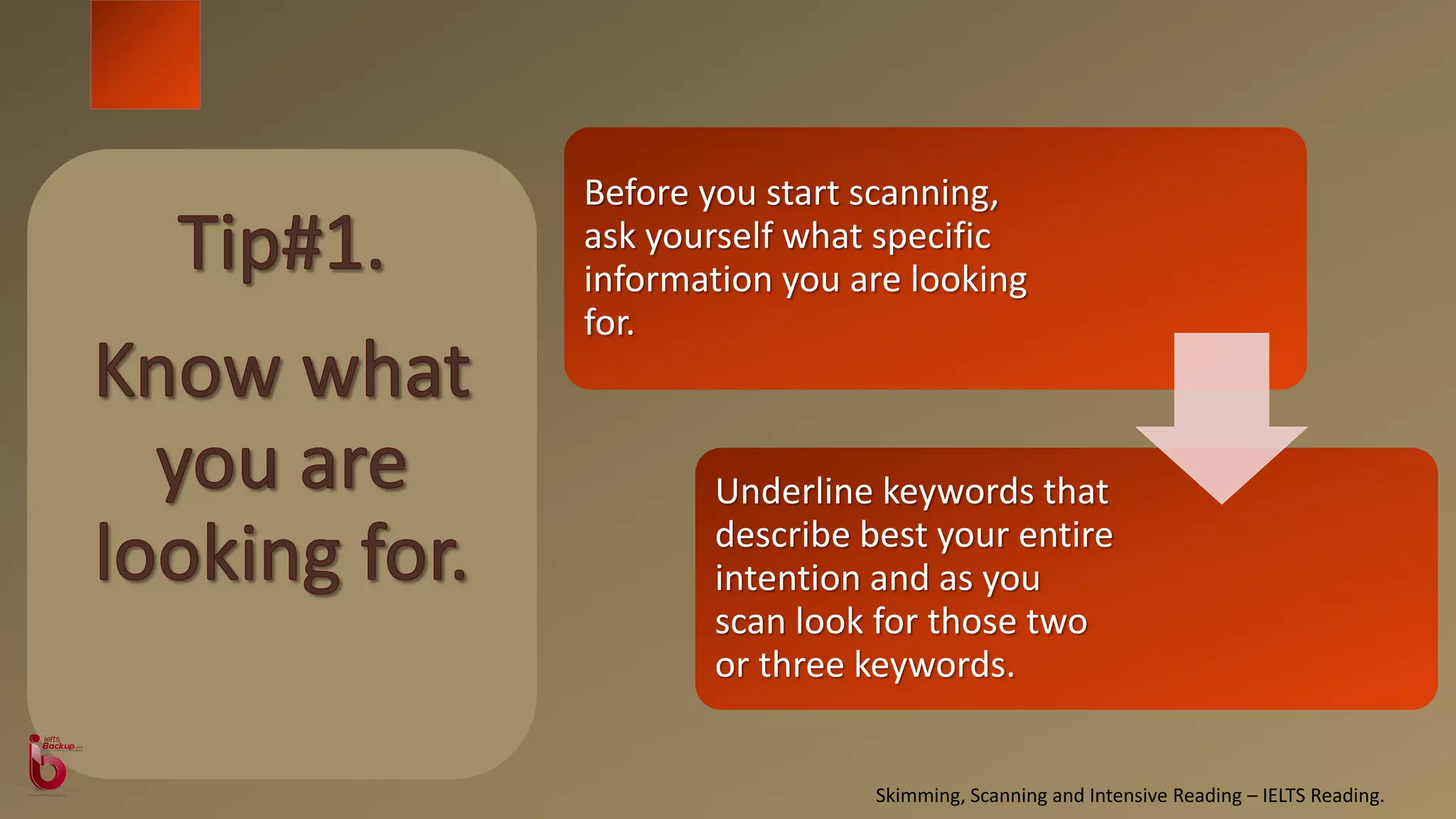
Keywords are often:
- "Unchangeable" words: These are the easiest to find because they are not usually paraphrased. Look for names (e.g., Dr. Lei Feng), places (e.g., Singapore), dates (e.g., 1998), and specific terms (e.g., circadian rhythms).
- Key nouns or verbs: Words that carry the main meaning of the question (e.g., "defend the brain," "reduce the risk").
Step 2: Scan the Text for Keywords
Now, move your eyes quickly over the text. Don't read every word. You are just looking for your target keywords. You can move your eyes in a pattern, such as down the middle of the page or in a zig-zag motion.
Remember, IELTS test-makers often use synonyms and paraphrasing. So, if the question says "reduce the risk," the text might say "cut down on the danger." You need to be looking for the idea, not just the exact word.
Step 3: Stop and Read Carefully
When you spot a keyword or a synonym, stop scanning. Read the sentence it is in, and perhaps the sentences before and after it, to understand the context and confirm you have found the right information to answer the question.
Let's see this process demonstrated in an IELTS context.
3. Scanning in Action: IELTS Question Types
Scanning is not just a general skill; it's the primary tool for many IELTS question types. The following video shows how an expert tutor uses scanning to find answers.
IELTS Reading 2026 EXPLAINED (What’s Changing)
This video from Fastrack IELTS demonstrates how to use scanning for several common IELTS question types. Notice how the tutor first highlights keywords in the question and then quickly finds them in the passage.
Please watch the following clips: True/False/Not Given: Watch from 05:24 to 08:35 to see how keywords like 'inability to fly' and 'chicks every year' are used to scan and find answers. Sentence Completion: Watch from 16:40 to 18:50. See how keywords like 'diet' and 'nests' help locate the exact words needed to fill the gaps. Matching Features: Watch from 26:52 to 28:15. This is a great tip: the tutor suggests highlighting all the names (the features) in the passage before reading the statements. This makes scanning for them incredibly fast.
As you can see, scanning is the foundation of an efficient reading strategy. You read the question, identify your target, scan to locate it, and then read in detail to confirm your answer.
4. Let's Practice!
Now it's your turn to practice. We'll use a short text and some questions designed to test your scanning ability.
IELTS Reading Skills – How To Improve Your Score
This resource from IELTS Jacky provides a short article about mushrooms and four questions. Your task is to use scanning to answer them as quickly as possible.
First, find and read the short text titled 'Mushrooms protect the brain from memory problems'. Then, read the four questions below it. For each question, identify the keyword(s) and scan the text to find the answer. Try to do this quickly! Once you have your answers, check them against the 'Answers & Tips' section that follows.
How did you do? Notice how "unchangeable" keywords like the name Lei Feng and the word university are very easy to spot. For other questions, you had to look for synonyms, like recollection being paraphrased as memory. This is excellent practice for the real exam.
Conclusion
Well done! Today you've learned the vital reading skill of scanning. Combined with skimming from our last lesson, you now have a powerful two-step method to tackle any IELTS Reading passage: first skim for the general idea, then scan for specific answers.
Key Takeaways:
- Scanning is a targeted search for specific information like names, dates, numbers, or keywords.
- The process is: 1) Identify keywords in the question, 2) Scan the text for those words or their synonyms, and 3) Stop and read the surrounding sentences carefully to find the answer.
- Look for "unchangeable" keywords first, as they are the easiest to spot.
- Scanning is essential for almost all IELTS Reading question types and is the key to managing your time effectively.
In our next lesson, we will move beyond just finding information. We will learn how to identify a writer's purpose, opinion, and attitude. This will help you answer more complex questions that require you to understand not just what the text says, but what the author means.