Hello! Welcome to your next lesson in the "Academic Writing Foundations" module.
In our last lesson, we focused on using nominalization to make your writing style more formal and objective. We saw how changing a verb like "analyze" into a noun like "analysis" shifts the focus from the person doing the action to the concept itself. Today, we will learn another essential technique for achieving an objective and academic tone.
This lesson is about hedging. Your learning outcome is to apply cautious language (hedging) to present claims objectively. In academic writing, and especially in the IELTS exam, you are expected to make arguments and present opinions. However, strong, absolute statements like "Fast food causes obesity" can sound simplistic and are often easy to disprove. Hedging allows you to make your claims more accurate, reasonable, and credible—a key skill for achieving a Band 7 or higher.
1. What is Hedging and Why is it Important?
Hedging is the use of cautious or tentative language to soften claims and avoid making absolute statements. It shows that you are a careful and critical thinker who understands that most issues are not simply black and white.
Let's begin with a clear definition from an official IELTS source to understand the basic concept.
Hedging Language in IELTS Writing Task 2
This article from IDP, one of the co-owners of the IELTS test, explains what hedging is and why it's so important for your essays.
Read the first section, '1. What Is Hedging Language?'. Notice the difference between the 'Absolute statement' and the 'Hedged version'.
Now, let's watch a short video that brings this concept to life and explains exactly why it is so critical for your IELTS score.
Hedging in IELTS Writing and Speaking
This video from English Pro Tips explains hedging in a very clear way, showing how to soften statements that are too strong.
Watch the beginning of the video from 00:00 to 03:00. Pay close attention to the reasons why hedging is important for getting a higher IELTS score and for academic writing in general.
As the video and article explain, using hedging language is not about being weak or uncertain. It is about being precise and academic. Examiners reward this because it is a feature of high-level writing and demonstrates that you can present a balanced viewpoint.
2. The Main Tools for Hedging
There are several types of words and phrases you can use to hedge your statements. We will focus on the five most common and useful categories for your IELTS writing.
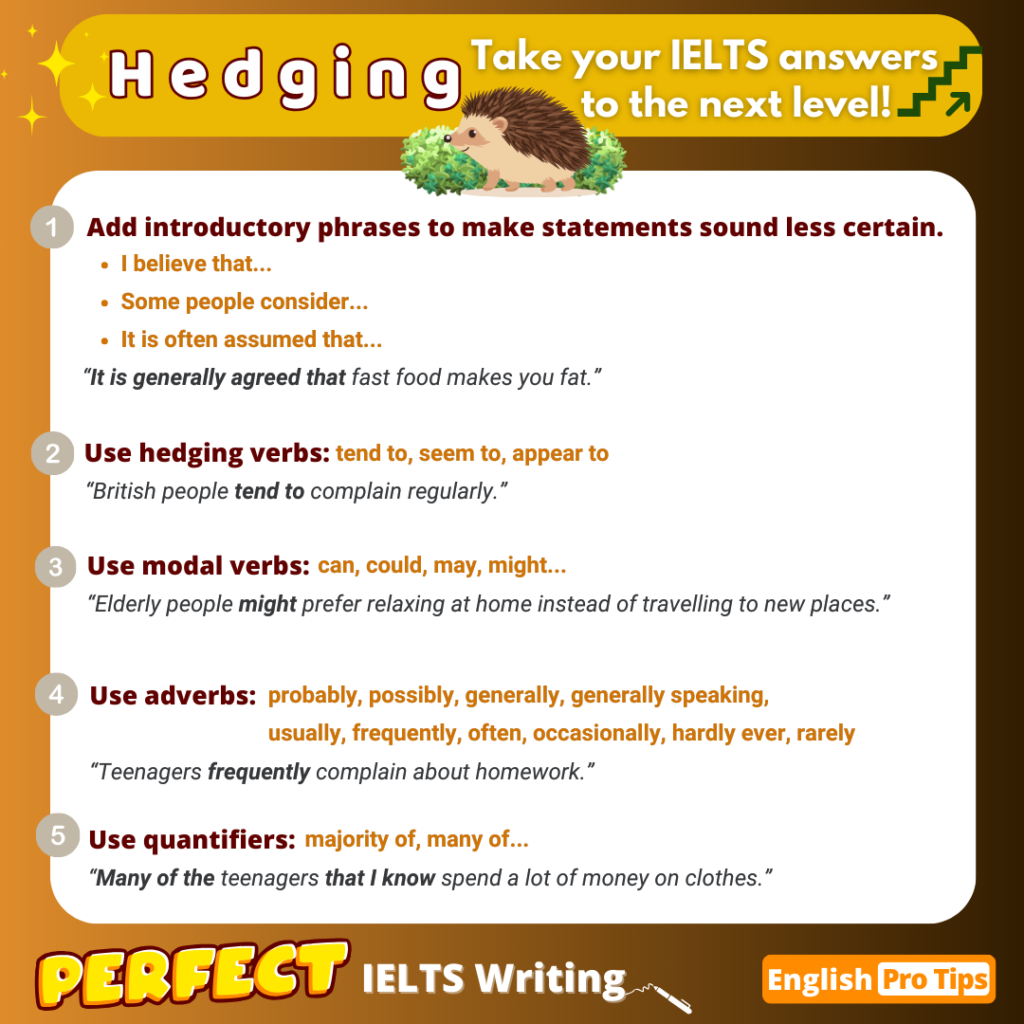
Let's look at each of these techniques. The IDP article you looked at earlier provides an excellent summary of these categories.
Hedging Language in IELTS Writing Task 2
The IDP article provides an excellent summary of these different types of hedging language. Please read this section to see clear 'Absolute' vs. 'Hedged' examples for each category.
Read section '2. Common Hedging Language in English'. As you read, think about which of these phrases you could use in an essay about a topic like public health or education.
To see and hear how these are used, let's return to the "English Pro Tips" video. It provides clear examples for each of the five techniques.
Hedging in IELTS Writing and Speaking
The video we watched earlier demonstrates these techniques very well. Let's watch the relevant parts for each method.
Watch the video from 04:25 to 12:18. The presenter will cover: Modal Verbs (like may, might, could) Introductory Phrases (like It is often assumed that...) Adverbs (like often, generally) Hedging Verbs (like tend to, seem to) Quantifiers (like many, most) As you watch, consider pausing after each section and writing one sentence of your own using the technique shown.
To summarize, instead of making an absolute statement like "X will cause Y," you can write:
- X may/might/could cause Y. (Modal verb)
- X tends to cause Y. (Hedging verb)
- X often/sometimes causes Y. (Adverb)
- Many studies show that X causes Y. (Quantifier)
- It is often argued that X causes Y. (Introductory phrase)
Notice how these hedged versions sound much more reasonable and difficult to disagree with.
3. Practice and Application
Now it's time to put your knowledge to the test.
First, let's try the quiz from the video you just watched. This will help you check your understanding of the different hedging words.
Hedging in IELTS Writing and Speaking
Let's see how well you've grasped these concepts. The next part of the video is a short quiz. Try to answer the questions before the presenter gives the solution.
Watch from 12:00 to 16:15. Keep a score of how many you get right out of 10!
Great work! Now, let's try rewriting some sentences yourself. Transform these absolute statements into more cautious, academic sentences using a hedging technique. I've used topics related to your field of dentistry and general health.
- Fluoride in water prevents all tooth decay.
- People who floss their teeth daily have no gum disease.
- New technologies make dental procedures completely painless.
Click to see model answers
Here are some possible ways to hedge the sentences. There are many correct answers!
-
Original: Fluoride in water prevents all tooth decay.
- Hedged: Fluoride in water can help to prevent tooth decay. (Modal verb + hedging verb)
- Hedged: It is widely believed that fluoride in water helps to prevent tooth decay. (Introductory phrase)
-
Original: People who floss their teeth daily have no gum disease.
- Hedged: People who floss their teeth daily are less likely to have gum disease. (Adjective phrase)
- Hedged: Flossing daily tends to reduce the risk of gum disease. (Hedging verb)
-
Original: New technologies make dental procedures completely painless.
- Hedged: New technologies can make dental procedures considerably less painful. (Modal verb + adverb phrase)
- Hedged: In some cases, new technologies make dental procedures almost painless. (Introductory phrase + adverb)
Finally, let's see how these techniques look in a full IELTS Task 2 answer.
Hedging Language in IELTS Writing Task 2
This sample essay from the IDP article is a great model of how to integrate hedging language naturally into your writing.
Scroll down to the 'Sample IELTS Essay Using Hedging Language'. Read the question and the sample answer, paying close attention to the bolded hedging phrases. Notice how they make the writer's claims sound more reasonable and academic.
4. An Important Warning: Don't Over-Hedge
While hedging is essential, it's possible to use it too much. This can make your writing or speaking sound vague and lacking in confidence. The goal is to be cautious, not uncertain.
Hedging in IELTS Writing and Speaking
Let's watch the final part of the video for a crucial warning about 'over-hedging'.
Watch from 16:15 to the end. The speaker explains how to hedge without sounding too weak, which is important for both the Writing and Speaking tests.
The key is balance. State your main points clearly, but use hedging when presenting evidence, making predictions, or discussing opinions that are not universal facts.
Conclusion
Excellent work today! You have learned how to use hedging to make your writing more objective, credible, and academic. This is a vital skill for presenting nuanced arguments in IELTS Writing Task 2 and will help you move towards your target of Band 7.
Key Takeaways:
- Hedging is the use of cautious language to avoid making absolute claims.
- It is crucial for academic writing because it shows critical thinking and makes your arguments more persuasive.
- You can hedge using modal verbs (may, could), hedging verbs (tend to, seem to), adverbs (often, possibly), quantifiers (some, many), and introductory phrases (It could be argued that...).
- Balance is essential: Use hedging to be precise and objective, but avoid over-hedging, which can make your arguments sound weak.
In our previous lesson, we covered nominalization. Today, we added hedging. Both are powerful tools for refining your academic style. In our next lesson, "Review your writing to identify and correct grammatical errors," we will focus on ensuring that your sophisticated sentences are also accurate. After all, a well-hedged argument is only effective if it is grammatically correct