Hello! Welcome to your next lesson in the Academic Writing Foundations module.
In our last lesson, we mastered paraphrasing, and you learned how changing a word's form (like from a verb to a noun) is a powerful way to rephrase a sentence. Today, we will dive much deeper into that specific technique.
This lesson focuses on nominalization, which is the process of turning verbs and adjectives into nouns. Your learning outcome for today is to use nominalization to create a more academic sentence style. This is a key feature of the formal, objective writing required to achieve a Band 7 or higher in the IELTS Academic Writing tasks. It allows you to package complex ideas into sophisticated noun phrases, making your writing sound less personal and more analytical.
1. What is Nominalization and Why Is It Important?
Nominalization is a formal way of writing and is not typically used in everyday conversation. It is, however, very common in academic texts, reports, and essays—exactly the style you need for IELTS.
To start, let's get a clear definition and understand the main reasons for using this technique.
What is Nominalisation? How to nominalise a sentence in academic writing.
This video from Academic English UK provides a concise introduction to nominalization and explains its purpose in academic writing.
Watch from 00:23 to 01:06. Focus on the three reasons given for using nominalization: developing complex grammar, achieving abstraction, and its use as a typical feature of academic writing.
As the video explained, nominalization helps make your writing more abstract and complex. Instead of focusing on who is doing an action (e.g., "Scientists analyzed the data"), it focuses on the action or concept itself (e.g., "The analysis of the data...").
Let's look at a clear example of this transformation.
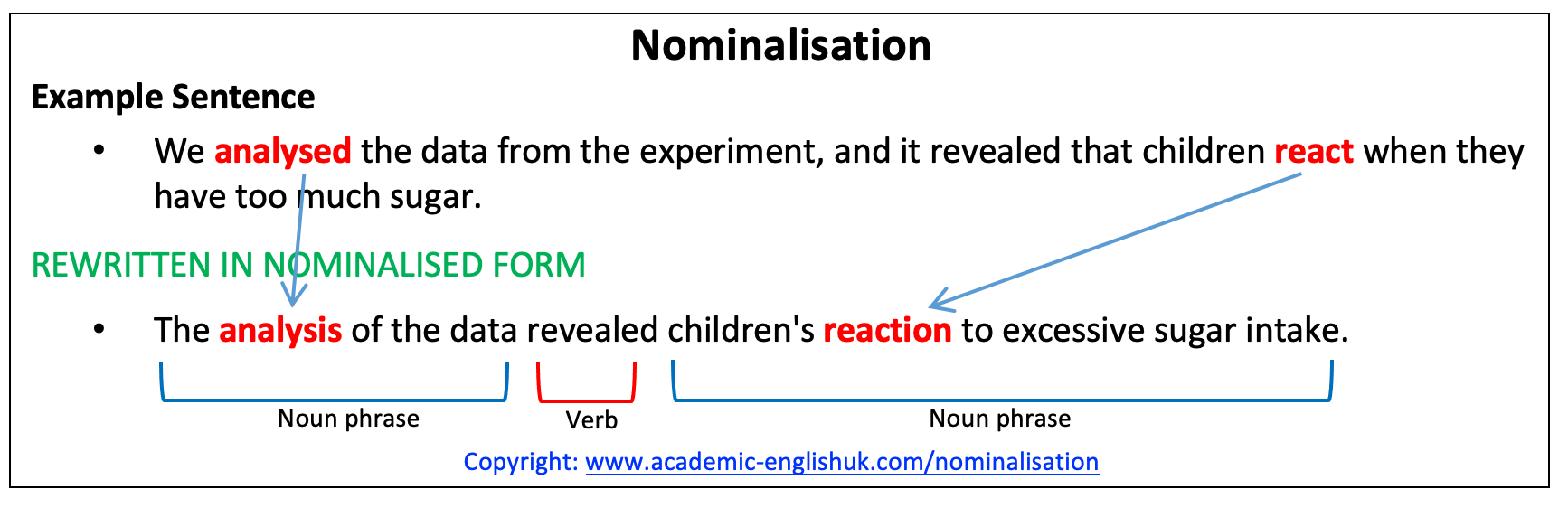
This change does two important things for your IELTS score:
- Improves Formality and Objectivity: It shifts the focus away from people (I, we, they, scientists) and onto the ideas themselves.
- Demonstrates Lexical Resource: It shows the examiner you have a wide vocabulary and can use different forms of the same word correctly.
To explore these benefits specifically for the IELTS exam, please read the following sections from a helpful guide.
Mastering Nominalization for High IELTS Bands: The Ultimate Guide
This article from IELTS Guide Phil explains exactly why mastering nominalization is valuable for achieving a high band score.
Read the sections 'What Is Nominalization?' and 'Why Is Nominalization Important in IELTS?'. Pay attention to how it links to the IELTS assessment criteria like Lexical Resource and Task Achievement.
2. How to Create Nouns (The Mechanics)
To use nominalization, you first need to know how to change verbs and adjectives into their noun forms. There are a few common ways to do this.
Method 1: Adding a Suffix
The most common method is to add a suffix (an ending) to the word.
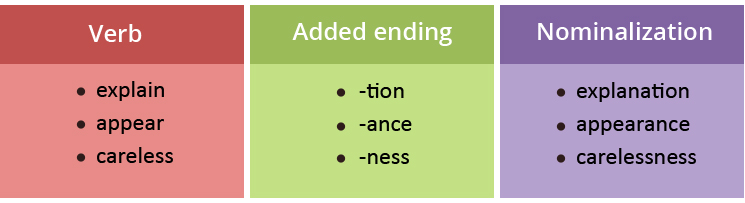
Knowing which suffix to use requires practice and building your vocabulary. A good learner's dictionary will show you the different forms of a word.
Let's practice this. The next video provides a list of common academic verbs and asks you to find their noun forms.
What is Nominalisation? How to nominalise a sentence in academic writing.
Let's return to the Academic English UK video. The presenter will guide you through an exercise to practice forming nouns from common verbs.
Watch from 03:20 to 04:14. When the table of verbs appears, pause the video and try to write down the noun form for each one. You can use a dictionary if you need to. Then, continue the video to check your answers.
How did you do? Don't worry if you didn't know all of them. The goal is to build this knowledge over time. Keep a list of these verb-noun pairs in your vocabulary notebook.
Method 2: Using the '-ing' Form (Gerunds)
A simple and effective way to nominalize an active verb is to add -ing to create a gerund, which acts as a noun.
Make Your English More Advanced With NOMINALISATION (Improve English Speaking Skills)
This video from English with Rupert explains how to use the '-ing' form to create nouns.
Watch from 08:08 to 08:33. Notice how 'run' becomes 'the running of animals'.
For example:
- Original: The government needs to solve environmental problems.
- Nominalized: The solving of environmental problems is a government priority.
Method 3: Converting Adjectives to Nouns
The same principle applies to adjectives.
- Original: The procedure is safe.
- Nominalized: The safety of the procedure is guaranteed.
3. Restructuring Sentences
Simply changing a verb to a noun isn't enough. You must also restructure the sentence to be grammatically correct.
A very common pattern you will see is the [noun] of [noun].
Make Your English More Advanced With NOMINALISATION (Improve English Speaking Skills)
Let's go back to the 'English with Rupert' video to see how this structure works.
Watch from 02:29 to 03:39. The speaker explains how changing a verb to a noun often leads to the the noun of noun structure, as in 'the proof of their idea'.
Let's apply this with a step-by-step process.
- Identify the main verb or adjective you want to change.
- Convert it to its noun form.
- Rewrite the sentence, often using
the [noun] of...orthere is/was a(n) [noun] in...
Here are some examples relevant to the IELTS exam:
IELTS Task 2 (Essay):
- Original: The government should invest more in healthcare.
- Nominalized: Greater government investment in healthcare is necessary.
IELTS Task 1 (Academic - Describing a graph):
- Original: The price of oil fell sharply.
- Nominalized: There was a sharp fall in the price of oil.
4. Practice and Key Pitfalls
Now, let's put it into practice. Rewrite the following sentences using nominalization.
- Companies are polluting the environment, and this is a major concern.
- In your field of dentistry, it is important to communicate clearly with patients.
- The university's library was extended, which cost a lot of money.
Click to see model answers
- Environmental pollution by companies is a major concern.
polluting(verb) →pollution(noun)
- Clear communication with patients is an importance in dentistry.
communicate(verb) →communication(noun)important(adjective) →importance(noun)
- The extension of the university's library was a significant cost.
extended(verb) →extension(noun)cost(verb) →cost(noun)
While powerful, nominalization can be misused. It's important to use it correctly and not too much.
Mastering Nominalization for High IELTS Bands: The Ultimate Guide
Let's read the final sections of the 'Mastering Nominalization' guide to understand common mistakes and best practices.
Read the sections 'Common Mistakes' and 'Dos and Don’ts'. The most important takeaway is balance. Do not try to nominalize every sentence, as this can make your writing very difficult to read.
Crucially, as the article notes, nominalization is a feature of formal writing. You should generally avoid it in the IELTS Speaking test, where a more natural, conversational style is better.
Conclusion
Well done! You've now learned how to use nominalization to make your writing more formal, objective, and academic. This is a high-level skill that, when used correctly, can significantly help you reach your goal of a Band 7.
Key Takeaways:
- Nominalization is the process of changing verbs and adjectives into nouns (e.g.,
analyze→analysis,important→importance). - It makes your writing more formal and objective, which is essential for IELTS Academic Writing.
- You can form nouns by adding suffixes (like
-tion,-ment,-ness) or by using the -ing form of the verb. - When you nominalize, you must restructure the sentence, often using patterns like
the [noun] of [something]orThere was a [noun]. - Balance is key. Use nominalization strategically, but do not overuse it, as it can make your writing unclear.
In our next module, we will begin looking at IELTS Writing Task 1. You will immediately see how useful nominalization is. Describing trends in graphs and charts relies heavily on nouns like "an increase," "a decrease," "a fluctuation," and "a period of stability." Today's lesson has given you a strong foundation for that task.