Hello! Welcome back to your IELTS preparation course.
In our last lesson, we navigated the visual challenge of labeling maps and diagrams. You learned to follow directions and understand the language of location. Today, we shift our focus from spatial relationships to factual details.
This lesson addresses a very common task type in the IELTS Listening test: completing form and note completion tasks accurately. These questions test your ability to listen for specific information—like names, numbers, and key facts—and write it down correctly. Mastering this skill is essential, as these tasks appear frequently, especially in Section 1, and offer a great opportunity to secure points.
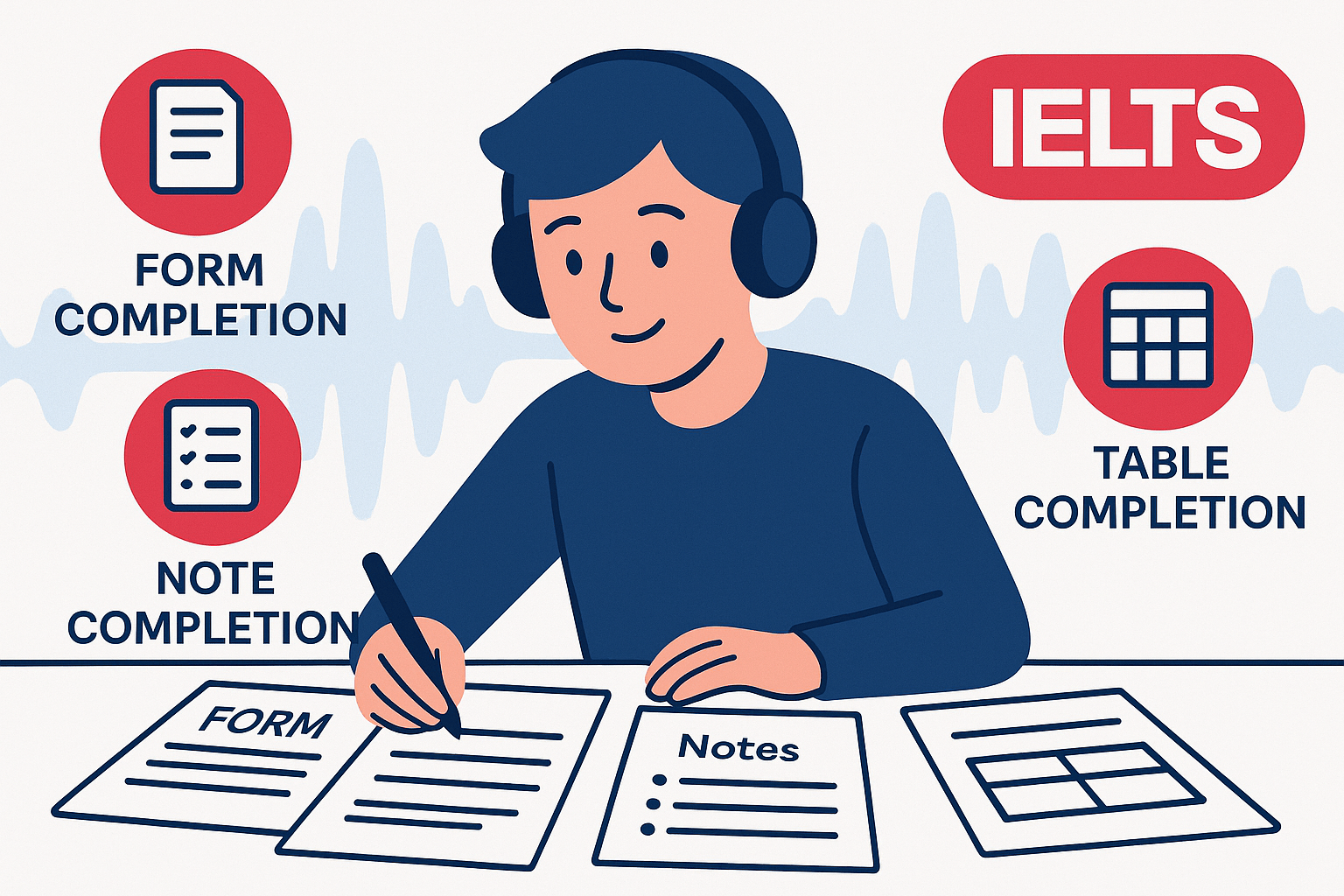
By the end of this 60-minute lesson, you will have a clear strategy to tackle these questions, including how to predict answers, spot keywords, and avoid common traps.
1. Understanding the Task: A Strategic Approach
Form and note completion questions require you to fill in the missing information in a document based on a recording. The document could be an application form, a customer order, or a set of lecture notes.
Let's begin by understanding the fundamentals and a reliable strategy you can use every time.
How to Complete Tables, Forms and Notes in the IELTS Listening Test
This article from IDP, an official IELTS partner, provides a great introduction to these question types.
Please read the first main section, 'What are IELTS Listening form, table and note completion tasks?'. This will give you a clear overview of the different formats this question can take.
To tackle these tasks effectively, it's best to have a consistent method. The following video introduces a simple but powerful four-step strategy.
IELTS Listening Note Completion in 2026 for Band 9 Success
Let's watch the beginning of this video from E2 IELTS to learn a four-step method for note completion, which also applies perfectly to form and table completion.
Watch from the beginning until 01:45. Pay close attention to the four steps Natasha outlines: Check instructions Find clues and keywords Think of possible answers Listen for keywords
Let's break down those steps a bit more.
- Step 1: Check the Instructions: This is crucial. The instructions will tell you the word limit (e.g., "NO MORE THAN TWO WORDS AND/OR A NUMBER"). Exceeding this limit will result in a wrong answer, even if your information is correct.
- Step 2: Predict the Answer: Before the audio starts, look at the gaps. Try to predict what kind of information is missing. Is it a name? A phone number? A date? A noun? An adjective? This primes your brain to listen for the right thing.
- Step 3 & 4: Listen for Keywords (and Distractors): The words around the gaps are your keywords. The speaker will use these words, or synonyms, to guide you to the answer. However, be careful of distractors. As we saw in the last lesson, a speaker might mention one piece of information and then correct it. Always listen until the idea is complete before finalizing your answer.
2. Practice with Form Completion
Form completion tasks are very common in Section 1, which is usually a conversation in an everyday social context (e.g., booking a service, joining a club). These often involve spelling out names and giving numbers. As an Arabic speaker, pay close attention to the pronunciation of letters, especially those that can sound similar.
First, a quick warm-up focused on numbers and spelling.
IELTS Listening Form Completion with Alex
This video from E2 IELTS includes a short, focused exercise on listening for spelled names and numbers.
Watch from 02:33 to 04:13. Grab a pen and paper and write down the answers as you listen. Check your answers at the end of the clip.
Now, let's apply the full strategy to a practice form completion task.
IELTS Listening Form Completion with Alex
You'll now listen to a full Section 1 practice task about hiring a meeting room. Use the preparation time to read the form and predict the answers.
Watch the video from 04:13 to 09:49. The video will give you time to read the questions before the audio starts. Use this time to predict the information for each gap. Listen carefully to the conversation and write down your answers. Notice the pause in the middle of the audio—use this time to read the next set of questions. At the end, the video will show the answers. Check how you did.
How did that go? Did you notice any distractors? For example, the caller first mentions July, but then corrects himself to June. This is a classic example of a distractor.
3. Strategy for Note Completion
Note completion tasks can appear in any section but are very common in Section 4, which is typically a monologue or lecture on an academic subject. The notes summarize the main points and structure of the talk.
Here, the layout of the notes (using headings, subheadings, and bullet points) is a powerful clue to help you follow the speaker.

Let's see the four-step strategy applied to a note completion task. You've already seen the beginning of this video; now we'll watch the rest to see how the strategy works in practice.
IELTS Listening Note Completion in 2026 for Band 9 Success
Let's return to the E2 IELTS video on note completion. This time, we'll watch the detailed explanation of how to find the answers in the audio.
Watch from 07:13 to 14:59. Your goal here is not to do the test, but to follow the tutor's explanation. Notice how she uses keywords from the notes to locate the answers in the audio and how she identifies and dismisses distractors (like choosing 'service' instead of 'detail' for question 4).
This exercise shows that even when the information is more complex, the same fundamental strategy of using keywords and understanding the structure will lead you to the correct answers.
Conclusion
Well done! You have now developed a solid strategy for another key IELTS Listening question type. Unlike map labeling, completion tasks are about capturing precise words and numbers, and you now have the tools to do that accurately.
Key Takeaways:
- The Strategy is Key: Always use your preparation time to read instructions, understand the context, and predict the type of information needed.
- Listen for Keywords and Synonyms: The questions provide a roadmap. Follow the keywords, but be prepared for the speaker to use different words with the same meaning.
- Beware of Distractors: Speakers often correct themselves or mention information that seems right but isn't the final answer. Listen for words like "but," "however," or "oh, sorry."
- Spelling and Numbers Matter: These details are often tested directly. Practice listening for them, and always double-check your spelling and word limits.
This lesson concludes our module on specific IELTS Listening strategies. You have covered multiple choice, matching, map labeling, and now completion tasks.
In our next lesson, we will begin a new module and focus on the IELTS Reading test. We'll start with the essential skill of skimming, a technique for quickly grasping the main idea and overall structure of a text.