Hello! Welcome to the final lesson of your IELTS preparation course.
Throughout this journey, we have covered all four sections of the IELTS exam, from foundational skills to specific test-taking strategies. Most recently, in our "Timed Practice and Review" module, you learned how to complete full practice tests and, crucially, how to analyze your performance and create an error log to learn from your mistakes.
Now, we come to the final, essential piece of the puzzle. Your success on test day depends not only on your English skills but also on your state of mind. Therefore, today's lesson focuses on a critical aspect of high-stakes performance. Your learning outcome is to apply strategies to manage test anxiety and maintain focus during the exam.
This lesson will equip you with a toolkit to understand, prepare for, and handle the pressure of the IELTS test, ensuring that anxiety doesn't prevent you from achieving your target Band 7 score.
1. Understanding Test Anxiety: What It Is and How It Affects You
Before we can manage anxiety, we need to understand it. Test anxiety is more than just feeling a little nervous; it's an intense stress response that can have real physical and psychological effects, directly impacting your ability to concentrate.
For the IELTS, this can be particularly damaging. A lack of focus can cause you to miss key information in the Listening test, misread questions in the Reading section, or struggle to organize your thoughts in the Writing and Speaking tests.
How to Conquer IELTS Test Anxiety
Let's begin with a clear overview of test anxiety from an official IELTS source. This article explains what it is and how it can affect your focus.
Please read the introduction and the section titled 'Understanding test anxiety and its impact on focus'. As you read, think about whether you have experienced any of the physical or psychological symptoms described.
Now that you have a general understanding, let's explore the science behind this response. A psychologist can provide valuable insight into what is happening in your brain and body when you feel stressed. As a dental student, you may find this physiological explanation particularly interesting.
Get help with IELTS exam stress from a professional psychologist!
In this video from My IELTS Classroom, a professional psychologist explains the stress response in an exam context. Her explanation of how anxiety affects our senses is incredibly relevant for the IELTS.
Please watch the video from the beginning until 09:58. Pay close attention to the discussion on how stress can: Create a cycle of negative thoughts about the past and future. Cause physical changes in your body. Narrow your vision and hearing, making it harder to focus and perceive information—a key challenge in the Listening and Reading tests.
Understanding that these effects are a natural, physiological response—not a personal weakness—is the first step toward managing them.
2. Before the Test: Building a Foundation of Calm
The best way to manage anxiety on test day is to prepare for it in the days and weeks leading up to the exam. This involves a combination of practical, physical, and mental preparation. Cramming and stressing at the last minute are counterproductive.
The following video tells the stories of four students who made small but powerful changes in the 24 hours before their test. We will go through their stories to learn from their mistakes and successes.
IELTS Tips You MUST Know Before Your Test
This video from IELTS Advantage, 'IELTS Tips You MUST Know Before Your Test', provides a memorable framework for pre-test preparation. Let's start with Sarah's story, which focuses on mental preparation.
Watch from the beginning until 04:56. Notice Sarah's initial mistakes (cramming, isolation, negative self-talk) and the five simple strategies she used to overcome anxiety in her second attempt. The video also introduces a useful 'Why?' technique to find the root cause of your stress.
As you can see, your mindset is critical. But practical and physical readiness are just as important. Let's continue with the other stories from the same video.
IELTS Tips You MUST Know Before Your Test
Now, let's look at the practical, physical, and language-related aspects of preparation.
Please watch the rest of the video, focusing on the stories of Ahmed, Mae, and Carla: Ahmed's Story (04:56 - 07:23): Focus on the simple logistical steps he took to remove practical stressors on test day. Mae's Story (07:13 - 09:51): Pay attention to the link between physical well-being (sleep, nutrition) and mental performance. Carla's Story (09:42 - 12:05): Understand the importance of a 'language warm-up' to ensure your brain is operating in English mode.
This infographic provides a great visual summary of the key lifestyle habits that support mental focus.
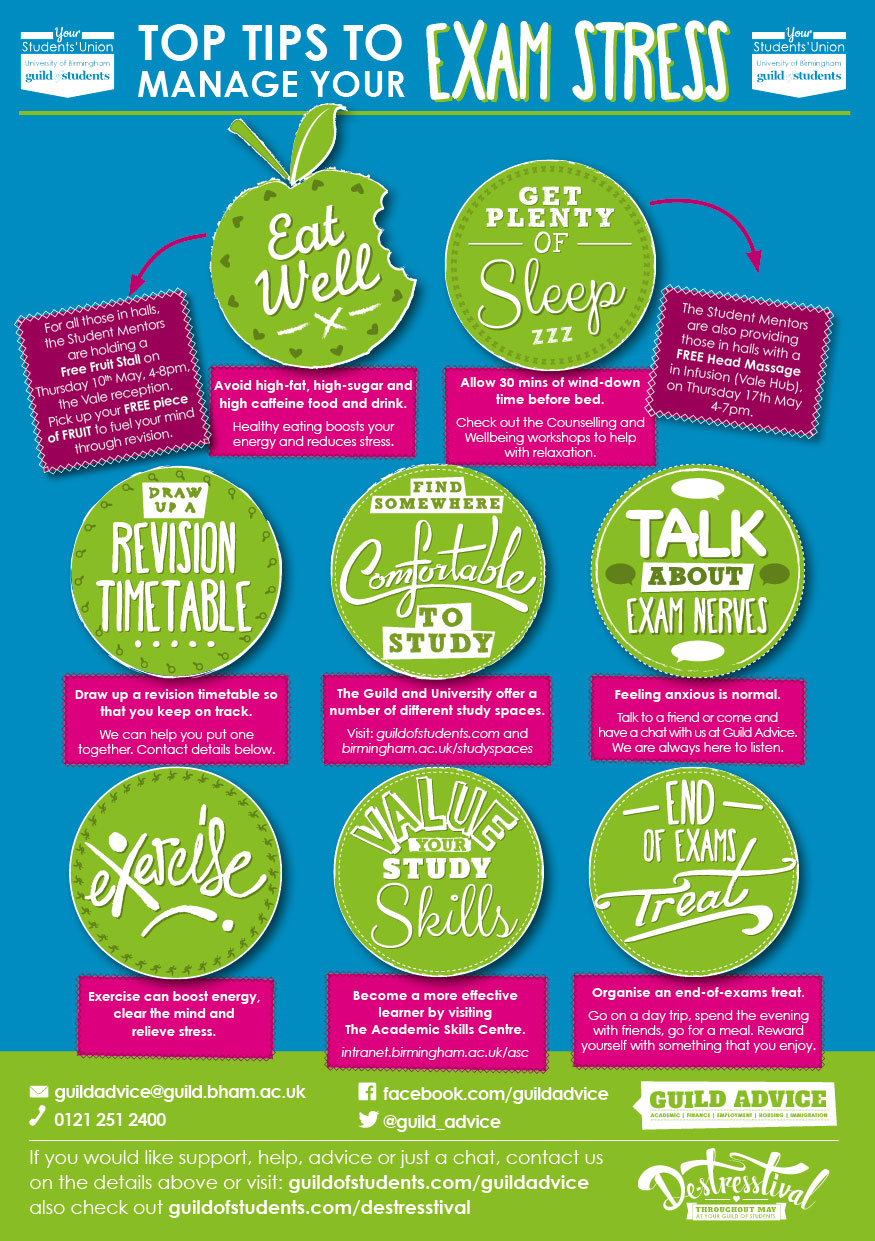
By combining solid test preparation with these mental, physical, and practical strategies, you build a strong defense against test-day anxiety.
3. During the Test: In-the-Moment Techniques
Even with the best preparation, you might feel moments of panic or lose focus during the exam. For these situations, you need simple, discreet techniques you can use right at your desk. We will explore two types: somatic (body-based) and cognitive (thought-based) strategies.
Somatic Techniques: Calming Your Body to Calm Your Mind
As the psychologist explained earlier, anxiety is a physical response. Therefore, using your body to send calming signals to your brain can be incredibly effective.
Get help with IELTS exam stress from a professional psychologist!
Let's return to the psychologist from My IELTS Classroom. Here, she demonstrates several simple, body-based exercises to quickly reduce stress.
Watch from 09:58 to 21:59. As you watch, try the techniques she describes: The 'Thin Balloon' Breath: A slow, controlled exhale. The Self-Hug: A discreet way to provide physical comfort and security. Hand on Heart/Navel: A grounding technique to feel centered. Think about how you could use these discreetly in the exam room if you started to feel overwhelmed.
These simple physical actions can interrupt the body's stress response, giving you the space to regain your focus.
Cognitive Techniques: Taking Control of Your Inner Dialogue
Anxiety is often fueled by a stream of negative thoughts, or "negative self-talk." Learning to interrupt and reframe these thoughts is a powerful skill.
Get help with IELTS exam stress from a professional psychologist!
The psychologist now discusses how to manage the internal conversation that creates so much stress. This is where you can actively challenge the anxiety.
This is a longer section, so please watch from 21:59 to 47:33. Focus on these key strategies: Interrupting Negative Self-Talk: The simple but effective technique of telling yourself to "Stop!". Reframing Failure: Understanding that a failed attempt is a learning step, not a final judgment of your worth. Dealing with External Expectations: Separating your own goals from the pressure you might feel from family and friends. The Two-Column Exercise (44:20): Writing down your negative thoughts and actively creating a positive, truthful reframe for each one. This is a powerful exercise to practice.
Quick Activity (5 minutes):
Take a piece of paper and try the two-column exercise.
- In the left column, write down 1-2 anxious thoughts you have about the IELTS test (e.g., "I will run out of time," "I will fail my family's expectations").
- In the right column, write a positive, realistic reframe for each thought (e.g., "I have practiced my timing and have strategies to manage it," "My family supports me, and my worth isn't defined by one test score").
This practice of actively challenging negative thoughts builds mental resilience, a skill that will serve you well beyond the IELTS exam.
Conclusion
Congratulations on completing this course! You have dedicated yourself to learning the skills and strategies needed for every part of the IELTS test. This final lesson has given you the tools to manage your mindset, ensuring you can perform at your best when it matters most.
Key Takeaways:
- Test anxiety is a natural physiological response that can be managed with the right strategies.
- Before the test, focus on holistic preparation: ensure you are practically ready, physically rested, and mentally calm. Avoid last-minute cramming.
- During the test, use discreet somatic techniques (like controlled breathing) and cognitive strategies (like interrupting negative self-talk) to stay focused and calm.
- Remember to be compassionate with yourself. The IELTS is a challenging exam, and your journey is a process of learning and growth, not a single pass/fail event.
You now possess a comprehensive toolkit: the language skills, the test strategies, the method for self-analysis (your error log), and now, the techniques for mental focus. As you continue your final preparations for the exam in December 2025, remember to practice not just the test questions, but these wellness strategies as well.
I wish you the very best of luck on your exam and in your future career in dentistry. You have prepared well and are capable of achieving your goal.