Hello! Welcome back to our IELTS preparation course.
In our last lesson, you learned how to write a clear overview for Writing Task 1. You practiced identifying the most significant features of a chart or graph and summarizing them generally, without using specific data. That overview is the first step to a high-scoring response.
Today, we will build on that foundation by focusing on the body paragraphs. This is where you will provide the details that support your overview. Our goal for this lesson is to learn how to compare and contrast data using appropriate language. This skill is essential for showing the examiner that you can not only report data but also analyze the relationships within it, which is crucial for the 'Task Achievement' and 'Lexical Resource' criteria.
1. The Foundation: Comparative and Superlative Adjectives
Before we explore complex phrases, let's review the fundamental grammar for making comparisons: comparative and superlative adjectives. Since your goal is a Band 7, using these accurately is a basic requirement.
- Comparatives (
-erormore...than) are used to compare two things.- Example: The number of men was higher than the number of women.
- Superlatives (
-estorthe most...) are used to compare one thing against a group of others, highlighting the extreme (highest, lowest, etc.).- Example: The language course was the most popular choice overall.
The image below provides a helpful summary of the rules for forming these.

2. Expanding Your Comparative Vocabulary
To achieve a higher score, you need to use a wider range of language than just basic comparatives. Let's look at more sophisticated vocabulary and structures. This includes specific verbs for comparison, adverbs for adding detail, and phrases for showing similarity and difference.
The following video is an excellent resource for this. It covers vocabulary not just for trends but specifically for comparing two different data sets.
Essential Vocabulary for IELTS Academic Task 1
This video from English Pro Tips provides essential vocabulary for comparing and contrasting data in Task 1, which is exactly our focus today.
Please watch the segment from 06:43 to 10:47. Pay close attention to: The use of comparative (cheaper than) and superlative (the cheapest) forms. Advanced verbs for when one value passes another, like surpass, overtake, and exceed. Vocabulary for when data points move together (converge) or apart (diverge).
As the video demonstrated, using varied language like "surpassed" or "converged" will make your writing more dynamic and precise.
3. Using Linking Words and Structures for Comparison
Now that you have the vocabulary, you need to connect your ideas smoothly. This is done using linking words (also called cohesive devices or transition words) and specific sentence structures.
The resource below provides an excellent summary of different ways to structure your comparative sentences.
IELTS Journal - The language for comparing
This section from an IELTS study journal offers a great list of phrases and structures for making comparisons.
Please read the sections 'Other Important Language for Comparisons' and 'Using Simple Comparisons'. You can find them on pages 21 and 20 respectively. Focus on the different ways to express contrast and similarity, such as: Transitions: In contrast, ..., On the other hand, ... Conjunctions: ..., whereas ..., ..., while ... Other structures: ...twice as much as..., ...compared to...
Using a mix of these structures will help you avoid repetition and demonstrate grammatical range. For example, instead of always writing two separate sentences, you can combine them with while or whereas.
- Simple: The figure for the USA was 50%. The figure for the UK was 25%.
- Better: The figure for the USA was 50%, while the figure for the UK was only 25%.
4. How to Structure a Comparative Paragraph
Knowing the words is one thing; using them effectively in a paragraph is another. A common mistake is simply listing data points one by one. A better strategy is to group your data and make direct comparisons.
This next video shows a very clear method: describe the key figures for the first item, and then use that as a benchmark to compare the other items.
easiest way to *compare* 3 pie charts - ielts writing task 1
This video from Lilie IELTS demonstrates an effective way to organize your body paragraphs by comparing pie charts. The strategy applies to all chart types.
Please watch from 05:40 to 10:06. Notice how the presenter first describes the data for one nutrient (sodium) and then compares the second nutrient (saturated fat) directly to it, using signposting words like also (for similarity) and however (for difference). This is a key strategy for clear, comparative writing.
The key takeaway is to always be comparing. After stating a fact for one category, ask yourself: "How does the next category relate to this? Is it higher, lower, or similar?" Then use a linking word to show that relationship.
5. Practice Time
Let's apply what you've learned. Look at the bar chart below. It shows the number of men and women who attended different evening courses.
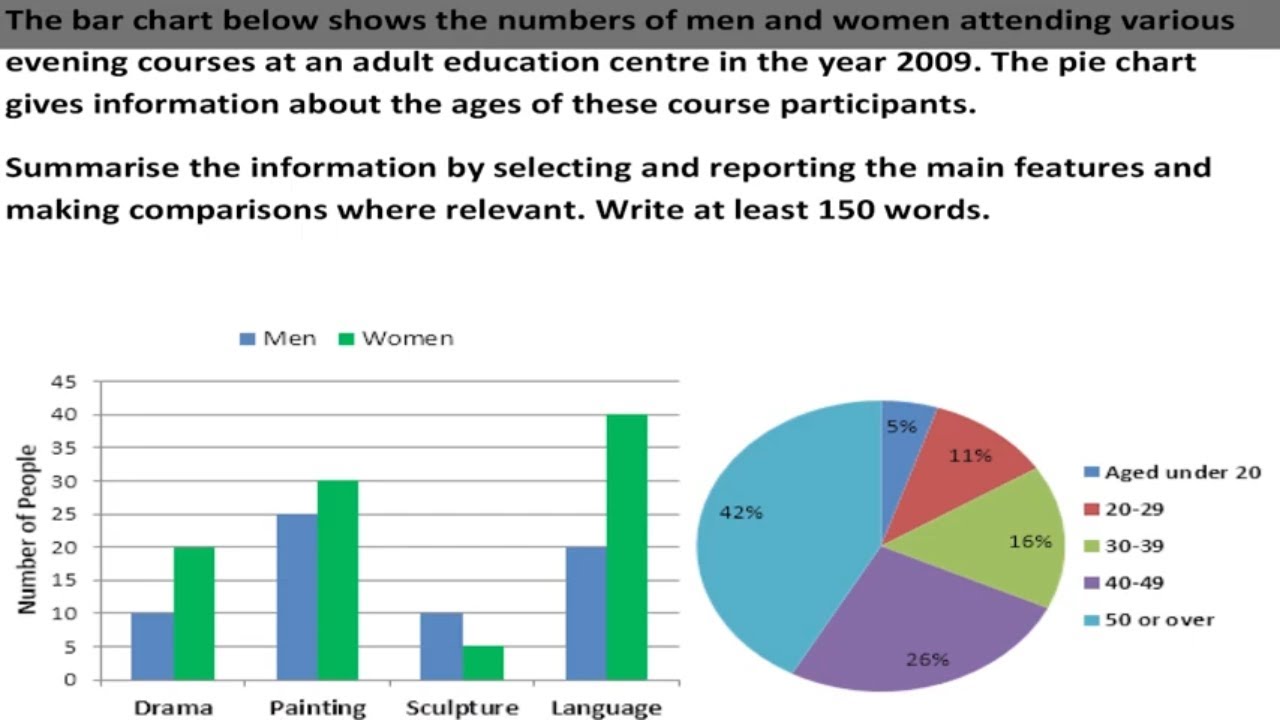
Your task is to write one body paragraph that compares the participation of men and women in these courses.
Instructions:
- Group your information. You can go course by course.
- For each course, compare the number of men and women.
- Use a variety of the comparative language we've studied today (e.g.,
more...than,while,in contrast,surpassed). - Include the specific numbers from the chart to support your comparisons.
Take about 10 minutes to write your paragraph.
Model Answer:
Here is a sample paragraph that effectively compares the data:
Regarding the evening courses, female participation was significantly higher than male participation in both drama and language classes. In the drama course, the number of women, at 40, was double the figure for men. A similar pattern was seen in the language course, where 35 women attended, compared to only 20 men. In contrast, the sculpture course attracted more men than women, with figures standing at 25 and approximately 18 respectively. Painting was the only course with nearly equal participation, where around 32 men and 34 women were enrolled.
Analysis of the model answer:
- It directly compares men and women within each course (
higher than,compared to). - It uses linking words to show relationships between the courses (
A similar pattern was seen...,In contrast,...). - It uses a variety of comparative structures (
double the figure for men,nearly equal participation). - It includes the data to support each point.
Conclusion
Great job today! You have learned the essential language and strategies for writing effective body paragraphs in Task 1. By moving beyond simple descriptions and actively making comparisons, you demonstrate a deeper understanding of the data.
Key Takeaways:
- Accurately use comparative (
more popular) and superlative (the most popular) adjectives. - Vary your vocabulary with verbs like
surpassandexceed, and phrases liketwice as much as. - Connect ideas using linking words like
while,whereas, andin contrast. - Structure your paragraphs by grouping information and making direct comparisons, rather than just listing facts.
In our next lesson, we will shift our focus to a different type of Task 1 question: describing a process. You will learn the specific sequencing language needed to explain the stages of a process diagram clearly.