Hello! Welcome to the next lesson in our journey to master local SEO at scale.
In our last session, we focused on structuring your website's data by implementing advanced LocalBusiness schema. You learned how to tell search engines about each of your locations with perfect clarity using code. A core part of that schema was the NAP information: Name, Address, and Phone number.
Now, we'll address the other side of the coin. It's not enough to state your NAP correctly on your own site; Google verifies this information by checking for mentions of your business across the entire web. These mentions are called citations.
Today's lesson is designed to help you audit and optimize local citations and NAP consistency at scale using automation tools. We will build a framework to ensure that the information in your schema is perfectly mirrored across hundreds of online directories, social platforms, and data aggregators—a critical task for any multi-location brand.
1. The Challenge: NAP Consistency at an Enterprise Scale
For a single-location business, managing citations is straightforward. For a multi-location brand, the complexity grows exponentially. Before we dive into the tools, it's crucial to understand why this is such a significant challenge.
First, let's establish a clear definition of citations and their importance.
How to Do Local SEO for Multiple Locations
The video 'How to Do Local SEO for Multiple Locations' from Exposure Ninja provides an excellent, concise explanation of what NAP citations are and why they function as a core local ranking signal, similar to how backlinks work in traditional SEO.
Please watch from 15:10 to 17:00. Focus on the core concept: Google looks for consistent mentions of your Name, Address, and Phone number across the web to build trust and authority for your business in a specific location.
As the video explains, Google's algorithm rewards consistency. When it sees the exact same NAP for your "Austin" location on Yelp, Apple Maps, Facebook, and a local business directory, its confidence in your data skyrockets.
However, for a brand with 50 locations, this becomes what the enterprise SEO world calls "The Scale Problem."
Optimize NAP for Multi-Location Brands
The article 'Optimize NAP for Multi-Location Brands' by Rankworks breaks down the unique challenges that large brands face. It provides a professional, data-driven perspective on the problem we're solving today.
Please read the introduction and the section 'Why NAP Consistency Is 10x Harder for Multi-Location Brands.' Pay close attention to the three core problems identified: The Scale Problem: The sheer volume of citations to manage. The Franchise Complexity Problem: The lack of centralized control. The Data Aggregator Lag Problem: The hidden infrastructure that distributes your data.
This article highlights that managing 50 locations isn't 50 times the work; it can be 500 times the work. A single incorrect address can cascade across dozens of directories, creating conflicting signals that erode Google's trust and damage your local rankings.
2. The Framework for Auditing and Optimizing at Scale
To tackle this complexity, we need a systematic, scalable process. Manually checking hundreds of directories for thousands of listings is not an option. The entire workflow can be summarized in a few key stages, which are driven by a centralized strategy and executed with powerful automation tools.
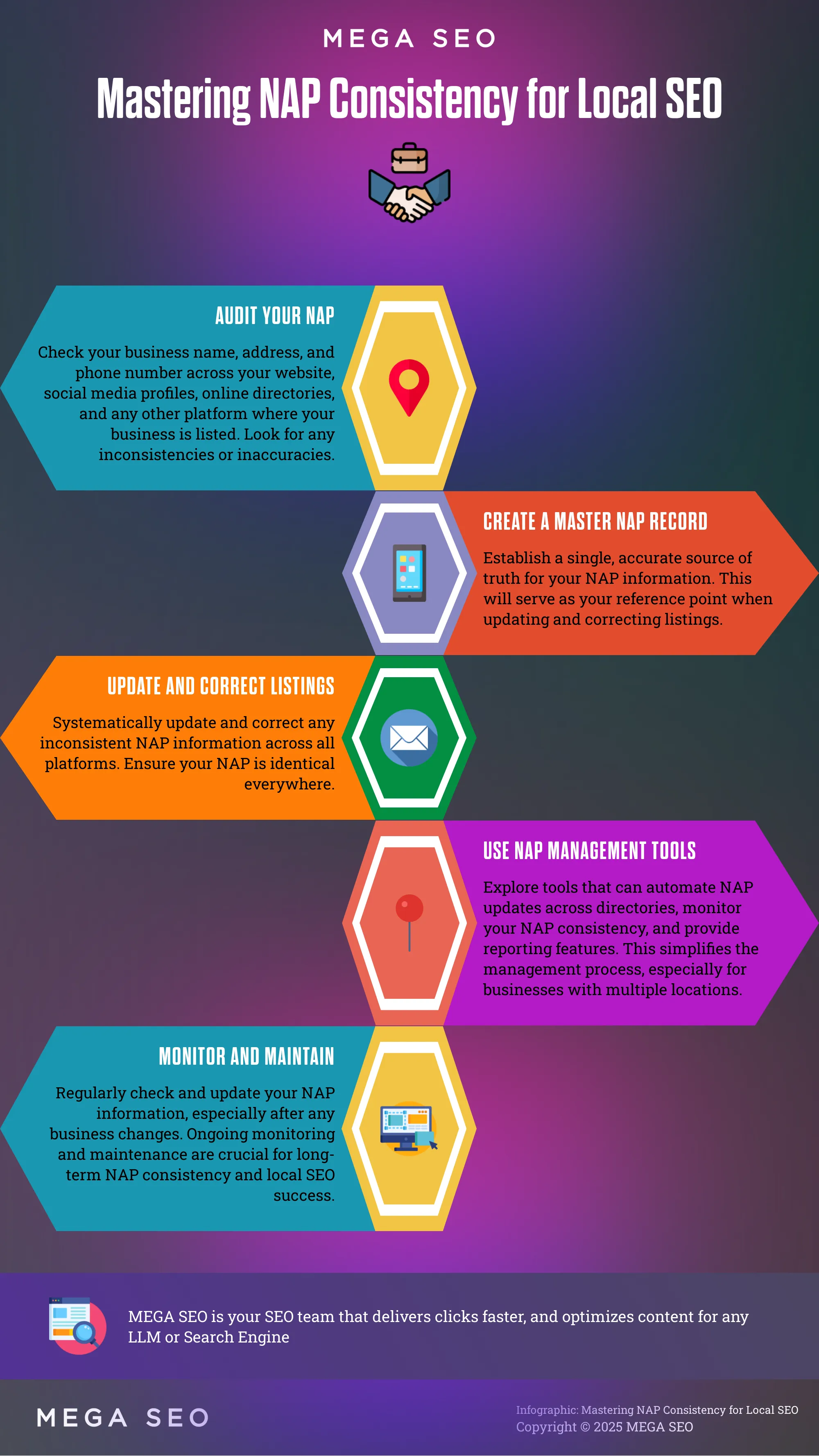
Step 1: Establish a Single Source of Truth (SSoT)
As highlighted in the Rankworks article, the most common point of failure is having location data scattered across different systems. The solution is to create one master location database that serves as the undisputed source for all NAP information.
This SSoT is typically a spreadsheet or a dedicated database that contains meticulously standardized data for every location, including:
- Location ID: A unique identifier.
- Business Name: The exact, approved format (e.g., "Brand Name - Downtown" vs. "Brand Name Downtown").
- Address: Standardized using a verifier like the USPS database (e.g., always "Street" vs. "St.").
- Phone Number: The exact format to be used everywhere (e.g.,
(555) 123-4567). - Website URL: The specific URL for the location landing page.
This SSoT is your ground truth. The goal of the audit is to make every citation on the web match this record.
Step 2: Conduct an Automated Citation Audit
With your SSoT established, the next step is to find out where your citations currently stand. This is where automation tools become indispensable. Tools like BrightLocal, Whitespark, or Moz Local can scan the web and compare existing listings against your correct NAP data.
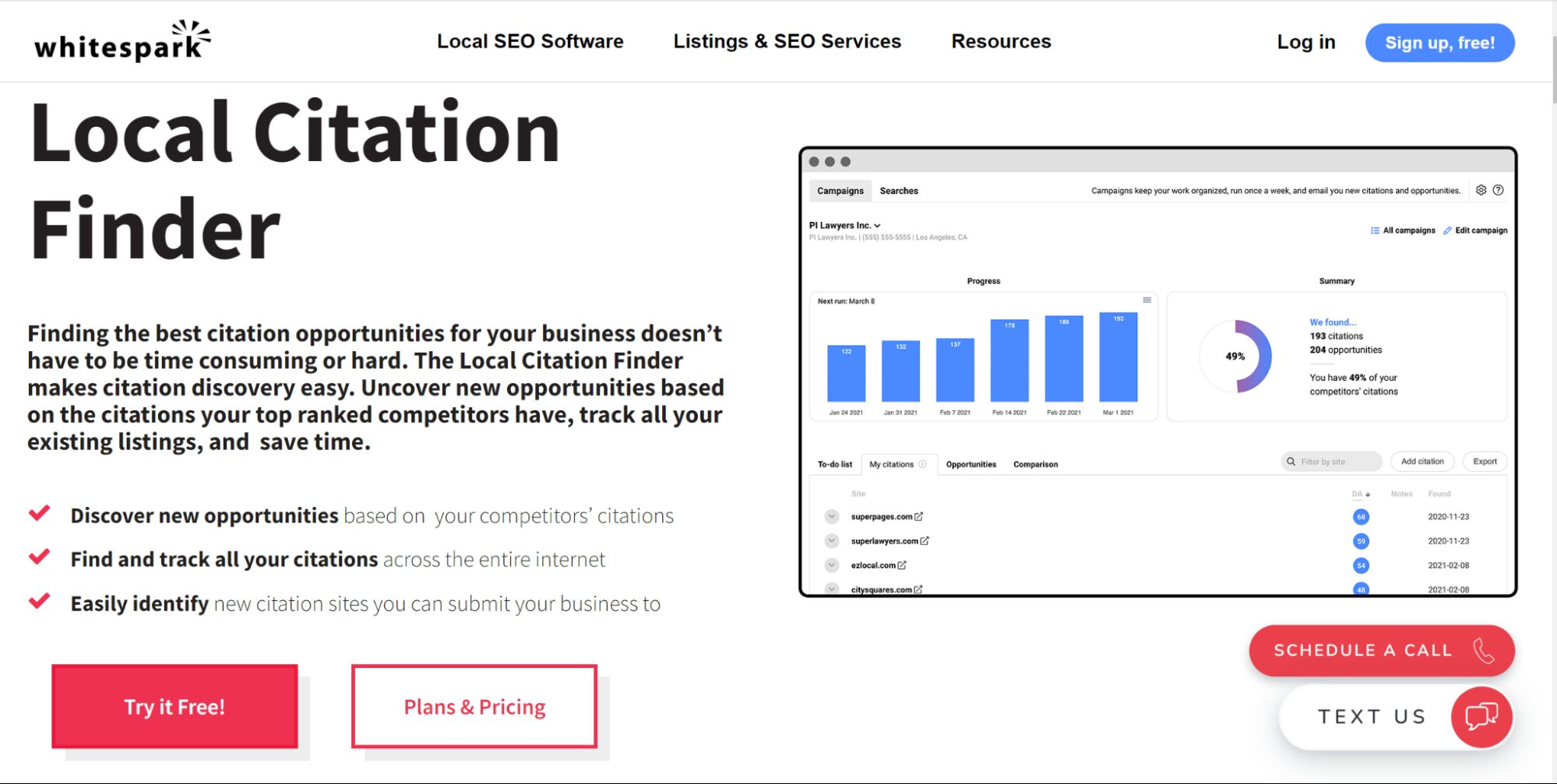
Let's see how this works in practice using BrightLocal, a popular tool in this space.
How I Use BrightLocal To Rank Local Businesses #1
The video 'How I Use BrightLocal To Rank Local Businesses #1' provides a direct look into a typical workflow. We'll focus on how to input your SSoT data and then use the tool to find inconsistencies.
Please watch two short clips: 0:20 - 1:08: See how the 'Location Manager' is used to input the core business data from your SSoT. 11:02 - 12:15: Observe how the 'Citation Tracker' report works. The presenter shows how to quickly identify NAP errors, find duplicate listings, and investigate issues. Focus on the efficiency of the process. The tool automatically surfaces the problems that need fixing.
The output of this audit is a prioritized list of actions:
- NAP Errors: Listings with incorrect names, addresses, or phone numbers.
- Duplicate Listings: Multiple, conflicting listings for the same location on a single platform.
- Missing Citations: Key directories where your business isn't listed at all.
Step 3: Optimize and Build Citations with Automation
Once you've identified the errors, the next step is to correct them and build new, accurate citations. For a multi-location brand, this is best handled through a combination of manual and automated methods.
- Manual Correction: For the most important "Tier 1" directories (like Google Business Profile, Yelp, Facebook, Apple Maps), you may need to log in and manually claim and correct listings.
- Automated Distribution & Building: For the hundreds of other directories, using a platform or service is the only scalable solution. These services take your SSoT data and push it out to major data aggregators (like Foursquare and Data Axle) and a wide network of directories.
The BrightLocal video briefly touched on their "Citation Builder" service, which is an example of this automated approach. These platforms can correct existing listings and create new ones for you, saving hundreds of hours of manual work.
Test your understanding!
You are managing SEO for a chain of 100 hardware stores. The marketing team decides to use call-tracking numbers on Google Business Profile listings to measure phone leads. Based on what you've learned about NAP consistency, why is this a potentially disastrous idea, and what is the correct approach?
Show answer
Using rotating or unique call-tracking numbers on Google Business Profile or in other public citations creates massive NAP inconsistency. Google's algorithm will see dozens of different phone numbers for the same location, eroding its trust in the business's data and likely harming local rankings.
The correct approach is to use the official, local phone number from your Single Source of Truth on all public citations, including GBP. Call tracking should be implemented using methods that don't alter the public-facing NAP, such as Dynamic Number Insertion (DNI) on your website only, or by using the call history report built into Google Business Profile itself.
3. Continuous Monitoring and the Role of AI
NAP consistency is not a "set it and forget it" task. Listings can become corrupted over time due to a variety of factors:
- Data aggregators pushing old, incorrect data.
- Franchisees or local managers making unauthorized changes.
- Users suggesting edits to your listings.
- Platform updates overwriting your information.
This is why continuous monitoring is the final, crucial step. Modern platforms automate this by constantly scanning your key citations and alerting you to any discrepancies from your SSoT.
This is where AI is having a significant impact, shifting the process from reactive alerts to proactive, automated management.
7 Best AI SEO tools for multi-location brands for 2026
The article '7 Best AI SEO tools for multi-location brands for 2026' from Birdeye explains how AI is elevating local SEO. It perfectly captures the forward-thinking approach you're aiming for.
Please read the following sections to understand how AI is automating this entire workflow: 'How AI is rewriting the SEO playbook' to understand why data accuracy is more critical than ever. Focus on the description of 'Birdeye' and its 'Listings AI Agents' to see a concrete example of an AI-powered tool. 'How AI SEO tools help businesses improve workflows & visibility at scale' to see how this enables a shift to continuous visibility management.
As the Birdeye article explains, AI-powered systems can now automatically identify inaccurate or duplicate listings and even initiate workflows to correct them. These "AI Agents" can enforce brand governance at scale, ensuring every location's data remains in sync across the web with minimal human intervention. This is the future of scaled citation management.
Conclusion
You have now built a complete, enterprise-level framework for managing NAP consistency. This process moves beyond manual checks to a strategic, tool-driven workflow designed for scale and efficiency.
Key Takeaways:
- NAP consistency is a foundational local ranking signal. Inconsistency erodes trust with search engines and hurts visibility.
- Scaling requires a system. For multi-location brands, this system is built on a Single Source of Truth (SSoT) and automation tools.
- The workflow is a continuous cycle: Audit existing citations, Optimize by correcting errors and building new listings, and Monitor for changes.
- AI is automating this cycle. Modern platforms use AI to detect and even correct inconsistencies, allowing SEOs to focus on strategy rather than manual tasks.
In our last two lessons, we've focused on ensuring Google has access to perfect, consistent data about your business locations—through schema markup on your site and citations across the web.
In our next lesson, we will see how this groundwork pays off. The topic is "Implement local SEO strategies specifically for voice-based 'near me' searches." You'll discover how voice assistants like Siri and Google Assistant rely on this precise, trustworthy location data to answer conversational queries and drive customers directly to your door.