Hello! Welcome back to our module on AI-Powered Link Building & Outreach.
In our last lesson, we focused on creating the what—the "linkable asset." You learned how to use AI to brainstorm and validate content ideas, like data studies and ultimate guides, that are so valuable they naturally attract backlinks.
Now that you have a high-value asset, it's time to master the how. How do you reach out to prospects in a way that cuts through the inbox noise and gets a "yes"? The answer is deep personalization, and AI is the key to doing it efficiently. This lesson will teach you how to use GPT-4 to draft personalized outreach email templates for specific link-building prospects. We'll move beyond generic templates and learn to craft messages that feel truly one-to-one.
1. The Foundation: Training ChatGPT with Custom Instructions
Before you write a single prompt, the most effective step you can take is to "train" ChatGPT on who you are and how you want it to behave. This is done using the Custom Instructions feature. By setting this up once, you ensure all future outputs are more consistent, on-brand, and require less editing.
Think of it like briefing a new team member. You wouldn't ask them to start writing emails without telling them about your company, your role, and your communication style. The same applies to AI.
ChatGPT FREE Backlinks: How I Create SEO Backlinks (AI Link Building)
To understand the power of Custom Instructions, watch this short clip from the video 'ChatGPT FREE Backlinks' by Julian Goldie SEO. He clearly demonstrates the setup and then compares the output with and without this feature enabled.
First, watch from 01:28 to 03:48 to see how to set up Custom Instructions for link building. Pay attention to the two fields: one for information about you/your website, and one for rules on how ChatGPT should respond. Then, watch the comparison from 05:18 to 06:33 to see the dramatic difference in email quality.
As you saw, the difference is significant. The email generated with Custom Instructions is more personal, better formatted, and directly relevant.
Your Action Item:
Go into your ChatGPT settings and enable Custom Instructions. Here’s a template you can adapt:
-
What would you like ChatGPT to know about you to provide better responses?
I am an SEO specialist for [Your Company/Website Name]. My website, [yourwebsite.com], focuses on [your niche, e.g., 'ethically sourced chocolate']. Our target audience is [describe your audience, e.g., 'conscious consumers and food bloggers']. I have [X] years of experience in SEO and digital marketing.- You can also paste a summary of your "About Us" page here.
-
How would you like ChatGPT to respond?
When writing outreach emails, always adopt a friendly, professional, and slightly informal tone. Keep paragraphs short (1-2 sentences). Every sentence should be on a new line for readability. Emails should be win-win and avoid corporate jargon or overly formal language like 'Dear Sir/Madam'. Make the call-to-action clear and simple.
Setting this up will save you immense time and dramatically improve the quality of your first drafts.
2. The Four Levels of AI-Powered Personalization
Not all personalization is created equal. Simply mentioning a prospect's city is a low-value "attention hack." True personalization demonstrates that you've done your research and understand their world.
The following article from Clay.com provides an excellent framework for thinking about this.
24 easy AI email personalization examples for cold outreach (with prompts)
Let's read a few key sections from the article '24 easy AI email personalization examples for cold outreach'. This will give us a strategic framework for crafting our prompts.
First, read the section titled 'What makes for a great AI email personalization?' to understand the difference between valuable insights and attention hacks. Then, review the section 'The 4 Levels of AI email personalization'. This framework is key to our strategy.
To recap, the four levels are:
- Level 1 (Random): Mentioning their college or city. (Low impact).
- Level 2 (Company/Lead Specific): Referencing their company's mission or their job title. (Better).
- Level 3 (Recent/Top-of-Mind): Commenting on a recent LinkedIn post or company news. (Good).
- Level 4 (Recent & Relevant to Your Offer): Connecting a recent event (like a new job posting or article they wrote) directly to the problem your linkable asset solves. (Excellent - this is our goal).
3. The Process: Gathering Data and Prompting GPT-4
To achieve Level 4 personalization, you need specific data points to feed into your prompt. The process looks like this:
- Gather Personalization Data: Scrape key information from your prospect's website or social profiles.
- Craft a Detailed Prompt: Combine that data with your linkable asset and clear instructions.
- Generate and Refine: Use GPT-4's output as a high-quality first draft.
Step 1: Gathering Data with AI
Manually digging for personalization "nuggets" is time-consuming. We can use AI to accelerate this research.
AI Link Building Strategy: Build 100s of FREE Backlinks with ChatGPT!
In this clip from 'AI Link Building Strategy', you'll see a practical demonstration of using ChatGPT with a browsing plugin (like the now-integrated browsing feature or a third-party plugin) to extract personalization points from a list of URLs.
Watch from 01:17 to 02:44. Note how the prompt asks for specific information: authors, topics, 'about' information, etc. This is the raw material for our personalized email.
Step 2: Crafting a Level 4 Personalization Prompt
Once you have your data, you can build a powerful prompt. The key is to provide GPT-4 with all the necessary context in one place.
A strong prompt framework includes:
- Your Role & Goal:
Act as an expert SEO outreach specialist. - Context about Your Asset:
I have created a data study titled 'The True Cost of a Chocolate Bar'. It reveals new data on the environmental impact of cacao farming. - Context about Your Prospect:
I am pitching to Jane Doe, the editor of 'EcoFoodieBlog.com'. I've gathered this information about her/her blog: [Paste the data you gathered in Step 1, e.g., 'She recently wrote an article about sustainable agriculture. Her blog's mission is to educate consumers on making ethical food choices.'] - The Task (with Guardrails):
Draft a short, friendly outreach email to Jane. The first line must be a personalized compliment about her recent article on sustainable agriculture. Connect her interest in that topic to my data study. The goal is to offer my study as a unique resource for a future article she might write. The call to action should be a simple question, not a hard pitch. - Output Format:
Keep the email under 150 words. Ensure each sentence is on a new line.
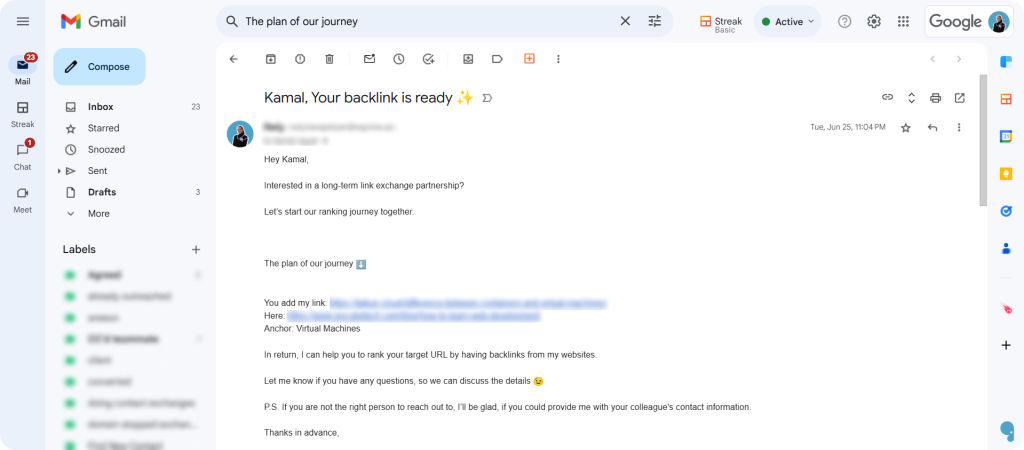
Here is an example of a well-crafted email, the kind of output we're aiming for.
4. Prompting for Different Link Building Scenarios
The same principles apply to any outreach reason. Your knowledge of standard link-building tactics is your strength; now you can layer AI on top.
This LinkedIn post offers several concise prompts you can adapt.
15 ChatGPT Prompts for Scalable Backlinks
Let's review '15 ChatGPT Prompts for Scalable Backlinks'. This post provides excellent, bite-sized prompts for common outreach tasks.
Quickly scan the list and pay special attention to prompts #2 (Guest Post Pitch), #5 (Backlink outreach referencing an article), and #15 (Pitching a resource link). These are direct templates you can use.
Let's adapt one for a broken link building scenario:
Prompt:Act as an SEO specialist. I found a broken link on this page: [URL of page with broken link]. The broken link pointed to an article about [topic of old article].
My website has a more up-to-date and comprehensive guide on the same topic here: [URL of your linkable asset].
Draft a short, helpful email to the site owner. The subject line should be 'A broken link on your page'. Politely point out the broken link and offer my article as a direct replacement. Keep the tone helpful, not demanding.
Test your understanding!
You are an SEO for a company that sells project management software. Your new linkable asset is an in-depth data study titled: "The Impact of Remote Work on Team Productivity: A 2026 Analysis."
Your prospect is a blogger who runs a popular HR blog. They recently published an article titled: "5 Challenges of Managing a Remote Team."
Draft a complete GPT-4 prompt to generate a personalized outreach email.
Show answer
Here is a well-structured prompt:
Act as a friendly outreach specialist for a project management software company.
I have created a new, data-driven report called "The Impact of Remote Work on Team Productivity: A 2026 Analysis." It contains original research and statistics on how remote work affects project deadlines and team collaboration.
My prospect is the author of a popular HR blog. They just published an article titled "5 Challenges of Managing a Remote Team."
Your task is to draft a personalized outreach email to them.
Follow these rules:1. The tone must be professional yet conversational.2. The first line must reference their recent article and offer a genuine compliment.3. Seamlessly connect the 'challenges' they wrote about to the 'solutions and data' in my report.4. Propose my report as a valuable, citable resource for their audience or a future article.5. The call to action should be soft, like asking if they'd be interested in seeing the report.6. Keep the email concise (under 150 words) and format it with short sentences on new lines.
Conclusion
Drafting outreach emails is no longer about choosing from a list of generic templates. With GPT-4, you can operate as a high-level communications strategist, feeding the AI with context and goals to produce truly bespoke messages.
Key Takeaways:
- Foundation First: Use ChatGPT's Custom Instructions to establish your identity and desired tone for all future outreach.
- Aim for Level 4: Strive for the highest level of personalization by connecting a prospect's recent activity directly to the value your linkable asset provides.
- Process is Key: A repeatable workflow of Gather Data -> Craft a Detailed Prompt -> Generate & Refine is the most efficient way to use AI for outreach.
- Context is King: The quality of your prompt—the context you provide about yourself, your asset, and your prospect—directly determines the quality of the output.
In this lesson, we mastered drafting individual, highly-personalized emails. But how do you do this for 100 prospects without it taking all week?
In our next lesson, we will build on this foundation to develop a system to generate personalized email templates at scale using dynamic variables and AI. We'll bridge the gap between manual crafting and full automation.