Hello! Welcome back to the fourth module on Enterprise SEO.
In our last session, we moved from diagnosis to strategy, learning how to correlate log file data with crawl data to create a prioritized action plan. We saw firsthand how architectural issues like deep crawl depth and orphan pages can waste crawl budget and leave valuable content undiscovered. That analysis was reactive—fixing problems on the existing structure.
Today, we shift to being proactive. This lesson addresses the learning outcome: Evaluate different site architecture models (e.g., silo, hub-and-spoke) for large multi-category websites. Instead of just patching a leaky roof, we're going to learn how to design a better one from the ground up. A well-designed site architecture is the foundation for efficient crawling, strong topical authority, and a seamless user experience—all critical for success at an enterprise scale.
1. The Blueprint of a Website: Why Architecture Matters
Before we compare specific models, let's solidify why this matters. As we saw in the previous lessons on crawl budget, search engine bots have limited resources. A confusing or overly deep site structure forces them to waste time and energy navigating, potentially missing your most important pages.
Google Jan 2026 Update: Website Architecture Killing Your SEO
This article provides an excellent analogy to frame the importance of good architecture. It compares a poorly structured site to a disorganized library, a concept that directly relates to the crawl budget issues we've been discussing.
Please read the section 'The Two-Minute Manager's Guide'. Focus on the library analogy and the comparison between good and bad architecture in terms of click depth.
The key takeaway is that a shallow, logical structure ensures your high-value pages are easily discoverable. This principle of minimizing click depth—the number of clicks required to get from the homepage to another page—is a core tenet of effective site architecture.
2. Foundational Site Architecture Models
While there are many ways to organize a site, most structures fall into a few common models. For an enterprise SEO specialist, it's crucial to know the pros and cons of each to make informed decisions.
Site Architecture for SEO: Structure That Ranks & Scales
The article 'Site Architecture for SEO' from Search Engine Land provides a clear overview of the four primary architectural models. Understanding this foundational knowledge will help us contextualize the more popular models used in SEO.
Please read the section 'Common types of website structures and when to use them'. Pay attention to the layout, advantages, and disadvantages of the Hierarchical, Sequential, Matrix, and Database models.
To summarize, here are the main models:
- Hierarchical: The most common and intuitive model, resembling a tree with the homepage at the root. It's the foundation for most large business and e-commerce sites.
- Sequential: A linear, step-by-step structure, ideal for processes like an e-commerce checkout or an online course.
- Matrix: A grid-like structure that allows users multiple ways to navigate content, often seen on large news sites with complex tagging.
- Database: A dynamic model where pages are generated from a database based on user queries. Think of Amazon's product pages.
For most large, multi-category websites, the Hierarchical model is the starting point. Within this model, two specific strategies have become dominant in SEO for building topical authority and managing crawl budget: Silos and Hub-and-Spoke.
3. The Silo Model: Creating Thematic Fortresses
The silo model is a strict, top-down approach to organizing your content. You group all related pages into distinct categories, or "silos," and intentionally limit linking between these silos to reinforce the topical relevance of each one.
Imagine a digital filing cabinet. All documents related to "Billing" go in one drawer, and all documents for "Customer Support" go in another. You wouldn't mix them up.

To see this in action, the following video provides a clear explanation of how silos are constructed and how internal linking works within them.
SEO Silos vs. Topical Clusters (What's best?)
The video 'SEO Silos vs. Topical Clusters' by Jaume Ros offers a fantastic visual breakdown of the silo structure. It will help you understand the theory behind its hierarchical organization and internal linking rules.
Please watch from the beginning until 05:30. Focus on: The definition of a silo and its benefits (00:18). The example of building a silo for a travel website (01:19). The discussion on internal linking rules, including parent-child and sibling relationships (02:30).
Evaluation of the Silo Model:
- Pros:
- Strong Topical Authority: By grouping content and linking tightly within a theme, you send very clear signals to Google about what each section of your site is about.
- Efficient Link Equity Flow: Authority from backlinks flows cleanly throughout the relevant pages within a silo.
- Scalable Organization: Excellent for large e-commerce sites with distinct product categories.
- Cons:
- Rigidity: Strict silo-ing can feel unnatural and may prevent you from making contextually relevant links to other sections, potentially harming user experience.
- Risk of Orphaned Content: If not managed carefully, it can be easy to create pages or even entire sub-silos that don't have enough internal links.
4. The Hub-and-Spoke Model (Topical Clusters): Building a Web of Expertise
The hub-and-spoke model, also known as a "topical cluster," is another hierarchical approach but with more flexibility. Instead of strict separation, it focuses on creating a central "hub" page for a broad topic, which then links out to multiple "spoke" pages that cover subtopics in greater detail. Each spoke page links back to the central hub.
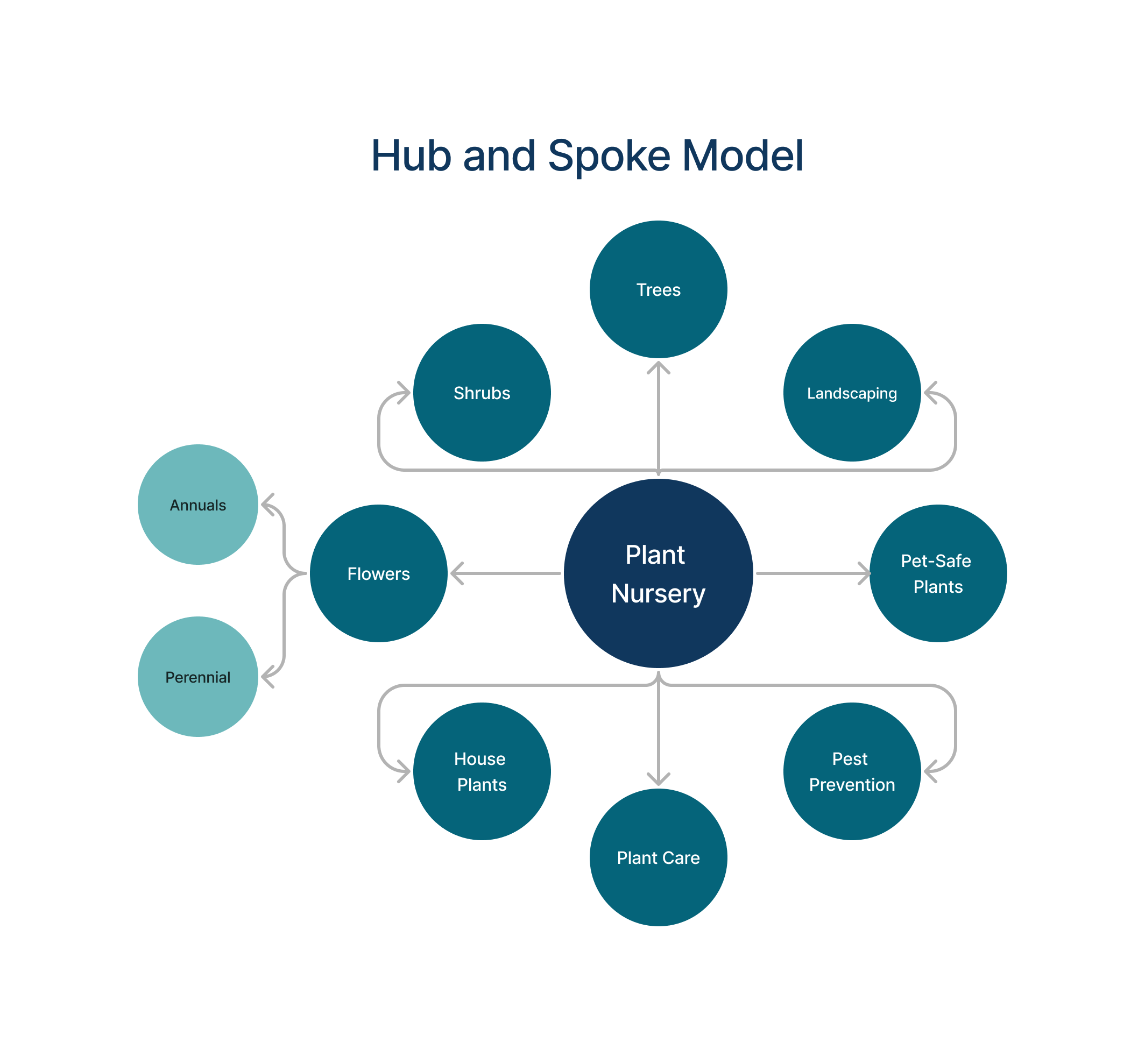
This model is less about what you don't link to and more about what you do link to in order to build a comprehensive web of content around a core theme.
SEO Silos vs. Topical Clusters (What's best?)
Let's return to the same video to see how topical clusters (hub-and-spoke) offer a more flexible alternative to silos.
Please watch from 05:54 to 07:00. Note the key difference: there are fewer rules about interlinking between clusters, making it more flexible.
Evaluation of the Hub-and-Spoke Model:
- Pros:
- Excellent for Topical Authority: Demonstrates comprehensive expertise on a topic to search engines.
- User-Friendly: Helps users discover related content and explore a topic in depth.
- Flexible: Allows for natural, contextual cross-linking between different hubs where relevant.
- Cons:
- Less Suited for E-commerce Categories: Works best for informational content (blogs, guides) rather than product listings.
- Planning is Crucial: Without a clear content plan, hubs can become disorganized and lose their thematic focus.
5. Choosing the Right Model: Silos vs. Hubs vs. Hybrid
So, which model is best? As with most things in SEO, the answer is: it depends on the context.
- Silos are often the best choice for the core structure of a large e-commerce site or a multi-service business where categories are distinct and separate (e.g.,
site.com/mens-clothing/andsite.com/womens-clothing/). - Hub-and-Spoke is typically the superior model for a site's blog or resource center, where the goal is to build deep expertise on informational topics.
For most large, multi-category websites, a hybrid approach is the most effective solution. You can use a silo structure for your primary navigation and commercial categories, while simultaneously using a hub-and-spoke model for your content marketing efforts.
The video you watched concludes with this exact point, noting how an e-commerce site can use silos for its product pages and clusters for its blog.
Test your understanding!
You are the SEO lead for a large online retailer that sells musical instruments. The site has two main parts:
- An e-commerce section with thousands of product pages organized by category (Guitars, Keyboards, Drums, etc.).
- An extensive blog called "The Practice Room" with hundreds of articles, including instrument buying guides, music theory lessons, and artist interviews.
Which architectural model(s) would you recommend for this website, and why?
Show answer
The best solution would be a hybrid model:
-
Silo Architecture for the E-commerce Section: You should implement a strict silo structure for the product categories. For example:
site.com/guitars/electric/site.com/guitars/acoustic/site.com/keyboards/digital-pianos/
This keeps the commercial categories distinct, helps Google understand the hierarchy, and ensures link equity from a specific guitar review page flows primarily to other guitar-related pages.
-
Hub-and-Spoke Model for the Blog: For "The Practice Room," a hub-and-spoke model is ideal. You could create pillar pages (hubs) like:
- "The Ultimate Guide to Learning Guitar"
- "A Beginner's Guide to Music Theory"
These hubs would then link out to detailed articles (spokes) like "How to Choose Your First Electric Guitar," "Understanding the Circle of Fifths," or "5 Essential Drum Rudiments." This builds deep topical authority around learning music, attracting a different type of search user than the purely commercial product pages.
This hybrid approach leverages the organizational strength of silos for commerce and the authority-building flexibility of clusters for content.
Conclusion
In this lesson, we moved from fixing architectural problems to proactively designing effective structures. You learned how to evaluate the foundational models of site architecture, with a deep dive into the two most important strategies for enterprise SEO.
Key Takeaways:
- Architecture is Foundational: A logical, shallow site structure is essential for crawl efficiency, topical authority, and user experience.
- Silos for Separation: Use the silo model to create distinct, thematically strong categories, ideal for the commercial sections of a large website.
- Hub-and-Spoke for Expertise: Use the hub-and-spoke model (topical clusters) to build comprehensive authority around informational topics, perfect for blogs and resource centers.
- Hybrid is Often Best: Most large, multi-category websites benefit from a hybrid approach, using silos for commerce and hubs for content.
We've now chosen our architectural model. The next logical step is to build it. The connections that form these structures are internal links. In our next lesson, we will design a scalable internal linking architecture to optimize crawl budget and topical authority, turning our architectural blueprint into a functional reality.