Hello! Welcome back to our module on Enterprise SEO.
In our last lesson, we evaluated different architectural blueprints for large websites, settling on the silo, hub-and-spoke, and hybrid models. We decided what to build. Today, we're focusing on how to build it. The steel beams and support columns of any site architecture are its internal links.
This lesson directly addresses the learning outcome: Design a scalable internal linking architecture to optimize crawl budget and topical authority. We will move from abstract models to a concrete framework for creating a network of links that guides both search engines and users effectively, especially on websites with thousands or even millions of pages.
1. The Foundation: Why Internal Linking is Mission-Critical at Scale
You're already familiar with the basics of internal linking from your experience, but at an enterprise level, its strategic importance is magnified. A haphazard approach simply won't work. We need a system. A well-designed internal linking architecture serves four primary functions that are crucial for scaling.
Programmatic SEO Internal Linking: Strategies for Scale
To start, let's review the fundamental roles of internal linking in the context of large, programmatically generated websites. This article, 'Programmatic SEO Internal Linking', does an excellent job of framing why this is so critical for the kinds of sites we're discussing.
Please read the first section, 'Why Internal Linking is Crucial in Programmatic SEO'. As you read, focus on how each point—Crawlability, Indexing, Link Equity, Context, and User Navigation—directly impacts the crawl budget and authority challenges we've discussed.
As the article highlights, internal links are the pathways that search bots use to navigate your site. Without a deliberate structure:
- Crawl budget is wasted on unimportant pages or in dead-end loops.
- Link equity (ranking power) gets trapped on a few top-level pages, starving your deeper content.
- Valuable pages become "orphans," invisible to both search engines and users.
Our goal is to design a system that prevents these issues and actively strengthens the site's SEO performance.
2. The Blueprint: Hierarchical and Contextual Linking
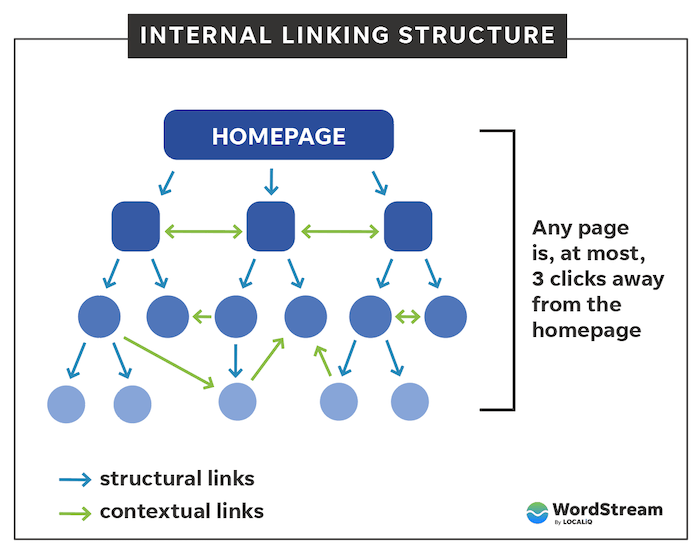
A scalable internal linking architecture is built on two types of connections: hierarchical (vertical) links that establish structure and contextual (horizontal) links that build relevance.
Hierarchical Linking: The Structural Framework
These are the predictable, automated links that form the skeleton of your site. They follow the parent-child relationships defined by your chosen architecture (silo or hub-and-spoke).
- Navigation Menus: Your main navigation automatically links to top-level category pages from every page on the site, ensuring they are always discoverable and receive consistent link equity.
- Breadcrumbs: These are essential for large sites. A breadcrumb trail like
Home > Guitars > Electric Guitars > [Product Page]provides clear orientation for the user and creates automated links back to every parent page in the hierarchy.
Contextual Linking: Weaving the Web of Relevance
While hierarchical links build the structure, contextual links build topical authority. These are the links within the body of your content that connect related ideas. They are more powerful for signaling relevance because they are surrounded by topical text.
At scale, you can't manually add every contextual link. The strategy involves:
- Linking to Sibling Pages: A page about "best cameras for wildlife" should link to "best lenses for wildlife photography."
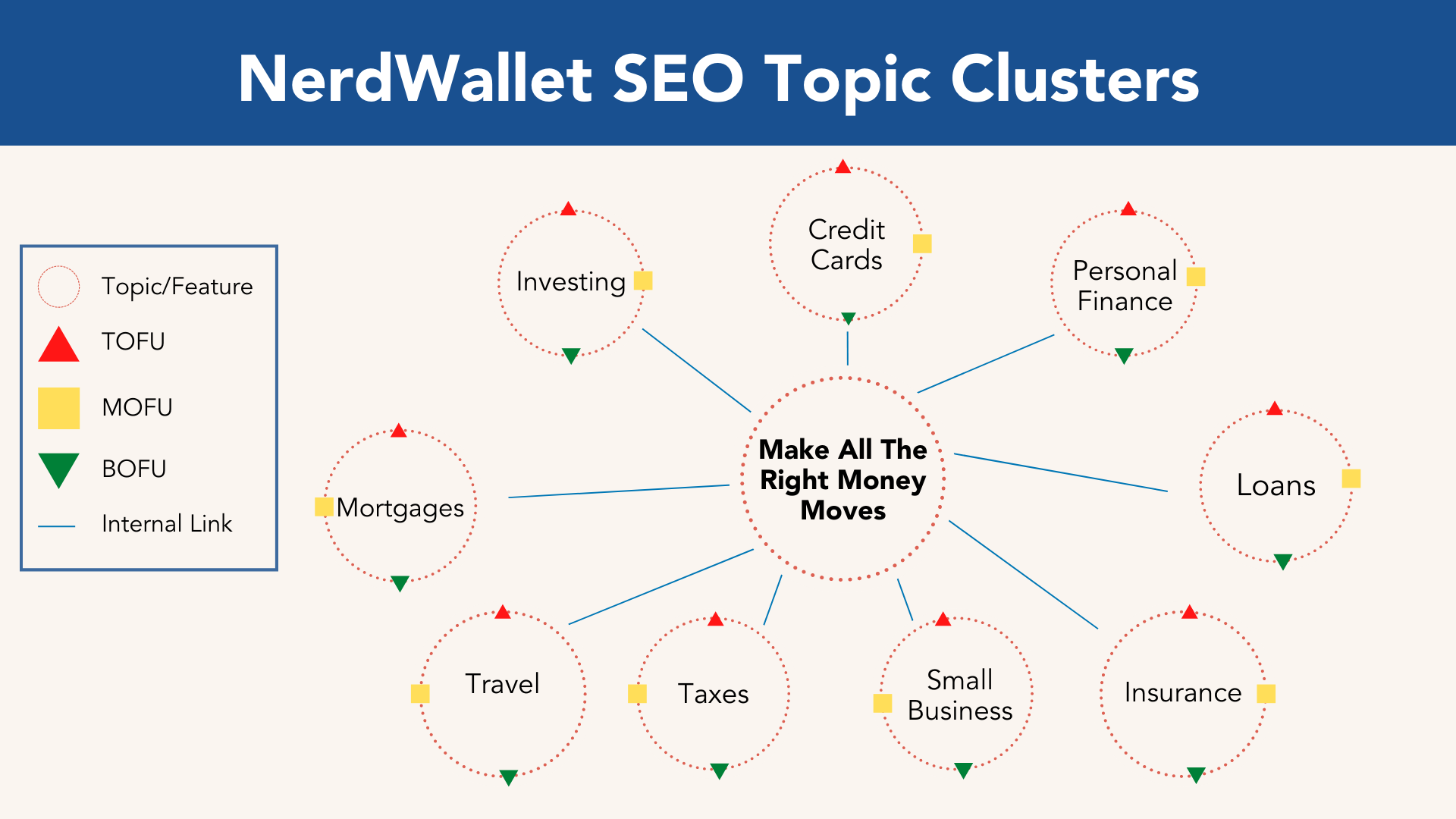
- Linking within Topic Clusters: All "spoke" pages in a cluster should link to the central "hub" page.
- Intelligent Cross-Silo Linking: While the strict silo model discourages this, a modern approach allows for relevant, user-focused links between different silos. For example, a blog post in your "Content Marketing" hub can (and should) link to a relevant service page in your "SEO Services" silo.
The resource below outlines how to combine these strategies into a cohesive plan.
Programmatic SEO Internal Linking: Strategies for Scale
Let's return to the 'Programmatic SEO Internal Linking' article. This section provides a practical checklist for building out your linking blueprint.
Please read the section 'Best Practices for Internal Linking at Scale'. Pay close attention to points #1 (Plan a Logical Site Hierarchy), #3 (Leverage Navigation Menus and Breadcrumbs), and #4 (Cross-Link Related Pages Contextually).
3. Anchor Text: The Art of Signaling Relevance at Scale
The text you use for your links—the anchor text—is a powerful signal to Google about the content of the destination page. At an enterprise scale, managing anchor text requires a nuanced strategy to maximize relevance without creating footprints that look like manipulation.
A fascinating study by SEO expert Cyrus Shepard, analyzing 23 million internal links, provides some of the best data-driven advice on this topic.
The SEO Strategies Cyrus Shepard Discovered After Analyzing 23 Million Internal Links
This interview with Cyrus Shepard contains some incredibly valuable, non-obvious insights about internal linking. We'll watch a few key clips.
Please watch the following segments: Variety Over Volume (11:50 - 15:30): Focus on the discovery that the variety of anchor text has a stronger correlation with traffic than the sheer number of links. Avoiding Over-Optimization (20:55 - 22:34): Listen to his personal strategy of 'under-optimizing' internal links to appear more natural. The '10 Links' Rule of Thumb (34:50 - 36:30): Note the finding that the benefits of internal links rise steeply up to about 10 unique, varied links, making this a great target for important pages.
Key Anchor Text Takeaways from the Study:
- Variety is King: It's more important to have 10 internal links with 10 different (but related) anchor texts than 100 links all using the exact same anchor text.
- Don't Just Use Exact-Match: While using your target keyword is important, you should also use partial-match keywords, branded terms, and natural descriptive phrases.
- Aim for ~10 Links: For any page you want to rank, a good target is to acquire around 10 varied internal links from other relevant pages on your site.
Test your understanding!
You are trying to improve the ranking of a pillar page with the URL site.com/seo/content-strategy. The primary target keyword is "content strategy for SEO."
Based on the principles of anchor text variety, create 5 different, effective anchor texts you could use to link to this page from other blog posts and service pages.
Show answer
Here are some examples of varied and effective anchor texts:
- Partial Match: "...you can learn more about developing a content strategy for SEO." (This is close to an exact match, which is fine to use sparingly).
- Semantic Variation: "...a key part of this is building a topical content plan."
- Question-Based: "...which answers the question of how to create content that ranks."
- Descriptive Phrase: "...our complete guide to planning and executing an SEO-focused content strategy explains this in detail."
- Branded/Navigational: "...see our main content strategy services page for more information."
This mix provides Google with a rich, natural set of signals about the page's topic without over-optimizing for a single term.
4. Automation & Tooling: Making it Happen at Scale
Manually implementing this architecture on a site with 100,000 pages is impossible. This is where automation and AI-powered tools become essential. Your job is to define the rules; the machine's job is to execute them.
Template-Based Automation: The most scalable method is to build linking logic directly into your page templates.
- Breadcrumbs: Implemented once in the template, they appear everywhere.
- "Related Posts/Products": Code your template to automatically pull and link to other pages from the same category or with similar tags.
- Parent Links: Automatically link from a child page back to its parent category page.
AI-Powered Internal Linking Tools:
For more sophisticated link discovery and management, specialized enterprise tools are used. These tools go beyond simple template rules and use natural language processing (NLP) to analyze your content and suggest the most relevant contextual linking opportunities.
Internal Linking Strategy: Architecture & Implementation
To give you a sense of the current landscape, this article provides a comparison of leading enterprise solutions for internal linking. It will help you understand what's possible with modern tooling.
Please read the section 'Automation and Scaling: Managing Internal Links at Scale'. Focus on the 'Tool Comparison' table. You don't need to memorize the tools, but understand the types of features they offer (e.g., AI-powered NLP analysis, template automation, crawl budget optimization).
These tools help solve the scalability problem by:
- Discovering opportunities you would miss.
- Automating the implementation workflow.
- Maintaining the link structure by identifying broken links and new opportunities over time.
Conclusion
Today, we've designed the internal linking architecture that brings our site structure to life. We've moved beyond simply "adding links" to architecting a system that scales.
Key Takeaways:
- A Scalable Architecture Combines Link Types: An effective design uses automated hierarchical links (nav menus, breadcrumbs) for structure and intelligent contextual links for topical authority.
- Anchor Text Variety is Crucial: To maximize relevance signals and avoid over-optimization, prioritize a diverse set of anchor texts for your important pages. Aim for around 10 varied links.
- Automation is Non-Negotiable: At an enterprise scale, you must leverage page templates and specialized AI-powered tools to implement and maintain your linking strategy.
- Prevent Orphan Pages: A core goal of your architecture is to ensure every valuable page is integrated into the site's link graph and is discoverable within a few clicks.
We have now established the site's structure and the links that connect it. In the next lesson, we will focus on another critical component of on-page SEO at scale: designing an SEO-friendly URL structure for a large-scale website. This will ensure that our URLs are as clear and logical as the architecture they represent.