Welcome back!
In our last lesson, we focused on building the strategic blueprint for our content by generating SEO-optimized outlines with ChatGPT. We learned to structure these outlines to align with search intent and target valuable SERP features.
Today, we take the next crucial step: turning that blueprint into a first draft. Our learning outcome is to use advanced prompt engineering to generate first-draft content that adheres to a specific brand voice. In an age where AI-generated content is becoming ubiquitous, a distinctive and consistent brand voice is no longer a "nice-to-have"—it's a critical differentiator. This lesson will equip you with the techniques to move beyond generic AI text and produce content that genuinely reflects a brand's personality, a core skill for scaling content creation effectively.
1. The Anatomy of a Powerful Prompt
Before we can command an AI to write in a specific voice, we need to understand how to structure our instructions for maximum control and precision. Vague prompts like "write a blog post" lead to generic, uninspired content. Advanced prompt engineering is about providing clear, layered instructions.
A great way to conceptualize this is through a structured formula. Let's watch a video that breaks down a high-quality prompt into six essential components.
Master the Perfect ChatGPT Prompt Formula (in just 8 minutes)!
This video, 'Master the Perfect ChatGPT Prompt Formula' by Jeff Su, introduces a simple yet powerful 6-part framework: Task, Context, Exemplars, Persona, Format, and Tone. Understanding these building blocks is fundamental to controlling AI output.
Watch the video from 00:29 to 07:06. As you watch, pay close attention to the definition and purpose of each of the six components. Notice how they build upon each other to create a highly specific instruction.
To summarize the key components from the video:
- Task: The specific action you want the AI to perform (e.g., "Write," "Analyze," "Summarize"). Always start with a clear verb.
- Context: The essential background information the AI needs to understand the task. Who is the audience? What is the goal?
- Exemplars: Examples of the desired output. This is one of the most powerful ways to guide the AI, as it provides a concrete model to follow.
- Persona: The role you want the AI to adopt (e.g., "Act as an expert SEO strategist," "You are a witty copywriter for a gaming company").
- Format: The desired structure of the output (e.g., "Format as a table," "Use H2s and H3s," "Output as a JSON object").
- Tone: The desired feeling or style of the writing (e.g., "formal," "casual," "humorous," "empathetic").
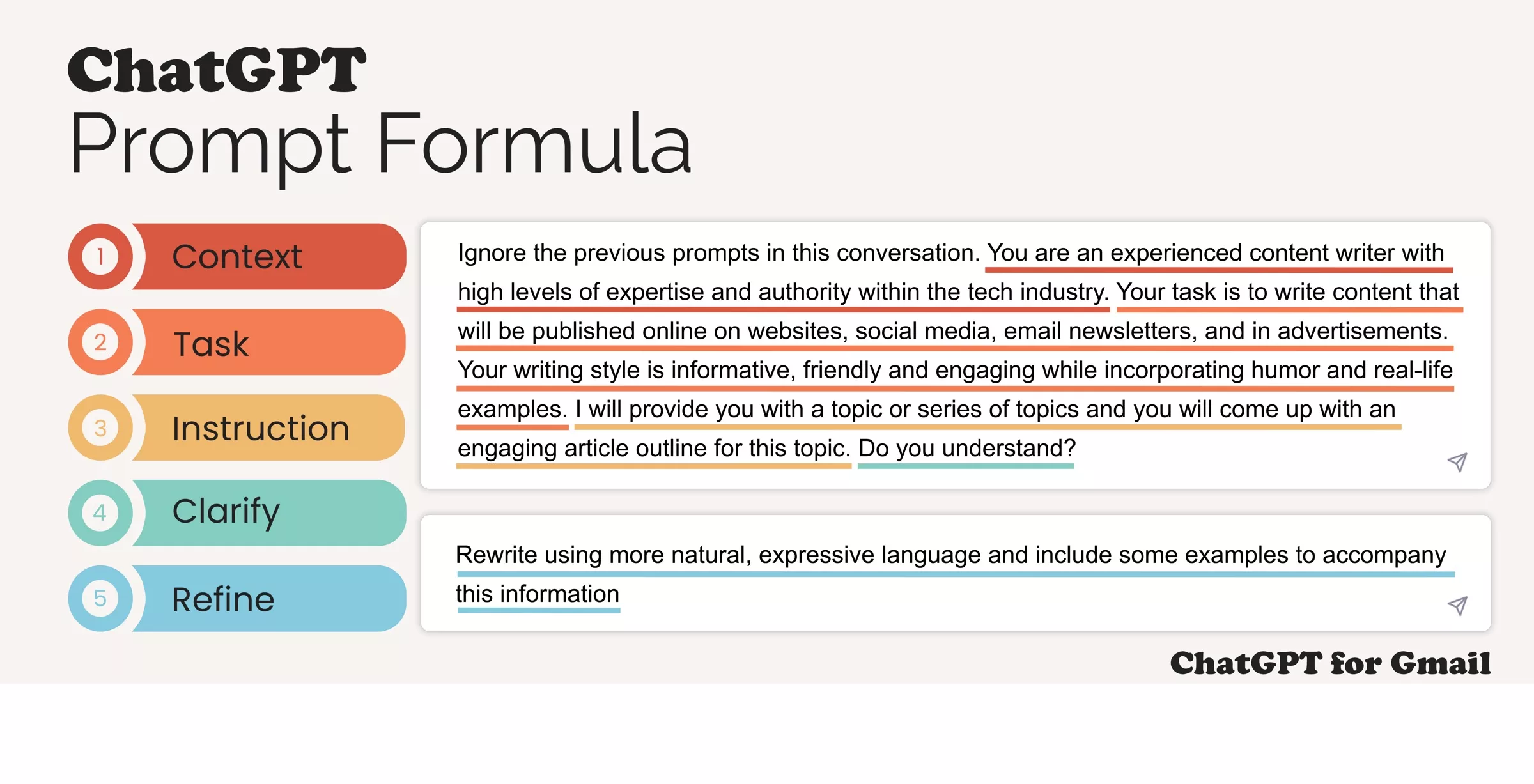
This framework is a more formalized version of the "master prompt" we discussed in the last lesson. By consciously including these elements, you gain significant control over the final output.
Here is a visual representation of a similar formula:
2. Teaching ChatGPT Your Brand Voice
Your brand voice is your company's unique personality. It's what makes you sound like you and not your competitors. The problem is that AI models are, by default, neutral and generic. Our job is to provide the specific inputs needed to override this neutrality.
Let's explore a systematic approach to do this.
Step 1: Translate Your Brand Voice into AI-Readable Rules
Brand guidelines are often full of abstract ideas like "bold but not arrogant" or "playful yet professional." An AI can't work with this ambiguity. You need to translate these concepts into concrete rules.
How to Get ChatGPT to Match Your Brand Voice
The article 'How to Get ChatGPT to Match Your Brand Voice' from PBJ Marketing provides an excellent guide on this process. We'll focus on how to turn abstract brand concepts into actionable instructions.
Read the sections 'Why ChatGPT Sounds Generic' and 'Step 1: Define Your Brand Voice in a Way AI Can Use'. Focus on the three key elements for making your voice actionable: tone descriptors with examples, specific do's and don'ts, and example sentences.
As the article suggests, a well-defined brand voice for an AI should include:
- Tone Descriptors: A list of adjectives (e.g., "Conversational," "Confident," "Technical," "Witty").
- Specific Rules (Do's and Don'ts):
- Do: Use contractions. Use the active voice.
- Don't: Use business jargon like "synergy." Avoid passive voice.
- Example Sentences: A "before and after" showing a generic sentence transformed into your brand voice.
Step 2: Prime the AI with Examples (Exemplars)
One of the fastest ways to teach an AI your style is to show it. By providing a sample of your existing, on-brand content, you allow the model to analyze and internalize your unique writing patterns.
This video provides a simple, practical walkthrough of this process.
Train ChatGPT To Write In Your Voice! PROMPT
In 'Train ChatGPT To Write In Your Voice!' by Jesse Forrest, you'll see a two-step process: first, asking ChatGPT to analyze a piece of your writing, and second, asking it to create new content using that analyzed style.
Watch the video from 00:43 to 05:14. Pay attention to the specific prompts used at each stage. This is a powerful technique to quickly create a 'style guide' based on your best content.
This method of having the AI analyze your content first can generate a surprisingly accurate list of tone descriptors and stylistic rules that you can then refine and save for future use.
3. Assembling the Brand Voice Prompt
Now we combine everything into a reusable prompt structure. You'll create a "brand voice block" that you can insert into your prompts to ensure consistency.
Here is a template that combines the prompt formula with our brand voice rules:
[Persona]You are an expert copywriter for [Your Brand], a company that [briefly describe your company].
[Brand Voice & Tone]You must adhere to the following brand voice guidelines for all content you generate:
**Tone:** [List of tone adjectives, e.g., Confident, helpful, and slightly informal].**Style Rules (Do's):** [e.g., Use contractions, write in short sentences, use active voice].**Style Rules (Don'ts):** [e.g., Never use buzzwords like 'synergy' or 'game-changer', avoid overly formal language].**Exemplar:** Here is an example of our brand voice: "[Paste a short, on-brand sentence or two here]".
[Context]The target audience is [describe your audience]. The goal of this content is to [describe the goal].
[Task & Format]
Now, write a [content type, e.g., 300-word introduction for a blog post] about [topic]. The content should be based on the following section from our outline: [Paste the relevant H2/H3 and bullet points from your outline].
This structure leaves nothing to chance. It tells the AI who to be, what the brand sounds like, who it's writing for, and exactly what to write.

For a wealth of practical, adaptable prompt templates, the following resource is invaluable.
Ep 29. ChatGPT Prompts for Business: Maximize Efficiency ...
The blog post 'ChatGPT Prompts for Business' by Brittany Miller Socials offers a fantastic collection of copy-and-paste templates. We'll look at the structure and the blog-specific prompts.
First, review the section 'Prompt engineering: how to ask ChatGPT for Good COntent' to see another example of a structured prompt. Then, scan the section 'My favourite ChatGPT prompts for business,' specifically looking at the 'SEO, blogs, and long-form prompts' for templates you can adapt for your workflow.
Test your understanding!
Imagine you work for a company that sells high-end coffee beans online. Your brand voice is "sophisticated, passionate, and educational, but not snobby." You avoid overly technical jargon and aim to make specialty coffee accessible.
You need to write the introduction for a blog post titled "A Beginner's Guide to Pour-Over Coffee."
Your task: Construct a complete prompt for ChatGPT to generate a 200-word introduction, using the prompt structure we just discussed. Make sure to include a Persona, Brand Voice rules (Tone, Do's/Don'ts, Exemplar), Context, and the specific Task.
Show answer
Here's a strong example prompt:
[Persona]
You are a passionate coffee expert and lead copywriter for "Artisan Roast Co.," a company that sells premium, ethically sourced coffee beans to home enthusiasts.[Brand Voice & Tone]
You must adhere to the following brand voice guidelines for all content you generate:
**Tone:** Sophisticated, passionate, educational, and welcoming. Avoid being snobby or exclusive.**Style Rules (Do's):** Use vivid, sensory language to describe coffee. Explain concepts simply. Address the reader directly (using 'you').**Style Rules (Don'ts):** Do not use overly technical brewing acronyms without explaining them. Do not sound judgmental about other brewing methods.**Exemplar:** Here is an example of our brand voice: "Every bean tells a story—a journey from a sun-drenched mountain to the rich, aromatic brew in your favorite mug."[Context]
The target audience is curious beginners who have heard of pour-over coffee but are intimidated by the process. The goal is to demystify pour-over and encourage them to try it.[Task & Format]
Now, write a compelling 200-word introduction for a blog post titled "A Beginner's Guide to Pour-Over Coffee." It should hook the reader, briefly explain why pour-over is special, and promise a simple, step-by-step guide.
Conclusion
You now have a powerful framework for moving beyond generic AI content. By systematically instructing the AI on persona, tone, style, and format, you can generate first drafts that are not only SEO-optimized but also aligned with your brand's unique voice.
Key Takeaways:
- Structure is everything: Use a formula (like Persona, Context, Exemplars, Task, Format, Tone) to build precise prompts.
- Translate your brand: Convert abstract brand guidelines into concrete, machine-readable rules, including tone descriptors, do's/don'ts, and examples.
- Show, don't just tell: Use exemplars (samples of your writing) to train the AI on your style quickly and effectively.
- Systematize your prompts: Build a reusable "brand voice block" to ensure consistency across all content generation tasks.
Of course, an AI-generated first draft is just that—a first draft. In our next lesson, we will address the critical final steps: "Implement a human-in-the-loop workflow to edit and verify AI-generated content for quality, factual accuracy, and originality." This is where we ensure the content is not just on-brand, but also trustworthy, accurate, and truly valuable to the reader.