Introduction
In our previous lesson, we derived the exact spin-spin correlation function for the 1D Ising model and found that the correlation length is finite for any non-zero temperature, diverging only as . This result is the definitive mathematical signature that something fundamental is missing in one dimension compared to our mean-field expectations.
This lesson directly addresses that finding. Our goal is to explain why the 1D Ising model has no finite-temperature phase transition, both from the exact solution and via a domain-wall entropy argument. We will first consolidate what our exact results for magnetization and correlation length tell us about the absence of spontaneous ordering. Then, we will develop a powerful and intuitive physical argument, based on the thermodynamics of defects, which explains why long-range order is so fragile in one dimension.
1. Argument from the Exact Solution
A phase transition into a ferromagnetic state is defined by the spontaneous appearance of a non-zero magnetization, , as the system is cooled below a critical temperature in the absence of an external field. Mathematically, this means the limit of the magnetization as the field is non-zero. Our exact solution allows us to test this condition directly.
Absence of Spontaneous Magnetization
Recall the expression for the magnetization per spin, , which can be derived from the Helmholtz free energy we found using the transfer matrix method.
[PDF] 1. The Ising Model - UBC Physics & Astronomy
This document provides the full derivation of the thermodynamic properties of the 1D Ising model. We will focus on the final result for the magnetization.
In the section titled "The Ising model in D = 1", please find equation (24), which gives the exact expression for the magnetization density m. Then, examine the conclusion drawn in equation (25), which evaluates the limit of this expression as the external field goes to zero.
The reading confirms the crucial result:
Since the spontaneous magnetization is zero for all temperatures above absolute zero, the system never enters a ferromagnetic phase. It remains in a paramagnetic state, where spins are correlated over short distances but there is no macroscopic, long-range alignment.
The video below walks through this same derivation and conclusion, which you may find helpful for reinforcing the logic.
Statistical Mechanics - Ising Model : The One Dimensional Ising Model
This video provides a pedagogical walkthrough of the transfer matrix solution and its consequences.
Watch the segment from this analysis, where the presenter takes the exact solution for magnetization and explicitly evaluates it in the limit of zero external field, concluding there is no spontaneous magnetization and thus no ferromagnetism.
Finite Correlation Length
The second, and arguably more fundamental, signature of a continuous phase transition is the divergence of the correlation length at the critical temperature . This divergence signifies the emergence of correlations over all length scales, which is the essence of long-range order.
As we established in the last lesson, the correlation length for the 1D Ising model is:
Let's analyze this function's behavior:
- For any finite temperature , the argument is finite.
- for any finite .
- is therefore finite and negative.
- Thus, is finite for any .
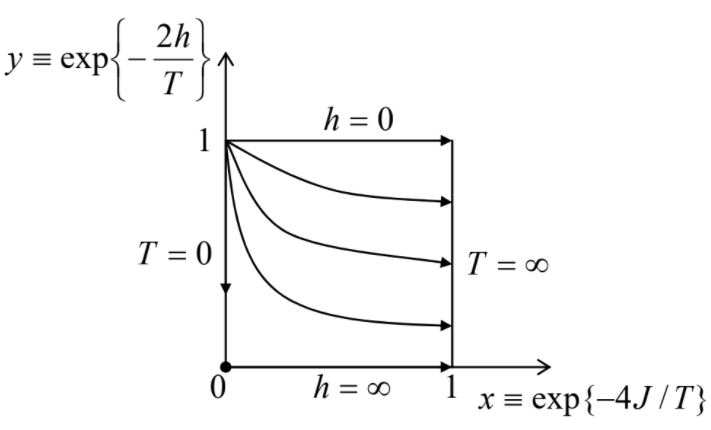
The correlation length only diverges as (), where and . This means the only critical point of the system is at absolute zero. A phase transition that occurs only at is not considered a true thermodynamic phase transition.
2. The Domain-Wall Argument: Energy vs. Entropy
While the exact solution provides a conclusive mathematical proof, a physical argument originally attributed to Landau and Peierls offers a deeper insight into why order is so fragile in one dimension. The argument is a beautiful application of thermodynamic reasoning, balancing the energy cost of creating a defect against its entropy gain. Your experience with modeling collective systems and their excitations should make this perspective feel very natural.
Let's consider the system at a low temperature and zero external field .
-
The Ordered State (Ground State): At , the system minimizes its energy by entering a perfectly ordered ground state. There are two such states: all spins up () or all spins down (). Let's consider the "all up" state. Its energy is approximately , and its entropy is , as it is a unique microstate.
-
Creating a Defect (A Domain Wall): Now, let's introduce the lowest-energy possible excitation. This involves flipping all spins to the right of a certain point, creating a single "domain wall" that separates a domain of up-spins from a domain of down-spins:
The vertical bar represents the domain wall.
-
The Energy Cost (): This defect disrupts only one bond. The energy of the bond at the wall changes from (for ) to (for ). Therefore, the energy cost to create this single domain wall is . Crucially, this cost is a constant, independent of the system size .
-
The Entropy Gain (): Where is the entropy gain? The domain wall is not fixed in space; it can be located at any of the links in the chain. The system's multiplicity has increased from to . This gives an entropy gain of:
-
The Free Energy Change (): To see if the system will spontaneously create such a wall, we must examine the change in the Helmholtz free energy, :
This simple equation holds the entire answer. For any finite temperature , no matter how small, the entropy term grows with the system size . For a sufficiently large system (approaching the thermodynamic limit, ), this logarithmic term will always overcome the constant energy cost . The change in free energy will become negative.
A negative means that the state with one domain wall is thermodynamically preferred over the perfectly ordered state. The system will spontaneously create domain walls to lower its free energy. These walls will proliferate throughout the chain, breaking it into finite-sized domains of up and down spins. The existence of a finite density of these randomly placed walls averages the total magnetization to zero, destroying any possibility of long-range order.
The following resource provides a concise summary of this powerful argument.
[PDF] Exact Results for the Ising Model
This section of the lecture notes lays out the thermodynamic domain-wall argument with great clarity.
Please read the entire section "Absence of long-range order in 1d". It directly derives the free energy difference \Delta F = \Delta E - kT \ln N and explains its consequences for long-range order.
Why is One Dimension Special?
This entropic argument seems so general, why doesn't it forbid phase transitions in two or three dimensions? The answer lies in the geometry of the domain wall.
- In 1D, a domain wall is a single point, costing a fixed energy .
- In 2D, to separate a region of up-spins from down-spins, you must create a domain wall that is a closed loop. The energy cost is no longer constant; it is proportional to the perimeter of the loop, . The entropy is related to the number of possible shapes of a loop of length . At low temperatures, the large energy cost of long loops is not compensated by the entropy gain, so large domains are suppressed, and long-range order can survive.
Professor Susskind provides a wonderful analogy for this, comparing the 1D case to a game of telephone and higher dimensions to a network with error-correcting capabilities.
Statistical Mechanics Lecture 9
In this excerpt, Leonard Susskind intuitively explains why dimensionality is key to sustaining order.
Watch his explanation from "How do you make it more interesting?". He contrasts the 1D chain, where a single "mistake" corrupts the entire message downstream, with a 2D lattice where a spin has multiple neighbors providing a "support system" or an "error-correcting" influence that helps maintain order.
This difference in the scaling of energy and entropy for defects is the fundamental reason why is a "low" dimension for this problem, while and higher are "high" enough to support a phase transition.
Conclusion
In this lesson, we have definitively established why the one-dimensional Ising model, despite being a cornerstone of statistical mechanics, does not exhibit a phase transition at any finite temperature.
Key Takeaways:
- From the Exact Solution: The calculated magnetization shows no spontaneous ordering () for any . The correlation length remains finite for all , only diverging at the critical point.
- From the Domain-Wall Argument: The free energy to create a domain wall is . For any , entropy wins in the thermodynamic limit (), making . This ensures a proliferation of domain walls that destroys long-range order.
- The Role of Dimensionality: This entropic destruction of order is a special feature of one dimension, where a defect is a zero-dimensional object (a point) with a size-independent energy cost.
Having thoroughly understood a system that lacks a phase transition, we are now perfectly positioned to build the general framework for describing systems that do. In the next module, we will begin our study of critical phenomena by classifying phase transitions, defining order parameters, and introducing the critical exponents that characterize the universal behavior of matter near a critical point.