Welcome to the next step in our construction of statistical mechanics. In our last lesson, we established the ergodic hypothesis, which justifies replacing the difficult-to-calculate time average of a single system with the more tractable ensemble average. This was a crucial move, as it gives us license to think in terms of a probability distribution over the microstates of a system. The immediate, and perhaps most fundamental, question that arises is: for a system in equilibrium, what is this probability distribution?
Today, we will answer this question for the simplest possible case: a completely isolated system. We will introduce the fundamental postulate of equal a priori probabilities, the bedrock assumption upon which equilibrium statistical mechanics is built. This lesson will define the postulate, explore its justifications from both dynamics and information theory, and set the stage for formally constructing the microcanonical ensemble.
1. The Arena: Isolated Systems and Accessible States
Before we can assign probabilities, we must clearly define the system we are studying. The simplest macroscopic setup is an isolated system: one that cannot exchange energy, volume, or particles with its surroundings. We characterize such a system by a fixed number of particles , a fixed volume , and a fixed total energy .
In reality, due to the uncertainty principle and microscopic fluctuations, the energy is never perfectly fixed. Therefore, we more accurately consider the system's energy to lie within a very narrow shell, , where .
The microstate of a classical system is a point in the -dimensional phase space. The set of all microstates consistent with the macroscopic constraints () is called the set of accessible microstates. The total number of such states (or, more precisely, the volume they occupy in phase space) is denoted by .
The following resource provides a clear definition of these core concepts.
These notes from the University of Oregon formalize the language we will be using.
Please read the sections that define the key terms for our discussion. Start in "1.3.1 Statistical Description of Large Systems" and read the definitions for microstate, macrostate, and accessible states. This establishes the hierarchy from microscopic details to macroscopic observables. Then, read the beginning of "1.3.2 The Equilibrium State," specifically the definitions for an isolated system and equilibrium.
With the concepts of an isolated system and its accessible microstates established, we can now ask how probability is distributed among them.
2. The Postulate of Equal a Priori Probabilities (PEAPP)
The foundational assumption of statistical mechanics for an isolated system is startlingly simple. It is known as the postulate of equal a priori probabilities:
For an isolated system in equilibrium, all accessible microstates are equally likely.
If there are accessible microstates, the probability of finding the system in any specific microstate is:
The term "a priori" is Latin for "from the earlier" and in this context means "based on reason alone, without prior experience." The postulate is an expression of the principle of indifference: in the absence of any information to the contrary, we have no reason to prefer one accessible microstate over another. We therefore assign them all the same probability.
The following video from an MIT OpenCourseWare lecture by Prof. Mehran Kardar presents this postulate as the starting point for the microcanonical ensemble.
13. Classical Statistical Mechanics Part 2
This clip introduces the microcanonical ensemble and provides the reasoning for assuming equal probabilities.
Watch the segment from the introduction of the microcanonical ensemble. Pay attention to how the postulate is framed as the most reasonable assumption to make for an isolated system, analogous to assuming a fair die.
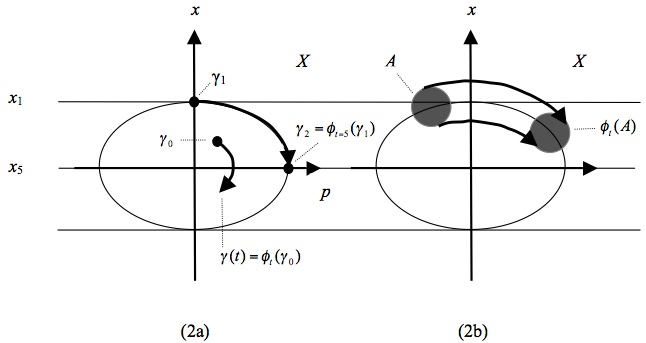
This postulate is deeply connected to the ergodic hypothesis from our previous lesson. If a system is ergodic, its trajectory explores the entire constant-energy surface of phase space. Over a long time, it spends an equal amount of time in every equal-sized volume of this surface. This dynamical behavior provides a powerful physical justification for assuming that at any given moment, the system is equally likely to be found in any of its accessible microstates.
3. Justifications for the Postulate
While it is called a "postulate," this principle is not arbitrary. It has strong justifications from both physics and information theory. Your preference for rigor makes it essential to examine the most powerful of these justifications.
Dynamical Justification: Ergodicity
As mentioned, the ergodic hypothesis provides the physical underpinning for PEAPP. The hypothesis states that for almost all initial conditions, the time average of an observable equals its ensemble average.
For an isolated system, the equilibrium distribution must be constant on the energy surface (from Liouville's theorem). Ergodicity ensures that the time-evolving system explores this surface without bias. Therefore, the only reasonable choice for the probability distribution is one that is uniform over the accessible states—which is precisely PEAPP.
Information-Theoretic Justification: Maximum Entropy
Perhaps the most elegant justification for PEAPP comes from information theory, a perspective pioneered by E.T. Jaynes. The task is to assign a probability to each microstate based on our limited knowledge. Our knowledge is simply that the system is isolated and in equilibrium, so its microstate must be one of the accessible ones.
We seek the probability distribution that is the "most honest" or "least biased" given this information. This is achieved by maximizing the Gibbs-Shannon entropy,
subject to the constraints we have. In this case, our only constraint is normalization: , where the sum is over the accessible states.
The following text explicitly carries out this maximization procedure and shows that it leads directly to the postulate of equal a priori probabilities.
PHYS11024: Statistical Physics 2024–2025
This textbook excerpt provides a concise mathematical derivation of PEAPP from the principle of maximum entropy.
Please read the section titled Example 1 on page 19, which begins right after the "Mathematical aside". It is located within Chapter 3, under "The maximum entropy approach". This short derivation uses the method of Lagrange multipliers to maximize the entropy given only the normalization constraint. You will see that this procedure uniquely determines the probability distribution to be uniform, p_i = 1/M (where their M is our \Omega), which is the statement of PEAPP.
This information-theoretic argument is profound. It reframes the postulate not just as a plausible physical assumption, but as the only logical inference we can make about the equilibrium state of an isolated system given the available information. It is the distribution that reflects our knowledge without introducing any unwarranted assumptions.
Conclusion
In this lesson, we have laid down the first cornerstone of equilibrium statistical mechanics. By combining the concepts of an isolated system and its accessible microstates, we arrived at the fundamental rule for assigning probabilities in this context.
Key Takeaways:
- An isolated system is characterized by fixed macroscopic constraints: number of particles (), volume (), and energy ().
- The accessible microstates are all microscopic configurations compatible with these constraints. Their total number is .
- The postulate of equal a priori probabilities (PEAPP) states that for an isolated system in equilibrium, all accessible microstates are equally likely.
- This postulate is not arbitrary. It is justified physically by the ergodic hypothesis and, perhaps more rigorously, as the unique probability distribution that maximizes entropy subject to our knowledge of the system.
With this postulate in hand, we are now equipped to formalize our description of isolated systems. In the next lesson, we will define the microcanonical ensemble based on PEAPP. We will then take the crucial step of connecting the microscopic world to thermodynamics by deriving Boltzmann's celebrated formula for entropy, , directly from this foundation.