Welcome to our final lesson in the module on quantum statistical mechanics. In our previous session, we meticulously calculated the partition function for a system of quantum harmonic oscillators and discovered a profound connection: the average excitation level of an oscillator, , follows the Bose-Einstein distribution for particles with zero chemical potential. This finding is the crucial stepping stone for today's topic.
Today, we will address one of the foundational problems that marked the birth of quantum theory: blackbody radiation. Our goal is to derive the Planck distribution for blackbody radiation by treating photons as a gas of non-conserved bosons. We will model the electromagnetic field inside a cavity as a collection of independent harmonic oscillators, where the quantized excitations of these oscillators are the photons. By combining the Bose-Einstein statistics for these photons with a calculation of the available electromagnetic modes, we will arrive at the celebrated formula that perfectly describes the spectrum of thermal radiation and resolved the "ultraviolet catastrophe" that plagued classical physics.
1. The Photon Gas: A Gas of Non-Conserved Bosons
The problem of blackbody radiation concerns the spectral distribution of electromagnetic radiation in thermal equilibrium with the walls of a cavity at a fixed temperature . According to the quantum theory of radiation, this electromagnetic field is composed of discrete energy quanta called photons. To apply statistical mechanics, we must first understand the key properties of this "photon gas."
The following video provides an excellent introduction to this concept. It clearly explains why photons are treated as bosons and, most importantly, establishes the critical property that distinguishes a photon gas from an ordinary gas of atoms.
Statistical Mechanics - Bose-Einstein Statistics : Planck’s Law for Blackbody Radiation
This video from the "Advanced Physics" channel sets up the problem by outlining the properties of photons and explaining how they differ from a conventional gas.
Please watch from the beginning up to the first eleven minutes. Pay close attention to these two key arguments: Photons as Bosons (at this timestamp): The video explains that photons have an integral spin (spin-1), which means they obey Bose-Einstein statistics. Non-conservation of Particles (from this point): This is the most crucial part. Unlike atoms in a box, photons can be absorbed and emitted by the cavity walls. Their total number N is not constant. The video explains that this lack of a conservation constraint on particle number means the associated Lagrange multiplier \alpha in the Bose-Einstein distribution is zero. Since \alpha = -\mu/k_BT, this implies the chemical potential for a photon gas is zero: \mu = 0.
The conclusion from the video is central to our entire derivation. For a gas of non-conserved particles like photons, the chemical potential . Recalling the Bose-Einstein distribution for the average occupation number of a state with energy :
Setting and using the photon energy relation , we find the average number of photons in a single electromagnetic mode of frequency :
This is precisely the expression for the average excitation number of a quantum harmonic oscillator that we found in the last lesson. This confirms our model: the thermal energy of the electromagnetic field can be understood by summing the energies of its constituent modes, each behaving as a quantum harmonic oscillator populated by a bosonic quasi-particle, the photon.
2. Counting the Modes: The Density of States
To find the total energy in the cavity, we must sum the average energy of every possible electromagnetic mode. Since the frequencies of these modes form a near continuum, we need to replace a direct sum with an integral. This requires knowing how many modes exist within a given frequency interval, a quantity known as the density of states, .
The derivation involves considering the allowed wavevectors in a finite box and then taking the thermodynamic limit. David Tong's lecture notes provide a clear and mathematically rigorous derivation of this quantity.
3 Quantum Gases‣ Statistical Physics by David Tong
These notes derive the density of states for a general relativistic system and then specialize it for photons.
Please read the section titled "3.1 Density of States" and the beginning of "3.2 Photons: Blackbody Radiation". Begin by reading the general derivation of the density of states. Focus on how the sum over discrete states is converted into an integral over momentum, as shown here. Next, read the subsection "3.1.1 Relativistic Systems", which shows that for massless particles like photons, the density of states is proportional to E². Finally, read the start of section "3.2 Photons: Blackbody Radiation" up to the final expression for g(\omega)d\omega. The key step here is to account for the two polarization states of the photon, which introduces a factor of 2. Then, the energy E is replaced with frequency \omega using E=\hbar\omega to get the density of states in terms of frequency.
From this reading, the number of electromagnetic modes in a volume with angular frequency between and is:
This expression tells us that the number of available modes grows quadratically with frequency. This is a crucial piece of the puzzle.
3. Assembling the Pieces: The Planck Distribution
We now have all the necessary components to derive the Planck distribution. The energy density of radiation, , within a small frequency interval is the product of three factors:
- The number of modes per unit volume in that interval: .
- The average number of photons occupying each of these modes: .
- The energy carried by a single photon in that mode: .
The video you watched earlier walks through this exact calculation, combining the density of states with the Bose-Einstein distribution.
Statistical Mechanics - Bose-Einstein Statistics : Planck’s Law for Blackbody Radiation
This part of the video executes the final steps of the derivation.
Please watch from this section. The lecturer first calculates the density of states (which will be a good review of the reading) and then multiplies the three factors together to arrive at Planck's famous formula.
Multiplying the three terms gives the energy per unit volume in the frequency range from to :
Rearranging terms, we obtain the Planck Radiation Law:
This formula gives the spectral energy density of blackbody radiation as a function of angular frequency and temperature .
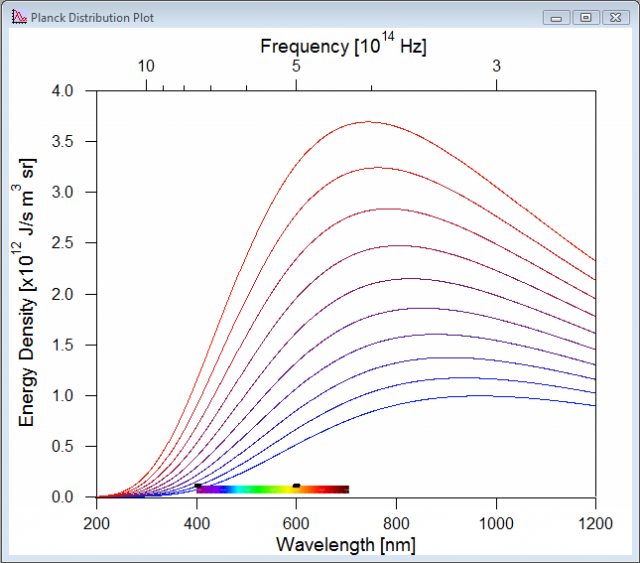
This result was a triumph of quantum statistical mechanics.
- At low frequencies (), we can approximate . The formula reduces to , which is the classical Rayleigh-Jeans law. This law agrees with experiment at low frequencies but diverges at high frequencies—the ultraviolet catastrophe.
- At high frequencies (), the exponential term dominates, and . This exponential suppression prevents the divergence and correctly describes the experimental observation that the spectrum falls to zero at high frequencies.
For completeness, the derivation can also be performed more formally by first calculating the log of the grand partition function for the photon gas and then finding the internal energy, as shown in the KIT lecture notes.
[PDF] Lecture Notes, Statistical Mechanics (Theory F) - TKM (KIT)
These notes offer a slightly more abstract but equivalent derivation, which you might appreciate for its formal structure.
Please read the section "5.2.7 Photons in equilibrium" (page 60-61). Notice how the author starts with the expression for internal energy as a sum over states, written here. The integral contains the density of states and the Bose-Einstein factor implicitly. The derivation then explicitly finds the density of states and substitutes it in to get the famous Planck formula.
Conclusion
In this lesson, we successfully applied the principles of quantum statistical mechanics to derive the Planck distribution for blackbody radiation. By modeling the electromagnetic field as a collection of harmonic oscillators and treating the excitations—photons—as a gas of non-conserved bosons, we arrived at a formula that perfectly matched experimental data and resolved a major crisis in classical physics.
Key Takeaways:
- A gas of photons is a system of non-interacting bosons whose particle number is not conserved, leading to a chemical potential of .
- The average number of photons in a mode with frequency is given by the Bose-Einstein distribution .
- The density of electromagnetic modes in a volume is , including a factor of 2 for polarization.
- Combining these elements gives the Planck distribution for spectral energy density: .
We have now seen Bose-Einstein statistics applied to both phonons (in the harmonic oscillator model) and photons. This concludes our module on the formalism of quantum statistical mechanics. In the next module, we will shift our focus to the other family of quantum particles—fermions—and begin by exploring the properties of the ideal Fermi gas, a model of fundamental importance for understanding electrons in metals and the structure of white dwarf stars.