Introduction
Welcome back! In our previous lesson, we analyzed the powerful impact of currency exchange rates on the Sri Lankan economy and the Colombo Stock Exchange (CSE). We saw how a weakening LKR can hurt importers but benefit exporters, and critically, how currency instability can deter foreign investors.
Today, we'll expand on that theme to cover our final topic in this module. This lesson addresses the learning outcome: Explain how global economic events and foreign investor activity can influence the CSE.
Sri Lanka's economy and stock market do not operate in a vacuum. They are deeply interconnected with the global financial system. Decisions made by central bankers in Washington, geopolitical events in Europe, and the sentiment of international investors can create significant ripples—and sometimes waves—in the CSE. Understanding these connections is vital for any serious investor.
Part 1: The Global-to-Local Transmission
Global events affect the CSE through several channels. Major events, like a pandemic or a war, can disrupt supply chains and commodity prices. However, one of the most powerful and consistent channels is the monetary policy of major economies, especially the United States.
A Perfect Storm: Global Factors in the 2022 Crisis
The 2022 Sri Lankan economic crisis is a stark case study of how pre-existing domestic vulnerabilities can be dramatically amplified by global shocks. To understand this dynamic, let's look at how experts analyzed the situation as it unfolded.
Sri Lanka’s economic collapse ringing ‘alarm bells’ for emerging markets: Expert
This video from Yahoo Finance, filmed during the 2022 crisis, explains how Sri Lanka's situation was seen as a warning for other emerging markets. It highlights the mix of domestic and global factors at play.
Please watch from the beginning to 02:42. As you watch, listen for the global factors the speaker identifies as contributing to the crisis. You'll hear about the pandemic, fiscal management, high debt, the war in Ukraine, and interest rate hikes by major central banks.
The video identifies a "toxic mixture" of events. While Sri Lanka had its own severe domestic issues (like tax cuts and policy missteps), the situation was pushed over the edge by global factors:
- The Russia-Ukraine War: This caused a surge in global energy and food prices, dramatically increasing Sri Lanka's import bill.
- Higher Interest Rates: Major central banks, like the U.S. Federal Reserve (the Fed) and the European Central Bank (ECB), started raising interest rates to fight their own domestic inflation.
This next reading confirms the role of these global pressures.
Sri Lanka: From Stability to Growth
This article, 'Sri Lanka: From Stability to Growth', reflects on the 2022 crisis from a later perspective. Its opening sentences provide a concise summary of the global triggers.
Please read the first paragraph of the article. Notice how it explicitly names the war in Ukraine and the U.S. Federal Reserve's tightening cycle as the 'final straw' for the Sri Lankan economy.
Both resources point to the same conclusion: global events mattered, and they mattered a lot. Let's now zero in on the most influential of these factors: U.S. interest rate hikes.
The Spillover Effect of U.S. Monetary Policy
When the U.S. Federal Reserve raises its interest rates, it creates a powerful ripple effect across the globe. For investors, it changes the fundamental equation of risk and reward.
This infographic provides an excellent overview of the process.
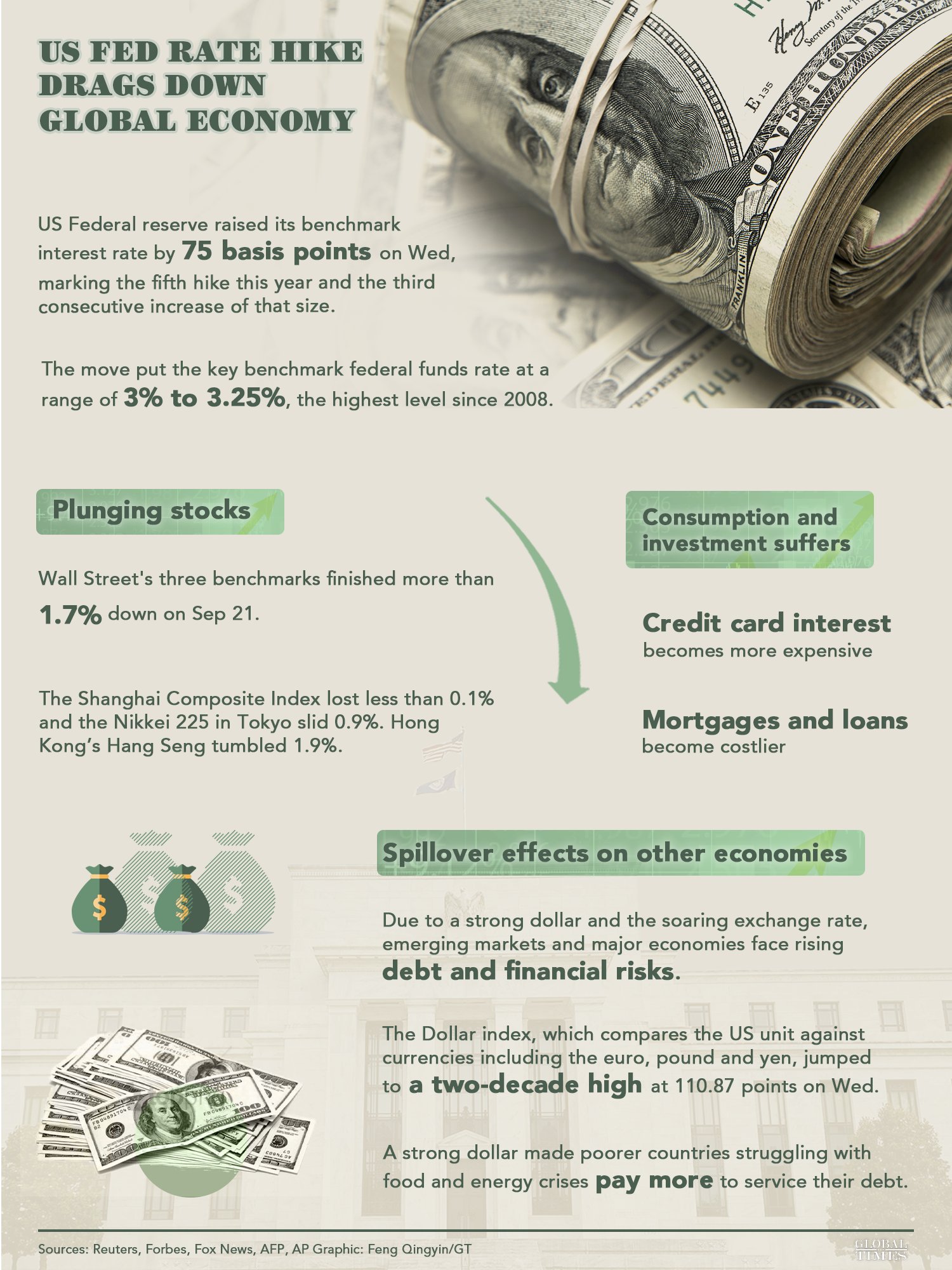
The core mechanism is capital flow. Global investment capital is mobile, constantly seeking the best possible return for a given level of risk.
- When U.S. interest rates are low, investors are more willing to seek higher returns in riskier assets, including stocks in emerging markets like Sri Lanka. This is often called a "risk-on" environment.
- When U.S. interest rates rise, investors can get a higher, safer return from U.S. government bonds. This makes emerging market stocks seem less attractive by comparison. Capital flows out of emerging markets and back to the U.S. This is a "risk-off" environment.
This movement of capital out of emerging markets is often called "capital flight." The following academic paper explains this mechanism in more detail.
How Have Central Bank Interest Rate Policies After COVID-19 Affected Stock Market Volatility
This research paper discusses how central bank policies affect stock markets. While academic, some sections clearly explain the 'spillover' effect on emerging markets. We will focus on these key explanations.
Please read the following specific parts of the paper. Don't worry about the academic jargon; focus on the core ideas. Find the paragraph that starts with 'This discrepancy raises questions...'. Read to the end of that section. It explains that rising interest rates in advanced economies attract capital away from emerging markets. Go to the section titled 'Emerging Markets: Hit Hard by Global Financial Spillovers'. Look at the paragraph below 'Figure 4'. It describes how rising U.S. yields were accompanied by a decline in emerging market equities as capital moved to safer U.S. assets. Finally, find the section 'Interest Rate Increases and Their Unpredictable Consequences'. Read the bullet point that begins 'Capital flight out of emerging markets...'. It explicitly states that higher U.S. yields draw capital out, leading to falling stock prices in emerging markets.
To summarize this crucial mechanism:
U.S. Fed raises rates ➝ U.S. bonds become more attractive ➝ Global investors sell riskier assets (like CSE stocks) ➝ Capital flows out of Sri Lanka ("capital flight") ➝ Selling pressure pushes down stock prices on the CSE.
(This is a good point for a break. We've established how major global events, particularly U.S. interest rate changes, are transmitted to the CSE through the flow of international capital.)
Part 2: Foreign Investors and the Flow of "Hot Money"
In the first part, we discussed the "why"—why global events cause capital to move. Now, let's focus on the "who" and "what"—the foreign investors and the nature of their investments.
Foreign Portfolio Investment (FPI)
When we talk about foreign investors in the stock market, we are primarily referring to Foreign Portfolio Investment (FPI). This is distinct from Foreign Direct Investment (FDI), which involves building physical assets like factories and is considered a long-term investment.
FPI is the purchase of financial assets, such as stocks and bonds. It is often called "hot money" because it can be moved into and out of a country's market very quickly.

FPI's Impact on the CSE
The flow of FPI has a direct and significant impact on the CSE's performance.
-
Capital Inflows: When foreign investors are optimistic about Sri Lanka's prospects, they buy stocks. This large-scale buying increases demand across the market, pushing up share prices. A rising market can then attract even more foreign capital, creating a positive feedback loop. This contributes to bull markets.
-
Capital Outflows: When sentiment turns negative (due to local or global reasons), foreign investors sell their holdings to move their money elsewhere. This coordinated selling can overwhelm local buying, putting broad downward pressure on the market and causing sharp declines.
The Evidence of Recovery: FPI Returns to Sri Lanka
The article we looked at earlier, "Sri Lanka: From Stability to Growth," provides a perfect example of this dynamic in reverse. After the crisis, conditions began to stabilize, and the CSE became extremely cheap from a valuation perspective.
Let's revisit that article to see what happened next.
Sri Lanka: From Stability to Growth
This article discusses the CSE's remarkable recovery. This recovery was fueled by renewed investor confidence, which includes the return of foreign capital attracted by stability and low valuations.
Please reread two parts of the article. Near the end of the introduction, note the sentence about the price-to-earnings (P/E) ratio of the Colombo All-Share Index being only 4.0x at the end of 2022. Then, read the section that starts with 'The combination of macroeconomic stability...'. \nFocus on how the combination of stability, recovery, and 'very attractive company valuations' led to a 'significant re-rating' and a massive return in the stock index. This 're-rating' is the market's way of saying investors, including foreign ones, are confident again and willing to pay more for the same assets.
The CSE returning "nearly 200 percent in US dollar terms" since the start of 2023 is a clear sign that capital flowed back into the country. Foreign investors, seeing a stabilized currency, a path to recovery, and extremely low stock valuations (a P/E of 4.0x is remarkably low), saw a major investment opportunity. Their buying helped fuel the market's powerful rally.
As an investor, you can track this activity. The CSE publishes daily, weekly, and monthly data on net foreign flows, showing whether foreign investors were net buyers or net sellers. This is a key data point that market analysts watch closely.
Conclusion
In this lesson, we have connected the dots between the global economy and the stock market in Colombo.
Key Takeaways:
- The CSE is not an isolated market; it is highly susceptible to global economic events.
- Key transmission channels include global commodity prices, geopolitical events, and, most importantly, interest rate changes by major central banks like the U.S. Federal Reserve.
- Higher interest rates in developed markets can trigger capital flight from emerging markets like Sri Lanka, as investors move their money to safer, higher-yielding assets. This puts downward pressure on the CSE.
- Foreign Portfolio Investment (FPI), or "hot money," is a major force in the market. Capital inflows from FPI can fuel bull markets, while outflows can cause sharp declines.
- The 2022 crisis and the subsequent market recovery in 2023-2024 are clear examples of this dynamic: global shocks exacerbated the downturn, and renewed confidence (partly from foreign investors) fueled the rebound.
Preview of the Next Lesson:
This lesson concludes our module on Macroeconomic Analysis. You now have a solid framework for understanding the "big picture" forces that shape the investment landscape in Sri Lanka.
In our next module, we will begin the final and most practical part of this course: Capstone: Building Your CSE Investment Plan. We will start by shifting the focus from the market to you, addressing the first learning outcome of that module: "Define personal financial goals and an appropriate investment time horizon." It's time to start building your personal toolkit for investing.