Introduction
Welcome to the first lesson of our module on the Principles of Stock Valuation. In the previous module, we focused on qualitative analysis, learning how to assess a company's business model, competitive landscape, and management quality. We learned how to identify a good business.
Now, we shift our focus to a critical question: what is that good business worth? This lesson tackles the foundational concept that underpins all valuation: explaining the concept of intrinsic value versus market price. Understanding this distinction is the single most important step in moving from a speculator, who bets on price movements, to an investor, who buys pieces of a business based on its underlying worth.
By the end of this lesson, you will understand the difference between the price you see on a stock ticker and the true value of the company behind it, setting the stage for all the valuation techniques we will learn next.
Price vs. Value: A Tale of Two Numbers
In everyday life, we often use "price" and "value" interchangeably. In investing, however, they are two distinct and crucial concepts. The market gives us a price for a stock every second of the trading day. Our job as analysts is to estimate the company's value.
Let's start by defining our terms.
- Market Price: This is the current price at which a stock can be bought or sold on an exchange, like the Colombo Stock Exchange (CSE). It's determined by the immediate forces of supply and demand and can be influenced by news, analyst ratings, economic data, and overall market sentiment (often called "investor psychology"). It is what you pay.
- Intrinsic Value: This is the underlying, fundamental worth of a business. It's an estimate of what the company is truly worth, based on its ability to generate cash and profits over its lifetime. It is what you get.
The famous investor Warren Buffett summarized this perfectly: "Price is what you pay. Value is what you get."
This image provides a clear visual breakdown of the factors that typically influence each one.
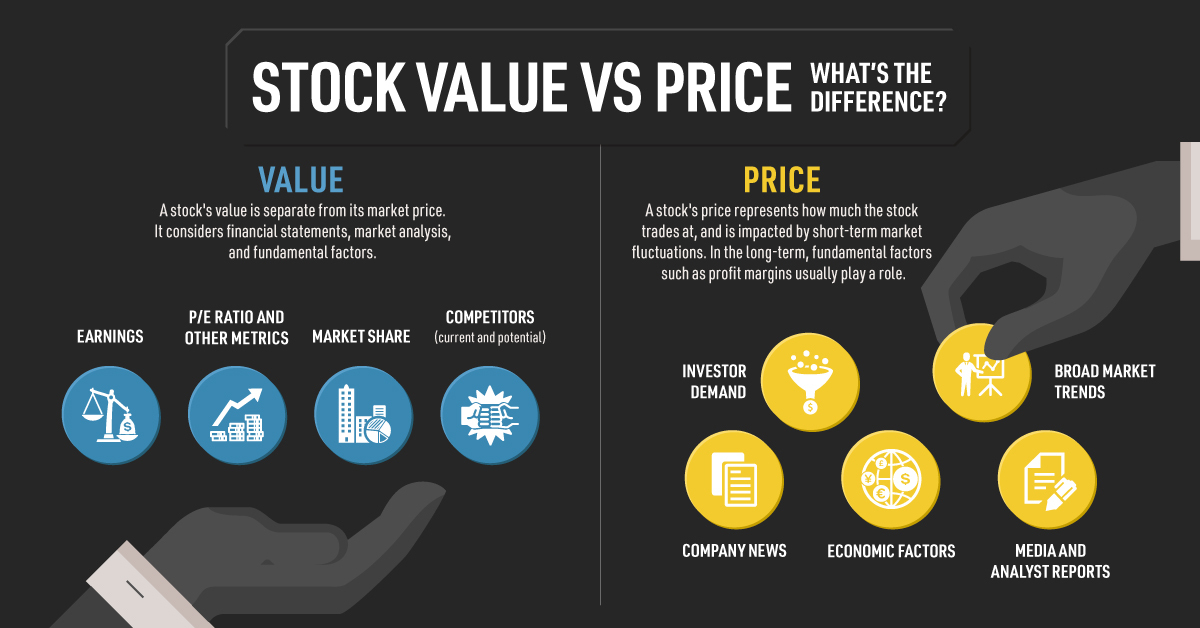
As you can see, intrinsic value is rooted in the long-term, fundamental performance of the business itself—the very things we learned to assess in our qualitative analysis module. Market price, on the other hand, can be swayed by many short-term, often emotional, factors.
Defining Intrinsic Value
So, how do we think about a company's "true" worth? Let's begin with a simple but powerful analogy.
Warren Buffett: How to Calculate the Instrinsic Value of a Stock
This video from the New Money channel provides an excellent high-level introduction to valuation. The first part introduces a helpful analogy for thinking about a business.
Watch the segment from 00:18 to 01:30. Focus on the idea of a business as a 'money printing machine' and the difference between its market capitalization (price) and its intrinsic value.
The video explains that market capitalization (share price × number of shares) is the market's current price for the entire company. Intrinsic value is what we, as investors, believe the entire company is actually worth.
- If Market Cap > Intrinsic Value, the stock is likely overvalued.
- If Market Cap < Intrinsic Value, the stock is likely undervalued.
This begs the question: how do you calculate that intrinsic value? Let's hear the most widely accepted definition directly from Warren Buffett.
Warren Buffett: How to Calculate the Instrinsic Value of a Stock
In this next clip from the same video, Warren Buffett provides the classic definition of intrinsic value. This is a cornerstone concept in finance.
Watch from 01:52 to 04:13. Pay close attention to Buffett's explanation of intrinsic value as the discounted value of all future cash a business will generate. Notice his comparison of a stock to a bond: with a bond, the future cash flows are known; with a stock, it's the analyst's job to estimate them.
Buffett's definition is the theoretical bedrock of valuation:
Intrinsic value is the discounted value of the cash that can be taken out of a business during its remaining life.
In simpler terms, a business is worth the sum of all the cash it will produce for its owners from now until it ceases to exist, with an adjustment to reflect the fact that money received in the future is worth less than money received today (a concept called the "time value of money," which we'll explore in a later module).
Your IT background gives you experience with complex systems. Think of a company's intrinsic value as the total, long-term productive output of that system. The daily market price is more like a single, noisy performance metric that fluctuates but doesn't always reflect the system's true health or capability.
The Dance of Price and Value
A key insight for investors is that a company's intrinsic value tends to be much more stable than its market price. The market price often dances around the intrinsic value, driven by fear and greed.

This fluctuation is not a problem; it's an opportunity. The goal of a value investor is to buy a stock when the market price falls significantly below your estimate of its intrinsic value.
The Margin of Safety: Your Buffer for Uncertainty
You might be thinking, "Estimating all future cash flows sounds difficult and uncertain." You're right. It's an imprecise art, not an exact science. Because our estimates of intrinsic value can be wrong, we need a buffer.
This buffer is called the Margin of Safety, a concept developed by Benjamin Graham, the father of value investing.
How to Tell When a Stock is Cheap/Expensive (Masterclass in Stock Valuation)
This video by The Swedish Investor does an excellent job of explaining the margin of safety and why it's so crucial.
Watch the segment from 07:59 to 10:47. Focus on understanding: What a margin of safety is. Why it's necessary (valuation is imprecise, the future is unpredictable). How the required margin of safety can change depending on the predictability of the business.
A margin of safety means demanding to buy a stock at a significant discount to your calculated intrinsic value. For example, if you estimate a company's stock is worth 100 LKR per share, you might only be willing to buy it if the market price drops to 60 LKR. That 40 LKR difference is your margin of safety. It protects you from:
- Errors in your valuation: Your assumptions about future growth might be too optimistic.
- Unforeseen problems: The company or its industry might face unexpected challenges.
- Bad luck: Sometimes, things just go wrong.
Applying the Concept in Sri Lanka
This framework of value vs. price is universal and directly applicable to your goal of investing in the Colombo Stock Exchange. Local financial educators and even the regulator emphasize this approach.
Let's look at a local resource.
Fair Value Calculator for Sri Lankan Stocks - Growclub.lk
The Sri Lankan financial education site Growclub.lk has a tool for calculating 'fair value'. In their FAQ, they define this term and explain its importance for investors on the CSE.
Read the FAQ section and the introductory text under 'Unlock Smarter Investing...'. Notice how they define 'fair value' as 'intrinsic worth' and highlight its role in finding undervalued stocks on the CSE. This directly connects the global concept we've discussed to your local market.
Furthermore, the Securities and Exchange Commission of Sri Lanka (SEC), the main regulator for the CSE, also endorses this approach.
Fundamental Analysis to Stock Market
This short page from the SEC of Sri Lanka website explains the purpose of 'Fundamental Analysis'.
Read the brief text on this page. Note how it explicitly states that by examining a company's financial data, you can identify whether its share price is 'overvalued or undervalued' to make better investment decisions.
Both local resources confirm that the core task of a fundamental investor in Sri Lanka is to compare the market price to an estimate of intrinsic value.
Conclusion
Congratulations on completing this foundational lesson! You now understand the most important principle in value investing.
Key Takeaways:
- Market Price is what a stock costs on the exchange, driven by short-term supply and demand.
- Intrinsic Value is what a business is fundamentally worth, based on its long-term ability to generate cash.
- Investing success often comes from buying businesses when their market price is significantly below their intrinsic value.
- Because estimating intrinsic value is an uncertain process, a Margin of Safety is essential to protect you from errors and bad luck.
- This framework of comparing price to value is the basis of fundamental analysis for stocks all over the world, including those on the Colombo Stock Exchange.
Preview of the Next Lesson:
Now that you understand the what (intrinsic value) and the why (to find undervalued opportunities), we can move on to the how. In our next lesson, we will distinguish between the two main approaches to valuation: absolute valuation and relative valuation. This will provide the roadmap for the practical valuation tools you will learn throughout the rest of this course.