Introduction
Welcome back! In our last lesson, you learned how to assess your personal risk tolerance and use it to determine a high-level asset allocation, such as an 80% stock and 20% bond mix. This raises a critical question: how do you build the "stock" portion of your portfolio? Is it wise to invest all 80% in a single company you believe in?
This strategy, known as putting all your eggs in one basket, is incredibly risky. If that one company performs poorly, your entire portfolio suffers. This lesson introduces diversification, the fundamental principle of spreading your investments to reduce risk. We will explore how diversification works by breaking down investment risk into two distinct types and showing how you can eliminate one of them.
By the end of this lesson, you will be able to explain the concept of diversification and understand its crucial role in reducing unsystematic risk.
1. Total Risk: A Tale of Two Risks
Every investment carries risk, but not all risk is created equal. The total risk of a stock can be broken down into two components:
- Unsystematic Risk: This is risk that is specific to a single company or industry. It's also known as "diversifiable risk" or "specific risk."
- Systematic Risk: This is risk that affects the entire market or economy. It's also known as "market risk" or "non-diversifiable risk."
Let's use an example. Imagine you invest only in Hayleys PLC, a major Sri Lankan conglomerate.
- An unexpected legal dispute involving one of their subsidiaries would be an unsystematic risk. It primarily affects Hayleys.
- A decision by the Central Bank of Sri Lanka to raise interest rates, slowing down the entire economy, would be a systematic risk. It affects Hayleys, but it also affects almost every other company listed on the Colombo Stock Exchange (CSE).
To solidify these concepts, please watch the following video. It provides clear definitions and examples for both types of risk.
Systematic Risk vs Unsystematic Risk
This video from Edspira offers a clear and concise explanation of the difference between systematic and unsystematic risk using real-world examples.
Watch from 01:07 to 03:12. The first part (starting at 01:07) defines unsystematic (firm-specific) risk. The second part (starting at 01:49) defines systematic (market-wide) risk.
2. Eliminating Risk with Diversification
The key takeaway is that you can protect yourself from unsystematic risk. How? By not relying on a single company's fate.
When you build a portfolio with many different stocks, the company-specific events start to cancel each other out. For every company that faces an unexpected problem (a negative unsystematic event), another might announce a surprisingly good quarter (a positive unsystematic event). As you add more and more uncorrelated stocks to your portfolio, these random, specific events "average out," and their impact on your overall portfolio diminishes.
This is the essence of diversification: it systematically reduces unsystematic risk.
However, diversification cannot protect you from systematic risk. A global recession or a major political event in Sri Lanka will likely impact all the stocks in your portfolio, regardless of how many you own. This is why systematic risk is called "non-diversifiable."
Therefore, the total risk of your portfolio can be expressed as:
Through diversification, we aim to make the unsystematic risk component as close to zero as possible.
3. Visualizing the Power of Diversification
The effect of adding more stocks to a portfolio is not just theoretical; it can be clearly visualized. As you increase the number of different securities you own, the total risk of your portfolio declines sharply at first, and then begins to level off.
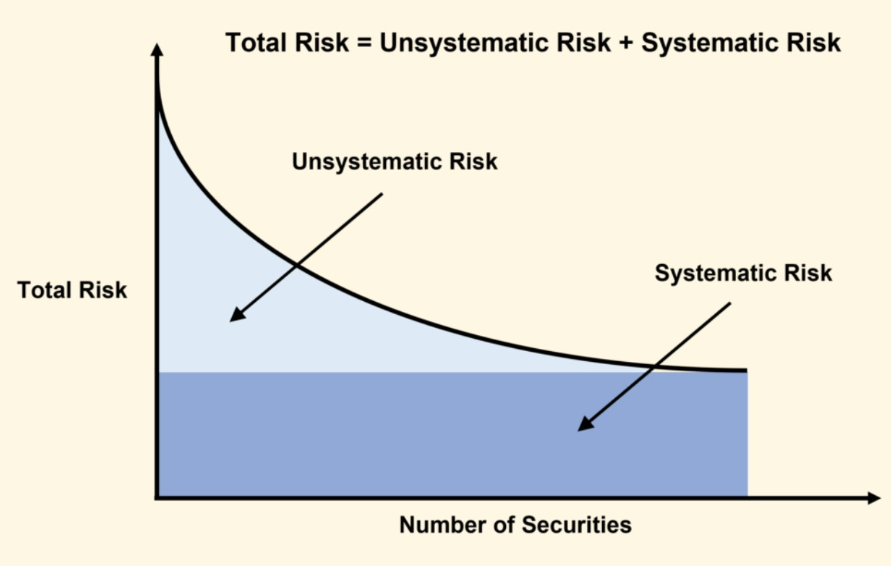
As the graph shows, the total risk curve slopes downwards and flattens out, approaching the level of systematic risk. The gap between the total risk curve and the systematic risk line represents the unsystematic risk that is being eliminated.
The following video provides a great walkthrough of this exact concept and offers a practical rule of thumb for how many stocks are generally needed to achieve effective diversification.
Systematic Vs Unsystematic Risk Explained In 5 Minutes
Let's watch a clip from Ryan O'Connell, CFA, FRM, that explains this graph and the distinction between the two types of risk.
Watch from the beginning to 00:54 to understand the core idea, and then from 02:46 to 04:48 to see a detailed explanation of the graph. Note the 'rule of 30' that is mentioned as a guideline for diversification.
As you saw, studies suggest that much of the benefit of diversification is achieved once a portfolio contains around 20-30 different stocks. Beyond that point, adding more stocks still reduces risk, but the incremental benefit becomes much smaller.
4. Diversification in the Sri Lankan Context
This principle is directly applicable to your goal of investing in the Colombo Stock Exchange (CSE). Due to the smaller size and specific characteristics of the Sri Lankan market, diversification is arguably even more important.
You can diversify your CSE stock portfolio in several ways:
- Across Companies: Instead of buying only Commercial Bank (COMB), you could also buy shares in Hatton National Bank (HNB) and Sampath Bank (SAMP) to reduce company-specific risk within the banking sector.
- Across Sectors: A more powerful strategy is to buy stocks across different sectors of the economy. If the tourism sector faces a downturn, a strong performance in the banking or consumer goods sector can help balance your portfolio.
The following article from WealthyIslander is tailored for CSE investors and provides excellent, practical examples of diversification strategies.
About Sri Lanka Stock Investment Split Calculator - Diversify Your CSE Portfolio with Precision
Let's read a resource focused on practical diversification for the Colombo Stock Exchange. This will help you see how to apply the theory we've just discussed.
Please read the 'Introduction' section to understand why diversification is so important for the CSE. Then, scroll down to the heading 'Common CSE Investment Strategies' and read that section to see practical examples like 'Equal-Weight Strategy' and 'Sector-Based Diversification,' which mention specific Sri Lankan companies.
As the article highlights, a diversified CSE portfolio might include:
- Banking stocks: COMB, HNB
- Conglomerates: JKH, HAYL
- Consumer goods: CTC, LLUB
- Telecommunications: DIAL
By holding a mix of companies from these varied sectors, you protect your capital from events that might severely impact a single industry.
Conclusion
In this lesson, we dissected the concept of investment risk and uncovered the powerful, yet simple, strategy of diversification.
Key Takeaways:
- Total investment risk consists of two parts: systematic (market) risk and unsystematic (company-specific) risk.
- Systematic risk affects all companies and cannot be eliminated through diversification.
- Unsystematic risk arises from events specific to a company or industry and can be significantly reduced by holding a portfolio of diverse assets.
- Diversification works by "averaging out" the random positive and negative events of individual companies.
- A well-diversified stock portfolio, typically containing 20-30 stocks across different sectors, is the primary defense against unsystematic risk.
Preview of the Next Lesson:
We've now seen how to manage risk within an asset class (by diversifying your stocks). In the next lesson, we will broaden our view to discuss asset allocation. This involves diversifying across different types of asset classes (like stocks, bonds, and real estate) to manage your portfolio's overall risk and align it with the risk profile you identified in the previous lesson.