Introduction
Welcome back! In our previous lesson, we established the fundamental risk-return tradeoff: the principle that higher potential returns come only with higher risk. We looked at where different investments like bonds and stocks sit on this spectrum and the various types of risk involved.
This leads us to a crucial personal question: "How much risk am I willing and able to take?" The answer is unique to every individual. This lesson is designed to help you answer that question by assessing your personal risk tolerance. Understanding your own risk profile is the most important step in building an investment strategy that works for you and that you can stick with through market ups and downs.
By the end of this lesson, you will be able to assess your own risk tolerance by considering key personal and financial factors, and you'll understand how this assessment informs your investment decisions, particularly your portfolio's structure.
1. Risk Tolerance vs. Risk Capacity: A Crucial Distinction
Before we dive into the factors that shape your risk profile, it's essential to understand two related but distinct concepts: risk tolerance and risk capacity.
- Risk Tolerance is psychological and emotional. It's about your willingness to take risks and how you would feel during a market downturn. It answers the question: "How much risk can I handle without panicking or losing sleep?"
- Risk Capacity is financial and situational. It's about how much risk your financial situation can actually withstand without jeopardizing your essential goals. It answers the question: "How much risk can I afford to take?"
Ideally, your investment plan should align with both. The image below provides a clear comparison of these two ideas.
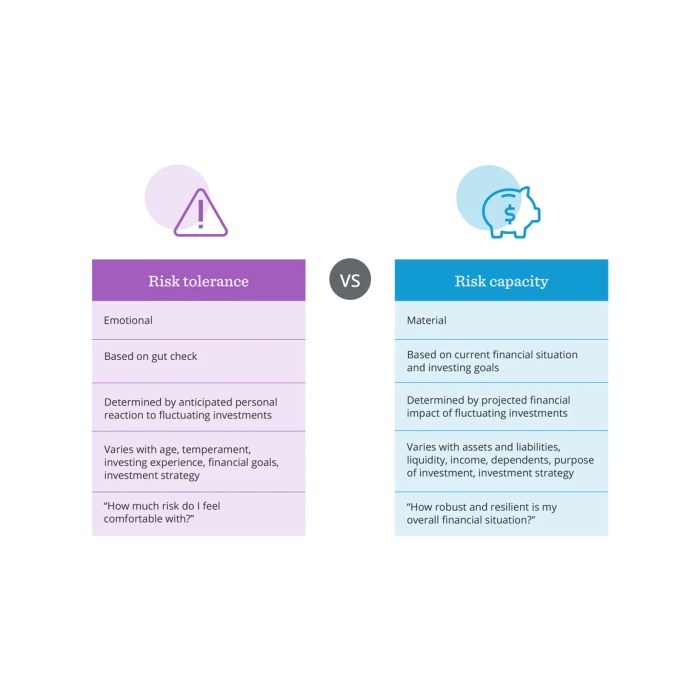
For example, a young software engineer with a stable, high-paying job may have a very high risk capacity but, due to a cautious personality, might have a low risk tolerance. Conversely, an experienced trader nearing retirement might have a high tolerance for volatility but a very low capacity to recover from large losses.
A guide from the CFA Society Sri Lanka puts it simply, defining risk tolerance as "The amount of psychological pain you are willing to suffer for your investments."
[PDF] Financial Literacy - CFA Society Sri Lanka
To see how this concept is defined in a local context, please read a short section from the 'Financial Literacy' guide by the CFA Society Sri Lanka.
Please read page 32 of the PDF. Find the paragraph that begins 'It is important for you to know your risk tolerance...'. It's a brief but very clear definition.
2. The Factors That Determine Your Risk Profile
So, what determines your tolerance and capacity for risk? It's a combination of several personal and financial factors. The following video details five of the most important ones. As you watch, think about how each applies to your own life.
Risk Tolerance & Asset Allocation | Determine Your Fit
This video from Financial Tortoise breaks down the process of determining your risk tolerance into five key considerations.
Watch the section from 03:56 to 08:14. It covers your income, investment time frame, personal obligations, financial goals, and personal tolerance to risk in general.
Let's summarize these five key factors:
- Time Horizon: This is arguably the most significant factor determining your risk capacity. If your financial goal is decades away (like retirement), you have more time to recover from market downturns. A shorter time horizon (e.g., saving for a house in three years) means you have a lower capacity for risk.
- Income Stability: A stable, reliable income, like that from your role as a TechOps Engineer, provides a safety net. This increases your risk capacity because you can continue to invest and cover expenses even if your portfolio's value temporarily drops.
- Personal Obligations: Having dependents who rely on you financially (like children or aging parents) reduces your risk capacity. Your primary responsibility is their well-being, which calls for a more cautious approach.
- Financial Goals: The scale of your ambitions determines your need to take risk. If your goal is to build substantial wealth, you will likely need to take on more risk than someone whose goal is simply to preserve capital and keep pace with inflation.
- Personal Temperament: This is the core of risk tolerance. Are you naturally a risk-taker, or are you more cautious? How do you think you would react emotionally to seeing your hard-earned money decrease in value during a market crash?
3. A Framework for Self-Assessment: Ability, Willingness, and Need
Another powerful way to structure your self-assessment is to think in terms of your Ability, Willingness, and Need to take risk.
- Ability = Risk Capacity (Time horizon, income stability, etc.)
- Willingness = Risk Tolerance (Your psychological comfort)
- Need = Your financial goals
The video below explains this framework and helps you think about how to balance these three elements.
How to Determine Your Investment Risk Tolerance (Index Fund Risk Assessment)
Let's explore the 'Ability, Willingness, and Need' framework with this video from Stephen Antonioni.
Please watch from 03:05 to 09:26. Notice how the speaker separates these three components to create a comprehensive picture of a person's risk profile.
4. A Practical Self-Assessment Exercise
Let's put this theory into practice with a thought experiment. This exercise, sometimes called the "sticker shock test," helps make the abstract concept of a percentage loss feel more concrete.
- Estimate Your Future Portfolio: Imagine you have been investing for several years. Pick a realistic future portfolio value you might aim for, for example, LKR 5,000,000.
- Simulate a Market Crash: Historically, severe bear markets can cause stock portfolios to fall by 30-50%. Let's use 30% for this exercise. Calculate the loss in LKR:
- Reflect on Your Reaction: Your portfolio is now worth LKR 3,500,000. That LKR 1.5 million loss isn't just a number on a screen; it represents years of your savings from your work. How does that make you feel?
- A) Anxious, but you understand it's part of long-term investing and see it as a chance to buy more at lower prices.
- B) Uncomfortable, and you are tempted to stop investing until things "calm down."
- C) Terrified, and your first instinct is to sell everything to prevent further losses.
Be honest with yourself. There is no right answer, but your gut reaction is a powerful indicator of your true risk tolerance. If your reaction is closer to C, a high-risk portfolio is likely not suitable for you, regardless of your high risk capacity.
5. From Risk Profile to Asset Allocation
The ultimate purpose of assessing your risk tolerance is to guide your asset allocation—the mix of different asset classes (like stocks and bonds) in your portfolio. Your risk profile generally falls into one of several categories.

These profiles translate directly into different stock-to-bond ratios. Stocks are the "engine" of growth but come with high volatility, while bonds act as the "brakes," providing stability and lower returns.
Let's see how this works in practice.
Risk Tolerance & Asset Allocation | Determine Your Fit
The final segment of the first video we watched connects risk profiles to specific stock/bond allocations.
Watch from 08:14 to 11:35. Pay attention to the sample asset allocations for aggressive, moderate, and conservative investors.
Here's a summary of the typical allocations mentioned:
| Risk Profile | Description | Typical Stock Allocation | Typical Bond Allocation |
|---|---|---|---|
| Aggressive | Seeks to maximize returns; comfortable with high volatility. Long time horizon. | 80% - 100% | 0% - 20% |
| Moderate | Seeks strong returns but with less volatility than an all-stock portfolio. | 60% - 80% | 20% - 40% |
| Conservative | Prioritizes capital preservation over high growth. Shorter time horizon or low risk tolerance. | 40% - 60% | 40% - 60% |
Given your age and stable career, you likely have a high risk capacity. Your choice will therefore depend heavily on your risk tolerance and financial goals. If you're unsure, it's often wise to start with a slightly more conservative allocation than you think you can handle. You can always adjust it upwards as you gain experience and become more comfortable with market fluctuations.
Conclusion
In this lesson, we moved from the general principle of the risk-return tradeoff to a personal assessment of your place on that spectrum. Understanding your own appetite for risk is the cornerstone of a successful and sustainable investment journey.
Key Takeaways:
- Risk Tolerance is your emotional comfort with risk, while Risk Capacity is your financial ability to take on risk. Both are crucial.
- Your ideal risk profile is a blend of your time horizon, income stability, financial goals, and personal temperament.
- A self-assessment using frameworks like "Ability, Willingness, and Need" and thought experiments can reveal your true comfort level with potential losses.
- The final output of this assessment is a target asset allocation (e.g., a 70% stock / 30% bond mix) that aligns with your personal risk profile.
Preview of the Next Lesson:
Now that you have an idea of your target asset allocation, the next question is how to build a portfolio that manages risk effectively within that allocation. Simply buying one stock or one bond is not enough. In our next lesson, we will explore the concept of diversification—the principle of "not putting all your eggs in one basket"—and its critical role in reducing risk.