Hello! Welcome to the first lesson of your course on investing in the stock market.
Our goal is to build your knowledge from the ground up, so you can confidently analyze and invest in companies on the Colombo Stock Exchange. To do that, we need to start with the fundamental principles that govern not just stocks, but all markets.
In this lesson, you'll learn about the core concepts of economics that drive prices: scarcity, supply, demand, and the equilibrium price. Understanding these ideas is the first and most crucial step, as the price of a stock is determined by the same forces that determine the price of any other good or service.
Let's begin.
1. Scarcity: The Fundamental Problem of Economics
At its heart, economics is the study of how people make decisions in a world of limited resources. This core challenge is known as scarcity.
To get a clear definition of this foundational concept, please watch the following short clip.
Introduction to economics | Supply, demand, and market equilibrium | Economics | Khan Academy
This video from Khan Academy provides a concise explanation of what economists mean by 'scarce resources.'
Please watch from 03:52 to 04:27. The video will define a scarce resource and provide several examples.
As the video explains, a resource is scarce if you don't have an infinite amount of it. This applies to money, time, food, and oil. In your work as a TechOps Engineer, you constantly manage scarce resources like server capacity, network bandwidth, and developer time. You must make decisions on how to allocate these resources efficiently to achieve your goals.
Economics studies how societies allocate their scarce resources on a grander scale. This allocation is largely managed through the mechanisms of supply and demand.
2. Supply and Demand: The Engine of the Market
Markets are where buyers and sellers come together. The interaction between them determines the price of everything, from your daily cup of tea to a share in a company. This interaction is governed by two opposing forces: supply and demand.
The following video provides an excellent and engaging overview of how these forces work.
Supply and Demand: Crash Course Economics #4
This video from Crash Course Economics vividly explains the concepts of markets, supply, demand, and how they interact.
Please watch the following three segments: What is a market? (00:45 - 01:14) The Law of Demand (03:31 - 03:52) The Law of Supply (03:52 - 04:07)
Let's break down those key ideas:
-
The Law of Demand: This states that, all else being equal, as the price of a good or service increases, the quantity that consumers demand decreases. Conversely, as the price decreases, the quantity demanded increases. Think about your own purchasing habits—you're likely to buy more of something when it's on sale. This inverse relationship is represented by a downward-sloping demand curve.
-
The Law of Supply: This describes the producer's perspective. It states that as the price of a good or service increases, the quantity that producers are willing to supply increases, because it becomes more profitable. Conversely, as the price decreases, the quantity supplied decreases. This is represented by an upward-sloping supply curve.
3. Equilibrium Price: Where Supply Meets Demand
So, we have buyers who want low prices and sellers who want high prices. How does the market decide on a final price? It happens at the point of equilibrium.
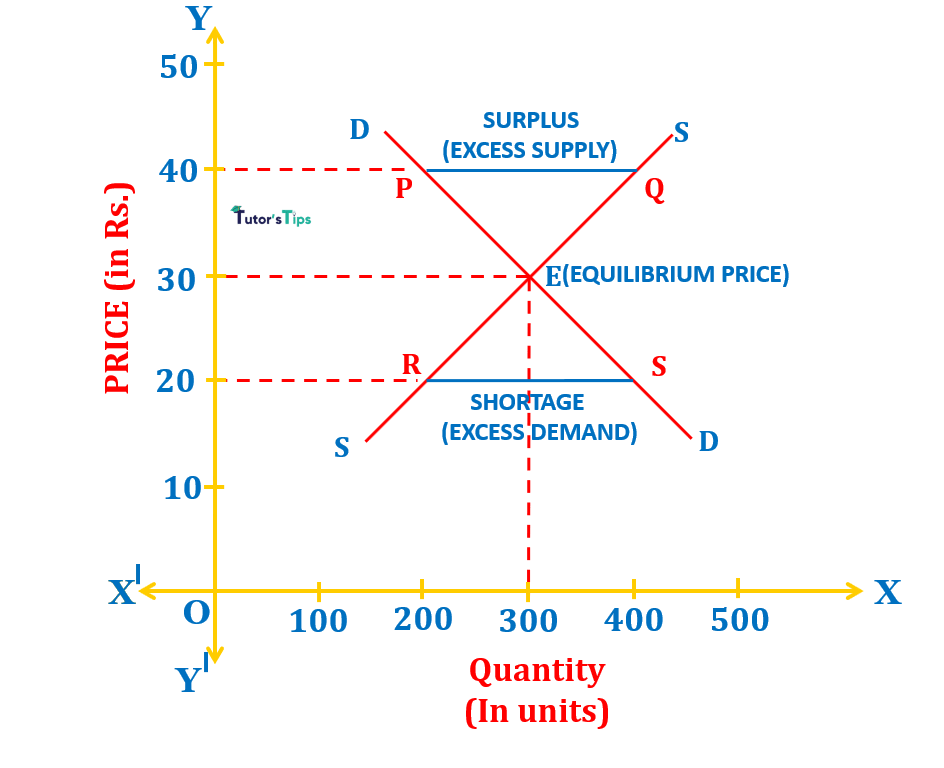
The equilibrium price is the only price where the plans of consumers and the plans of producers agree. It's the point where the quantity of a product that buyers want to purchase is exactly equal to the quantity that sellers are willing to provide.
Now, watch the next segment of the same Crash Course video to see how this works.
Supply and Demand: Crash Course Economics #4
This clip explains how the market finds its equilibrium price and what happens when the price is too high (a surplus) or too low (a shortage).
Please watch from 04:07 to 04:37.
The concepts of equilibrium, surplus, and shortage are captured visually in a standard supply and demand graph. Given your experience with data visualization tools like Tableau and Power BI, you're already skilled at interpreting data through charts. This is just another type of graph that tells a powerful story.
4. Supply and Demand in the Stock Market
Now, let's connect this directly to your goal of investing. A stock is simply a share of ownership in a company, and its price is determined by the exact same principles of supply and demand.
- Supply in the stock market refers to the number of shares that current owners are willing to sell at a certain price.
- Demand refers to the number of shares that potential buyers are willing to purchase at that price.
To see how this plays out in practice, please read the following article. It bridges the gap between economic theory and real-world stock price movements.
Understanding Supply and Demand in Stocks plus How Prices Move
This article from Gotrade explains how supply and demand dynamics specifically apply to the stock market.
Please read the following sections: What Is Supply and Demand in Stocks How Supply and Demand Moves Prices (focus on the 'Demand increases' and 'Supply increases' parts) Practical Market Example
As the article illustrates, when a company reports great news (like strong profits), more people want to buy the stock (demand increases). If fewer people are willing to sell, this imbalance pushes the price up until a new, higher equilibrium is found. Conversely, bad news can cause many people to sell (supply increases), pushing the price down.
Conclusion
In this lesson, we've laid the essential groundwork for your investment journey. You've learned the fundamental economic principles that dictate how prices are set in any market.
Here are the key takeaways:
- Scarcity: The basic economic problem of having unlimited wants but limited resources.
- Law of Demand: As price goes up, quantity demanded goes down.
- Law of Supply: As price goes up, quantity supplied goes up.
- Equilibrium Price: The market-clearing price where the quantity supplied equals the quantity demanded.
- Stock Prices: The price of a stock is determined by the supply of and demand for its shares, which are influenced by company performance, economic conditions, and investor sentiment.
In our next lesson, we will build on this foundation by exploring the difference between microeconomics (the study of individual markets, like we did today) and macroeconomics (the study of the economy as a whole). This will help you understand the broader economic context in which companies operate.