Hello! Welcome to your second lesson.
In our first session, we explored the forces of supply and demand, which determine the price of a single product or a specific company's stock. These concepts belong to one of the two main branches of economics.
Today, we will zoom out to see the bigger picture. This lesson will explain the difference between microeconomics and macroeconomics. Understanding this distinction is crucial for you as an investor. Microeconomics helps you analyze an individual company (the "tree"), while macroeconomics helps you understand the overall economic environment that affects all companies (the "forest"). A successful investor needs to be able to analyze both.
1. Two Views of the Economy: Small vs. Large
Economics is broadly divided into two fields:
-
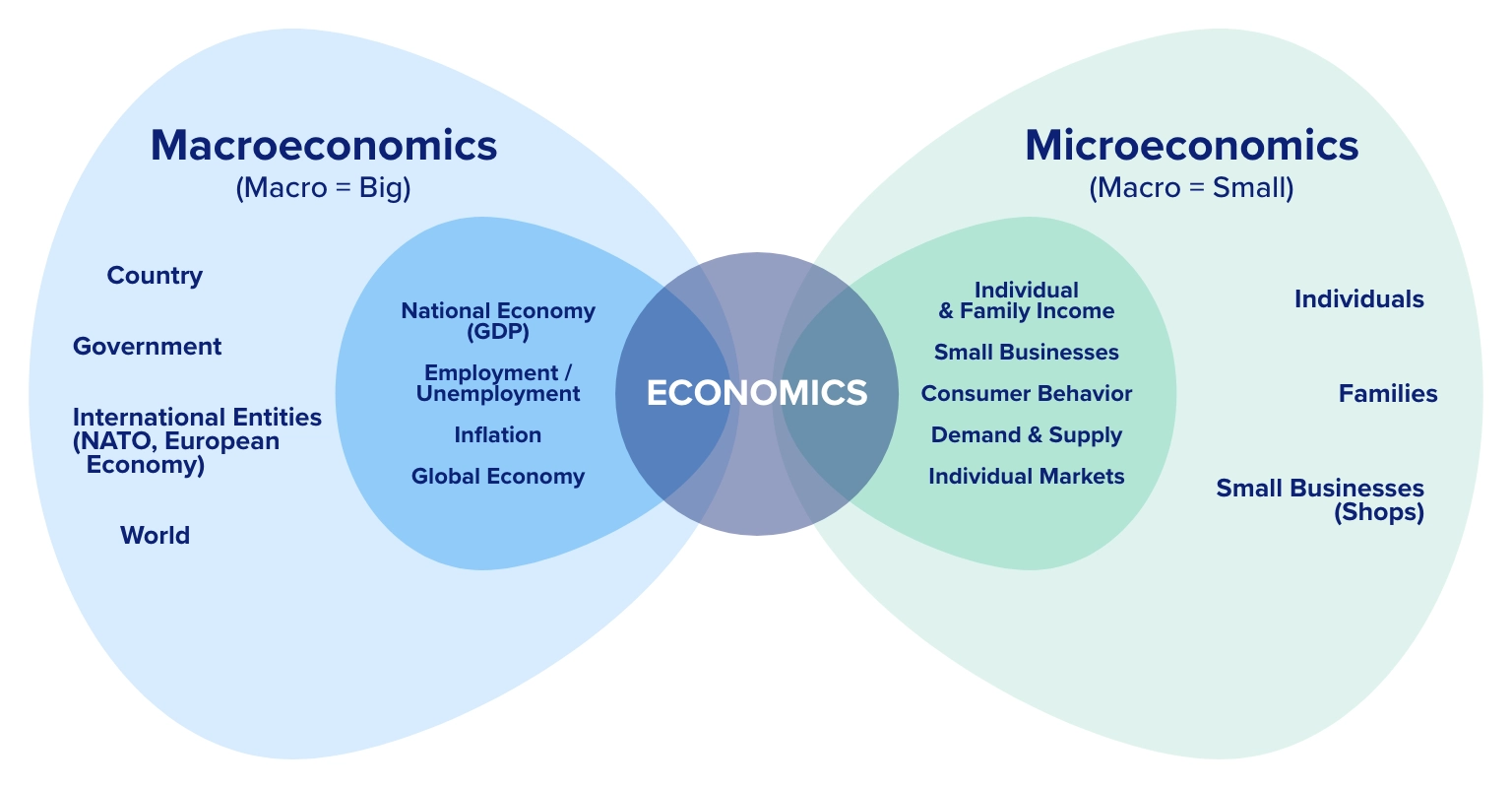
Microeconomics (from the Greek prefix mikros, meaning "small") focuses on the behavior of individual economic agents—like households, individuals, and businesses. It answers questions like, "How does a company set the price for its product?" or "How will a tax on soft drinks affect consumer choices?" Our last lesson on supply and demand for a single stock was a microeconomic topic.
-
Macroeconomics (from the Greek prefix makros, meaning "large") looks at the economy as a whole. It focuses on broad, economy-wide phenomena like inflation, unemployment, economic growth, and government policy. It answers questions like, "What is the effect of rising interest rates on the entire country?" or "How does government spending impact the national unemployment rate?"
This diagram provides a clear visual breakdown of the topics covered by each branch.
2. Deeper Definitions and Examples
To solidify your understanding, let's watch a video that defines these terms and provides practical examples to help you distinguish between them.
Microeconomics vs Macroeconomics
This video from The Organic Chemistry Tutor clearly defines microeconomics and macroeconomics and then presents scenarios for you to categorize.
Please watch the following segments: Microeconomics definition (00:52 - 01:15) Macroeconomics definition (01:15 - 01:54) Practical Examples (04:45 - 07:09) \nAs you watch the examples, try to guess whether each scenario is micro or macro before the narrator gives the answer.
As the video explains, another way to think about this is the approach they take:
- Microeconomics uses a bottom-up approach. It starts with the individual unit—one consumer, one company—and builds up to explain market phenomena.
- Macroeconomics uses a top-down approach. It starts with the entire economy and analyzes how national aggregates (like GDP and inflation) affect individuals and industries.
3. The Investor's Two Lenses
For an investor, neither view is more important than the other; they are two essential lenses that you must use together.
- The Microeconomic Lens: You use this when you analyze a specific company. You look at its financial health, the demand for its products, its competitors, and its pricing strategy. This is fundamental analysis, which we will cover in great detail later in the course.
- The Macroeconomic Lens: You use this to assess the overall economic and market environment. A fantastic company can still perform poorly if the entire economy is in a recession.
The following article is written specifically for investors and explains how to use both perspectives.
Microeconomics vs. Macroeconomics in Investments: A Holistic ...
This article from FXCM Markets, titled 'Microeconomics vs. Macroeconomics in Investments,' directly compares the two fields from an investor's point of view.
Please read the section titled 'Comparing Microeconomics and Macroeconomics in Investments' and its three sub-sections: 'A. Scope and Focus,' 'B. Time Frame,' and 'C. Decision-Making.' This will take about 5 minutes.
As the article highlights, micro analysis often informs short-term, specific decisions (e.g., "Should I buy stock in this specific company now?"), while macro analysis shapes your long-term, strategic decisions (e.g., "Should I be investing more in stocks or bonds right now, given the economic forecast for Sri Lanka?").
Think of it in terms of your work in TechOps. Microeconomics is like analyzing the performance and resource usage of a single server or application. Macroeconomics is like monitoring the health, capacity, and security of the entire data center or cloud environment. You need to do both to ensure the system runs effectively.
4. Interconnected Fields
Finally, it's important to remember that micro and macroeconomics are deeply interconnected. Macroeconomic phenomena are the result of countless individual microeconomic decisions.
For example:
- If millions of individual consumers (micro) decide to spend less money due to concerns about the future, this can lead to a decrease in the country's overall Gross Domestic Product (GDP) (macro).
- If the Central Bank of Sri Lanka raises interest rates (macro), it makes it more expensive for individual companies to borrow money for new projects and for individual families to get loans for homes or cars (micro).
These two branches constantly influence each other.
Conclusion
In this lesson, we have defined the two major branches of economics and, most importantly, framed them as two essential perspectives for an investor.
Key Takeaways:
- Microeconomics studies the behavior of individual economic agents like people and businesses. It takes a bottom-up view and helps you analyze the fundamentals of a specific company.
- Macroeconomics studies the economy as a whole, focusing on aggregates like GDP, inflation, and unemployment. It takes a top-down view and helps you understand the overall market environment.
- As an investor, you need to use both lenses to make well-rounded decisions—analyzing the specific company (micro) within the context of the broader economy (macro).
In our next lesson, we will explore a concept that is fundamental to both micro and macroeconomics: money. We will discuss its three basic functions and why it is the lifeblood of any modern economy.