Hello! Welcome to your fourth lesson in our journey into the world of investing.
In our last lesson, we defined money not just as currency, but by the crucial jobs it performs: acting as a medium of exchange, a unit of account, and a store of value. But a system as important as a nation's money supply needs a manager to keep it stable and effective.
Today, we'll meet that manager. This lesson addresses the learning outcome: Describe the role of central banks and how interest rates affect the economy. We will explore what a central bank is, what it does, and how it uses its most powerful tool—interest rates—to steer the entire economy. Understanding this is fundamental for any investor, as the actions of a central bank can create headwinds or tailwinds for the stock market.
1. The Economy's Financial Guardian: The Central Bank
Every country with a modern economy has a central bank. In Sri Lanka, this institution is the Central Bank of Sri Lanka (CBSL). In the United States, it's the Federal Reserve (the "Fed"), and in Europe, it's the European Central Bank (ECB).
A central bank is not a commercial bank where you or I would open an account. Instead, think of it as a "bank for banks" and the government's bank. Its primary mission is not to make a profit, but to manage the country's currency, money supply, and financial system to achieve broad economic goals.
To get a clear overview of their main responsibilities, let's watch a short introductory video.
How Central Banks Work: A Beginner's Guide
This video, 'How Central Banks Work', provides a concise introduction to the purpose and primary functions of central banks.
Please watch from the beginning until the 01:47 mark. Focus on understanding the key differences between a central bank and a commercial bank, and listen for its main responsibilities, especially regarding 'monetary policy'.
As the video explained, the core functions of a central bank like the CBSL include:
- Implementing Monetary Policy: This is the most important function for our purposes. It involves managing the supply of money and credit to achieve national economic objectives, primarily price stability (controlling inflation) and promoting economic growth.
- Controlling the Money Supply: The central bank issues the nation's currency and regulates its circulation.
- Regulating Financial Institutions: It supervises commercial banks to ensure they are operating safely and soundly, which helps prevent financial crises.
- Acting as a Banker to the Government: It manages the government's accounts and finances.
For investors, the most critical function to watch is the implementation of monetary policy, because this is where the central bank uses its tools to influence the entire economic environment in which companies operate.
2. The Master Lever: How Central Banks Use Interest Rates
The single most powerful tool a central bank has for conducting monetary policy is its ability to influence interest rates.
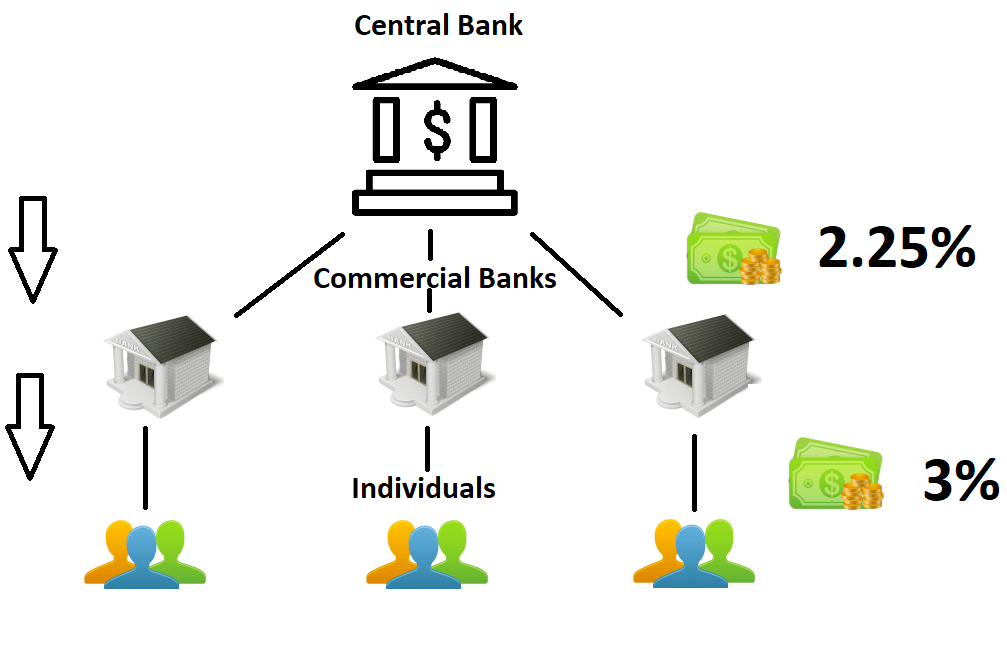
But how does one bank's interest rate affect every loan and savings account in the country? It happens through a ripple effect.
- The central bank sets a policy interest rate. This is the rate at which commercial banks can borrow money from the central bank or, more commonly, from each other for very short periods (often overnight).
- This policy rate acts as a benchmark. If it becomes more expensive for commercial banks to borrow money, they will pass on that higher cost to their customers.
- Consequently, the interest rates on mortgages, business loans, car loans, and credit cards will rise or fall in line with the central bank's policy rate. The same goes for the interest you earn on savings accounts.
This diagram shows how the rate set by the central bank filters down through the financial system to individuals and businesses.
3. Steering the Economy: Stimulating Growth vs. Taming Inflation
A central bank adjusts interest rates to either "press the accelerator" or "tap the brakes" on the economy. Let's look at the two main scenarios.
Scenario 1: Tapping the Brakes (Raising Interest Rates)
- When? When the economy is "overheating"—meaning it's growing too fast, causing high inflation (a rapid increase in the general price of goods and services).
- How? The central bank raises its policy rate.
- Borrowing becomes more expensive for everyone.
- Businesses are less likely to take out loans to expand, invest in new projects, or hire more staff.
- Consumers are less likely to borrow for large purchases like houses or cars. Mortgage payments increase, leaving households with less money to spend on other things.
- Saving becomes more attractive because you earn more interest.
- The Result: Spending and investment slow down across the economy. This reduced demand helps to ease the pressure on prices, bringing inflation under control. This is known as a contractionary or "tightening" monetary policy.
Scenario 2: Pressing the Accelerator (Lowering Interest Rates)
- When? When the economy is sluggish or in a recession, with low growth and rising unemployment.
- How? The central bank lowers its policy rate.
- Borrowing becomes cheaper.
- Businesses are encouraged to borrow money to invest, expand, and hire.
- Consumers are more likely to take out loans for big-ticket items.
- Saving becomes less attractive, encouraging people to spend or invest their money instead.
- The Result: Spending and investment get a boost, stimulating economic activity and helping to create jobs. This is known as an expansionary or "loosening" monetary policy.
The following video from The Economist provides an excellent and detailed explanation of how raising interest rates works in practice to control inflation.
How does raising interest rates control inflation?
This video, 'How does raising interest rates control inflation?', explains the detailed mechanics of how central bank actions ripple through the economy to affect consumers and businesses.
Please watch from 00:46 to 05:22. This segment explains what interest rates are, how central banks use them to fight inflation, and the detailed effects on mortgages, consumer spending, and business investment.
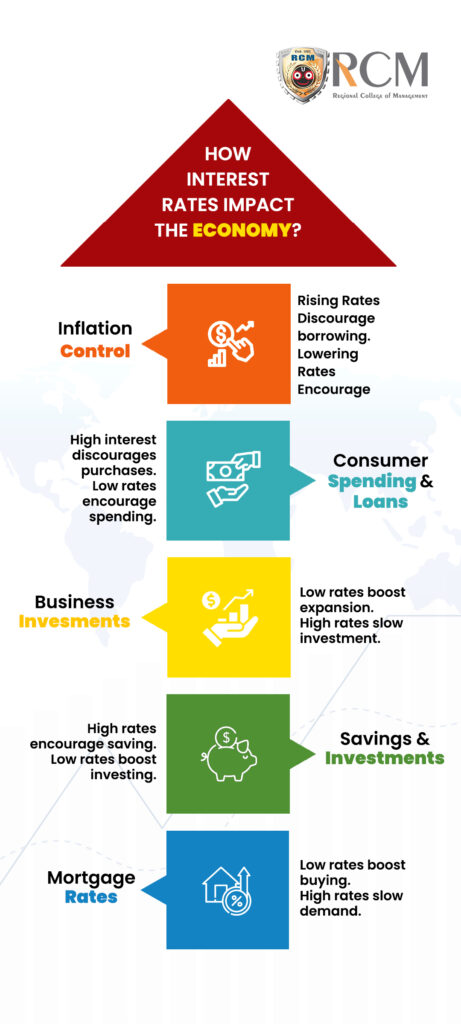
This infographic provides a great visual summary of the concepts we've just discussed.
4. How Interest Rates Affect Your Investments
So, why is this critical for you as a future stock market investor? Because interest rate changes directly impact company profits and stock prices.
To explore this connection, please read the following short article. It focuses on how stocks react to changes in interest rates.
How interest rate changes can affect your investments
This article from Qtrade provides a clear, investor-focused explanation of how interest rates affect stock prices.
Please read just the section titled 'How do interest rates affect stocks?'. It's a few paragraphs long and clearly explains the relationship.
As the article explains, the general relationship is as follows:
-
Rising Interest Rates: This is generally negative for the stock market.
- Higher Costs: Companies have to pay more to borrow money for operations and expansion, which can reduce their profits.
- Slower Economy: A slowing economy means customers spend less, leading to lower revenues for companies.
- Competition from Bonds: When interest rates are high, safer investments like government bonds or even high-interest savings accounts become more attractive. Some investors may sell stocks to buy these safer assets, putting downward pressure on stock prices.
-
Falling Interest Rates: This is generally positive for the stock market.
- Lower Costs: Cheaper borrowing can boost company profits.
- Economic Growth: A stimulated economy means more consumer and business spending, which drives company revenues.
- Stocks Become More Attractive: When interest on safe assets is low, investors are more likely to put their money into stocks in search of higher returns.
Conclusion
You now have a foundational understanding of one of the most powerful forces in finance and economics. By watching the actions and listening to the announcements of the Central Bank of Sri Lanka, you can gain insight into the direction of the broader economy.
Key Takeaways:
- Central banks, like the Central Bank of Sri Lanka, are responsible for maintaining economic and financial stability.
- Their primary tool for managing the economy is the policy interest rate.
- Raising interest rates makes borrowing more expensive, which slows down the economy to fight inflation (contractionary policy).
- Lowering interest rates makes borrowing cheaper, which stimulates the economy to promote growth (expansionary policy).
- Interest rate movements have a significant impact on corporate profits and stock prices, making them a crucial factor for investors to monitor.
In this lesson, we frequently mentioned the central bank's primary goal of fighting inflation. But what exactly is inflation, and how does it affect your personal finances and investments day-to-day? In our next lesson, we will explain what inflation is and how it impacts purchasing power and investments.