Welcome back! In the last two lessons, we've dissected the Income Statement (which measures profitability over time) and the Balance Sheet (which gives a snapshot of financial position). We noted that a company can be profitable on paper but still face a cash crunch. This lesson addresses that exact issue.
Introduction
Today, we'll explore the third and final core financial statement: the Statement of Cash Flows. This statement acts as a bridge between the Income Statement and the Balance Sheet by tracking the actual cash moving in and out of a company. It answers a simple but vital question: "Where did the cash come from, and where did it go?"
By the end of this 30-minute lesson, you will be able to read and interpret the key components of a cash flow statement: operating, investing, and financing activities.
To use an analogy from your IT background, if the Income Statement is a log of all completed transactions (revenue and expenses), the Cash Flow Statement is like a network traffic monitor. It doesn't just show the result; it shows the real-time flow of data packets (cash) into and out of the system, helping you diagnose the true health and liquidity of the operation.
Why is the Cash Flow Statement Necessary?
The need for this statement arises from the accrual basis of accounting, which we've touched on before. Under this method, the Income Statement records revenues when they are earned and expenses when they are incurred, regardless of when cash is actually exchanged.
For example, a company might record a large sale as revenue but won't receive the cash from the customer for 60 days. The Income Statement looks good, but the company has no new cash in the bank. The Cash Flow Statement corrects for these timing differences.
To get a clear explanation of this concept, let's start with a short video.
The CASH FLOW STATEMENT for BEGINNERS
This video from Accounting Stuff clearly explains why the Cash Flow Statement is crucial and how it differs from an Income Statement prepared under the accrual method.
Please watch from the beginning until 02:18. Focus on the distinction between the cash method and the accrual method of accounting.
The Three Categories of Cash Flow
The statement is neatly organized into three sections, which helps you understand how a company is generating and using its cash.
-
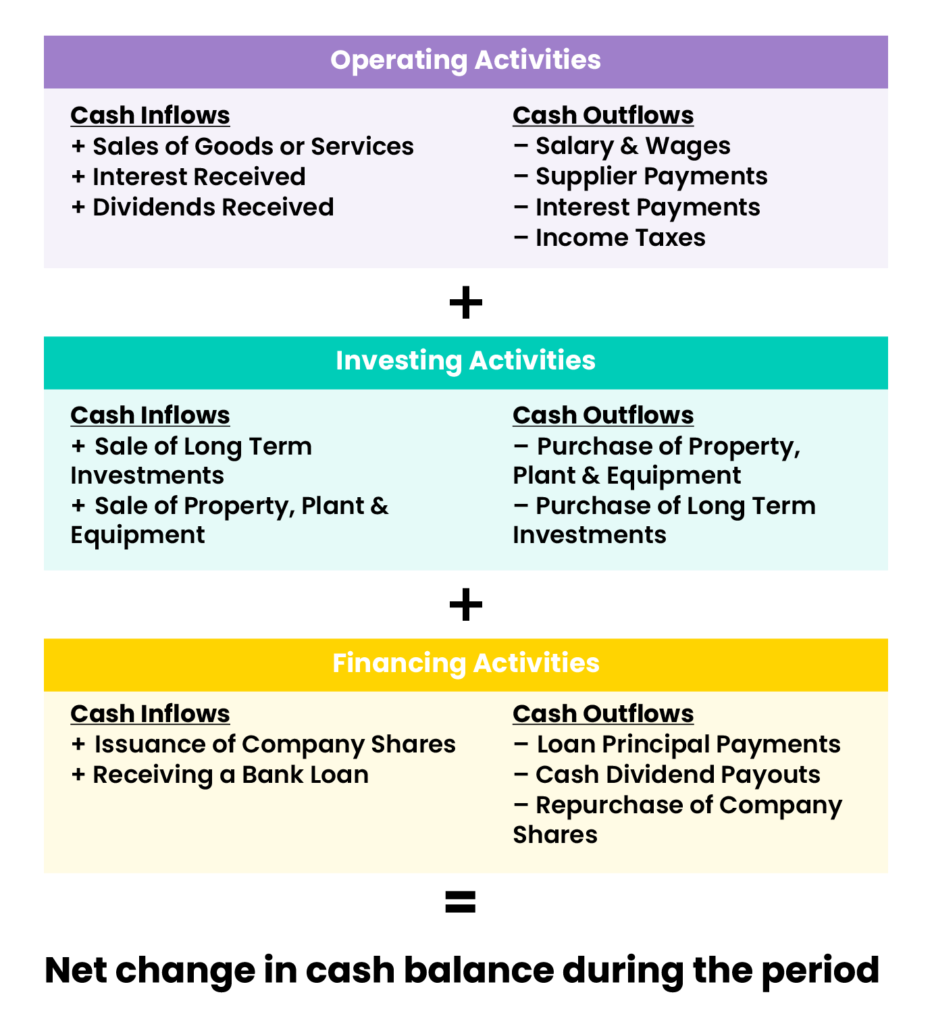
Cash Flow from Operating Activities (CFO): This shows the cash generated from a company's principal revenue-producing activities. It's the cash flow from the core business. A healthy company should consistently generate positive cash from its operations.
-
Cash Flow from Investing Activities (CFI): This section includes cash used to purchase long-term assets (like machinery or buildings) and cash received from selling them. It also includes buying or selling investments in other companies. This tells you how the company is investing in its future growth.
-
Cash Flow from Financing Activities (CFF): This shows how a company raises capital and pays it back to investors and creditors. It includes cash from issuing stock, borrowing from banks, repaying debt, and paying dividends to shareholders.
To see how these sections work together, the following video provides a concise overview.
The CASH FLOW STATEMENT: all the basics in 9 minutes
Brian Feroldi provides a quick, high-level walkthrough of the three primary sections of the cash flow statement.
Watch the segment from 00:52 to 03:33. Pay attention to the specific examples of cash inflows and outflows for each of the three activities.
This visual diagram provides a simple, powerful summary of what goes into each category.
To ground this in the context of your goal, let's review the definitions from the Colombo Stock Exchange (CSE) guide.
This PDF from the CSE explains the Statement of Cash Flow as it applies to Sri Lankan companies. Reading these definitions will familiarize you with the local reporting standards.
Please read page 17 and 18 of the PDF. Focus on the definitions under the headings: STATEMENT OF CASH FLOW (general introduction) OPERATING ACTIVITIES INVESTING ACTIVITIES FINANCING ACTIVITIES \nThis will take about 5 minutes and will reinforce what you just saw in the video, using the terminology relevant to the CSE.
How to Read the Operating Activities Section (Indirect Method)
The Investing and Financing sections are relatively straightforward—they list the cash spent or received. The Operating section, however, is usually calculated using the indirect method, which is essentially a reconciliation process.
Here’s how it works:
- Start with Net Income: This figure is taken directly from the bottom of the Income Statement.
- Add Back Non-Cash Expenses: The most common are depreciation and amortization. These were subtracted as expenses on the Income Statement, but no cash actually left the company, so we add them back to get to the true cash flow.
- Adjust for Changes in Working Capital: This step adjusts for the timing differences between earning revenue/incurring expenses and the actual cash movement.
- An increase in a current asset (like Accounts Receivable or Inventory) is a use of cash (subtracted).
- A decrease in a current asset is a source of cash (added).
- An increase in a current liability (like Accounts Payable) is a source of cash (added).
- A decrease in a current liability is a use of cash (subtracted).
Let's watch a brief explanation of these steps.
The CASH FLOW STATEMENT for BEGINNERS
Let's return to the Accounting Stuff video for a clear, step-by-step explanation of how the indirect method works to calculate cash flow from operations.
Watch the segment from 05:00 to 05:58. This focuses purely on the three steps of the indirect method: starting with net profit, adding back non-cash expenses, and adjusting for working capital.
Putting It All Together: A Sample Statement
Now, let's look at a full, albeit simplified, example. This shows how the three sections are presented and how they lead to the final change in the company's cash balance.
How to Read & Understand a Cash Flow Statement
This article from Harvard Business School Online provides a clear, well-structured example of a cash flow statement. It's a great reference for seeing how all the pieces fit together.
Scroll down to the section titled 'Cash Flow Statement Example' and review the table provided. Notice how: Operating Activities start with Net Income and then make adjustments. Investing Activities are mostly negative (cash used) due to purchases of securities and assets. Financing Activities show cash used for dividends and stock repurchases, but also cash raised from issuing debt. The three sections are summed to get the 'Increase / Decrease in Cash', which reconciles the beginning and ending cash balances.
When you analyze a company, you are looking for patterns. Is the company generating enough cash from its operations to fund its investments? Or is it relying on debt (financing) to stay afloat? A strong company typically has positive CFO, uses some of that for investments (negative CFI), and may use the rest to pay down debt or reward shareholders (negative CFF).
Conclusion
Excellent work. You have now covered all three major financial statements. The Cash Flow Statement is arguably the most critical for understanding a company's short-term viability, as it cuts through accounting assumptions to reveal the true cash position.
Key Takeaways:
- The Cash Flow Statement tracks the actual movement of cash over a period, correcting for the non-cash items in the Income Statement.
- It is divided into three key sections:
- Operating Activities: Cash from core business operations. This should ideally be positive and growing.
- Investing Activities: Cash used for or generated by long-term assets. Often negative for a company that is expanding.
- Financing Activities: Cash from interactions with owners and lenders (e.g., issuing stock, paying dividends, taking on debt).
- The indirect method is the common way to calculate operating cash flow, by reconciling Net Income with actual cash changes.
Preview of the Next Lesson:
Now that you can read each of the three financial statements in isolation, our next lesson will focus on how they link together. We will explore the dynamic relationships between the Income Statement, Balance Sheet, and Cash Flow Statement, enabling you to see the complete financial story of a company.