Hello! Welcome to the first lesson of our second module, where we transition from the broad world of economics to the specific mechanics of investing.
In our last lesson, we established that the financial system's main job is to channel money from savers to investors. We saw this happens in two ways: indirectly through intermediaries like banks, and directly through financial markets.
Today, we will zoom in on that second channel. This lesson addresses the learning outcome: Explain the purpose of financial markets and their role in the economy. Understanding this is the first step to appreciating what a stock exchange like the Colombo Stock Exchange (CSE) actually does and why it's so important for both companies and investors like you.
1. The Fundamental Purpose: A Marketplace for Money
At its core, a financial market serves a very simple but powerful purpose: it brings together two groups of people.
- Lenders/Investors: People or institutions with surplus cash they want to put to work to earn a return.
- Borrowers/Spenders: Companies or governments that need capital to fund their activities, such as building a factory, launching a new product, or funding public services.
Think of it as a specialized marketplace. Instead of selling goods, participants are buying and selling financial assets like stocks and bonds.
To see this foundational concept in action, let's watch a short, clear explanation.
An introduction to financial markets - MoneyWeek Investment Tutorials
This tutorial from MoneyWeek provides a very clear and intuitive explanation of why financial markets exist, framing them as the bridge between those who have money (investors) and those who need it (borrowers).
Watch the video from the beginning until the 04:26 mark. Focus on the diagram that shows investors on one side, borrowers on the other, and the financial markets in the middle.
As the video explains, the fundamental purpose of financial markets is to facilitate this flow of funds. Without them, it would be incredibly difficult and inefficient for a company needing to raise millions for a new project to find thousands of individuals willing to lend or invest small amounts. The market solves this matching problem.
The Bank of England uses a simple analogy in its article "What are financial markets and why are they important?": they are like eBay, but for financial assets. They create an organized platform to match buyers and sellers and establish a fair price.
2. The Economic Role of Financial Markets
This act of connecting savers and borrowers is not just a convenience; it is a vital engine for economic activity. Financial markets perform several crucial roles that contribute to a healthy economy.
We'll now watch a video that outlines six of these key functions.
Key Roles for Financial Markets I A Level and IB Economics
This video from tutor2u, an economics education channel, breaks down the key economic roles that financial markets play. While it uses the UK as an example for statistics, the core functions it describes are universal.
Watch the section from 05:50 to 08:35. Pay close attention to the six distinct roles described, as they form the heart of this lesson.
Let's unpack those key roles mentioned in the video, which are the essence of how financial markets serve the economy:
- Facilitating Saving & Lending: They provide a formal, regulated place for savings to be deployed and for businesses and governments to borrow funds.
- Allocating Funds to Productive Uses: This is perhaps the most critical economic function. Markets help direct capital to where it can be used most effectively—to the businesses with the most promising ideas and potential for growth. In a way, it acts like an optimization process, constantly seeking the highest risk-adjusted returns and thereby fueling innovation and expansion.
- Facilitating Exchange: They provide the "plumbing" for the economy, making it easy to buy and sell goods and services, often through payment systems linked to these markets.
- Providing a Market for Equities (Stocks): This is central to your goal. Markets allow companies to raise huge amounts of long-term capital by selling ownership stakes (shares) to investors. This is what allows a small startup to grow into a massive employer, as illustrated by the story of Apple raising funds through financial markets, mentioned in the Bank of England article.
- Enabling Risk Management: They allow businesses and investors to manage risk. For example, a farmer can use a "forward market" to lock in a price for their crop today, protecting them from future price drops.
- Price Discovery: By bringing all buyers and sellers together, the market determines the "correct" price of an asset at any given moment based on the collective wisdom (and sentiment) of all participants.
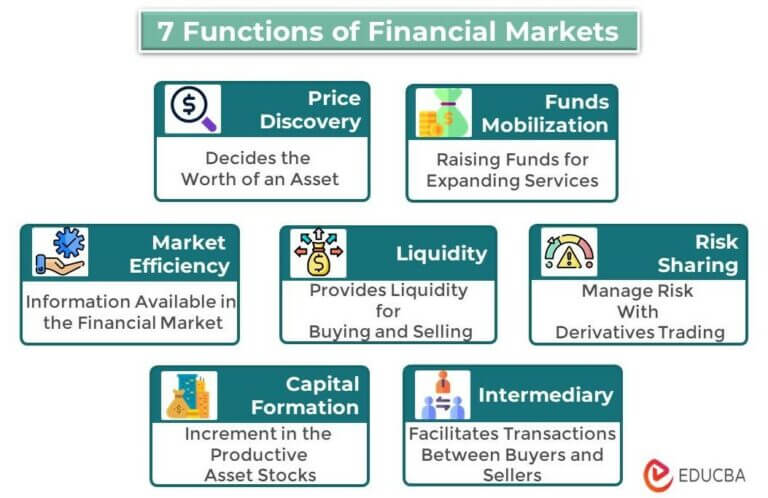
This infographic provides a great visual summary of these functions. Notice that different sources might use slightly different terms (e.g., "Funds Mobilization" or "Capital Formation"), but they all describe these same core economic contributions.
3. A Quick Tour of Market Types
The term "financial market" is very broad. To add some structure, it's useful to know the main categories. The primary distinction is based on the duration of the financial instrument being traded.
How Financial Markets Work: A Beginner's Guide
This article from the University of Johannesburg provides a concise definition of the two main types of financial markets. Reading this short section will help solidify the terminology.
Read the section titled 'What Are Financial Markets?'. Focus on the definitions of Capital Markets and Money Markets.
As the article states, the two main types are:
- Money Markets: For short-term borrowing and lending, typically for periods of up to a year. These are used by banks, corporations, and governments to manage their day-to-day cash needs.
- Capital Markets: For long-term financing, typically for periods longer than a year. This is where companies and governments raise capital for significant, long-term investments.
Our focus for this course is on Capital Markets, because that's where stocks are traded. Capital markets themselves are further divided into:
- Equity Markets: Where ownership in companies (stocks/shares) is bought and sold.
- Debt Markets: Where long-term loans, in the form of bonds, are bought and sold.
Conclusion
In this lesson, we have established the fundamental "why" behind financial markets. You are now equipped with the foundational knowledge of their purpose and importance.
Key Takeaways:
- The primary purpose of financial markets is to efficiently connect entities with surplus capital (savers/lenders) with those who need capital (borrowers/spenders).
- In doing so, they play several crucial economic roles, including allocating capital to productive businesses, allowing companies to raise funds for growth, and providing a means for individuals to invest their savings.
- Financial markets are broadly divided into money markets (short-term) and capital markets (long-term). The stock market is a key part of the capital markets.
Preview of the Next Lesson:
Now that we know why capital markets exist, our next step is to understand how they function. In the next lesson, we will distinguish between primary markets (where companies issue new shares to raise capital) and secondary markets (where investors trade existing shares with each other). This distinction is crucial for understanding how the stock market truly works.