Hello! Welcome back.
In our last lesson, we covered the exciting step of placing your first buy or sell order. We discussed how to communicate with your broker and the difference between a market order and a limit order. Once your order is successfully matched on the exchange, a "trade" is created. But the story doesn't end there.
Today, we will look at what happens in the background after you get that "trade executed" notification. Our learning outcome is to describe the trade settlement process (T+2) and transaction costs on the CSE. We'll demystify the journey of the shares into your account and the money out of it, and then break down the exact costs you'll see on your contract note. This knowledge is vital for understanding the complete lifecycle of an investment.
Part 1: The Trade Settlement Lifecycle
When you buy something at a store, the exchange is instant: you pay money and walk away with the item. In the stock market, the process is slightly different. The transfer of ownership (shares) and payment (cash) is not instantaneous. This formal, post-trade process is called settlement.
For the Colombo Stock Exchange, this process follows a T+2 settlement cycle. This is a standard notation in finance:
- T: Represents the Trade Date—the day your order is executed.
- +2: Represents two business days after the trade date.
So, T+2 means the final settlement of your trade will complete two business days after you bought or sold the shares.
Let's look at a high-level map of what happens on these days.
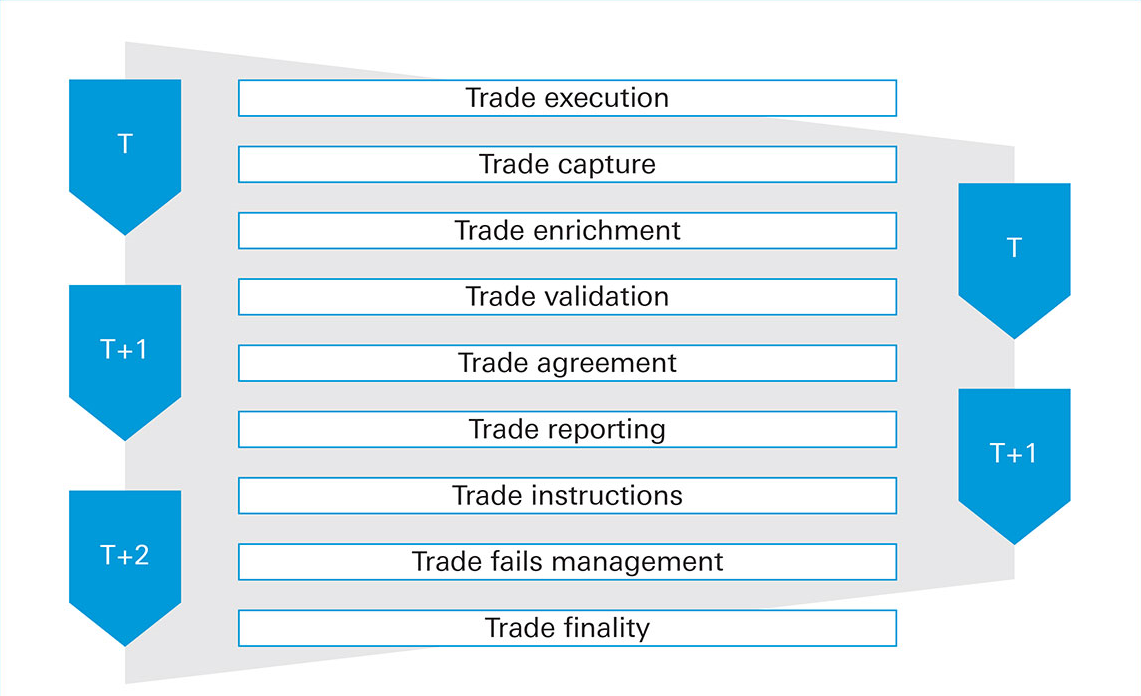
This diagram gives us a framework: T, T+1, and T+2 are distinct stages. Now, let's explore the detailed steps and the key players involved, such as the Clearing House and the Central Depository System (CDS).
Trade Life Cycle-Part 1| Equity Settlement Process| Clearing House| Back Office Operations|
To understand the mechanics of this process, we'll watch a video from FinEx Training titled 'Trade Life Cycle-Part 1'. It provides an excellent, step-by-step visual explanation. While the video uses the US market's T+3 cycle as an example, the underlying logic—trade capture, validation, clearing, and settlement—is universal and applies directly to our T+2 context. Focus on understanding the role of each entity.
Please watch the following segments: Trade Execution & Capture (02:54 - 06:06): Pay attention to how the broker passes trade details to a 'custodian' and the concept of 'trade capture'. This is the start of the back-office process on Day T. Confirmation & Reporting (09:39 - 12:31): Note how a 'confirmation' (your contract note) is sent and how the Stock Exchange reports all trades to a 'Clearing House'. The Clearing House is a crucial entity that guarantees the trade. Affirmation (12:31 - 14:24): Understand the 'affirmation' stage on T+1, where the trade details are formally agreed upon. Clearing & Settlement (14:24 - 20:43): This part shows how the Clearing House calculates who owes what (clearing) and then instructs the 'depository' to move the shares (settlement). In the CSE, clearing and settlement happen on T+2.
The video gives you a strong conceptual model. Now, let's map it precisely to the Sri Lankan T+2 process.
Sri Lanka - RBC Investor Services | Market Profiles
This market profile for Sri Lanka from RBC Investor Services provides the exact details for the CSE.
Please read two small sections on this page: Under the 'Settlement & Registration' heading, find the sub-heading 'Settlement Cycles'. Read the first line for 'Equities' to confirm the T+2 cycle. Immediately below, read the section on 'Settlement Procedures' (the 'Book-Entry' paragraph). This concisely explains the CSE's specific process.
Based on what you've just studied, here is a summary of the CSE's T+2 settlement process, connecting the concepts from the video to the facts from the RBC document:
-
T (Trade Day):
- Execution: Your order is matched on the CSE's Automated Trading System (ATS).
- Confirmation: Your broker sends you a contract note (the "confirmation" from the video) detailing the trade.
- Reporting: The CSE reports the trade details to the Central Depository System (CDS), which acts as the clearing and settlement facilitator.
-
T+1 (Confirmation/Affirmation Day):
- Affirmation: By 1:30 PM on T+1, your broker (acting as or through a custodian) must formally affirm the trade details with the CDS. This is the official "agreement" that the trade is correct and will be settled.
-
T+2 (Settlement Day):
- Clearing: The CDS finalizes the net obligations—calculating which brokers need to pay money and which are due to receive money, and which accounts need to deliver or receive shares.
- Settlement: The final two-way transfer happens. The CDS performs a Delivery versus Payment (DvP) settlement. This means the transfer of shares and the transfer of money happen simultaneously.
- The CDS debits the shares from the seller's CDS account and credits them to the buyer's CDS account.
- The money is moved from the buyer's broker to the seller's broker through the Central Bank’s Real-Time Gross Settlement (RTGS) system.
This systematic, automated process ensures that every trade is completed safely and efficiently, without either party having to trust the other directly. The Clearing House/CDS acts as the central guarantor.
Part 2: Transaction Costs on the CSE
As we've seen, executing and settling a trade involves a complex infrastructure. These services are not free. Every time you buy or sell shares, a small percentage of the transaction value is charged to cover these costs.
These costs will be clearly itemized on the Bought or Sold Note you receive from your broker.
Frequently Asked Questions (FAQs) - Asia Securities
The FAQ page from Asia Securities, a licensed stockbroker, provides a perfect breakdown of these charges. This is exactly what you need to know to understand your contract note.
On this page, find the question 'What are the market charges/fees?'. Please study the table provided for 'Transactions up to LKR 100 million'. This shows the complete breakdown of the standard transaction fee.
As you can see from the resource, for a standard trade up to LKR 100 million, the total cost is 1.12%. This is split between several parties:
| Fee Component | Percentage | Purpose |
|---|---|---|
| Brokerage Fees | 0.6400% | Your broker's fee for providing the trading service. |
| CSE Fees | 0.0840% | Fee for using the exchange's trading platform (ATS). |
| CDS Fees | 0.0240% | Fee for the clearing, settlement, and depository services. |
| SEC CESS | 0.0720% | A levy that funds the market regulator, the Securities and Exchange Commission. |
| Government Share Transaction Levy | 0.3000% | A tax levied by the government on share transactions. |
| Total | 1.1200% |
Let's do the math:
This 1.12% is applied to both buy and sell transactions.
- When you buy, the cost is added to your purchase amount.
- When you sell, the cost is deducted from your proceeds.
Example: You buy 1,000 shares of a company at LKR 50.00 per share.
- Transaction Value:
- Transaction Costs:
- Total Amount Payable by Buyer:
If you were the seller in this transaction:
- Total Amount Received by Seller:
Other Related Taxes and Fees
Beyond the main transaction cost, there are a few other tax-related points to be aware of:
- Withholding Tax (WHT) on Dividends: If you receive dividends, a 10% tax is automatically deducted before the money is paid to you.
- Capital Gains Tax: Currently, there is no capital gains tax on the profits you make from selling shares of listed companies on the CSE. This is a significant advantage for investors in Sri Lanka.
- Stamp Duty: Not applicable on investments in listed equities.
- Value Added Tax (VAT): VAT (currently 18%) is applicable on service fees, which includes your brokerage fee. This is usually calculated by your broker and itemized on your contract note.
Conclusion
You have now completed the final lesson in our module on the practicalities of the CSE. You have journeyed from opening an account to placing an order, and now you understand the entire post-trade process.
Key Takeaways:
- The CSE operates on a T+2 settlement cycle, meaning trades are finalized two business days after execution.
- The settlement process involves the Broker, CSE, and CDS, ensuring a secure Delivery versus Payment (DvP) of shares and cash.
- The standard transaction cost for trades up to LKR 100 million is 1.12%, which covers fees for your broker, the CSE, the CDS, the SEC regulator, and a government levy.
- When you buy, costs are added; when you sell, costs are deducted.
- Currently, there is no capital gains tax on profits from listed shares, but a 10% withholding tax applies to dividends.
Preview of the Next Lesson:
Now that you have mastered the "how" of trading, you need to start thinking about the "what". What information will you use to decide which companies to invest in? In our next lesson, we will begin a new module by exploring reliable sources of financial news, data, and research for the Sri Lankan market. This will equip you with the tools to start identifying potential investment opportunities.