Hello! Welcome back to our journey into the foundations of AI.
In the last lesson, we established the two main types of supervised learning problems: classification (predicting a category) and regression (predicting a number). We saw that how we measure "success" is different for each. For regression, we care about how close our prediction is. For classification, we care about whether we are correct and with what confidence.
Today, we will formalize this idea of measuring error. This lesson addresses the learning outcome: Define loss functions and explain their role in model training. A loss function is the mathematical heart of the learning process. It's the mechanism that tells the model not just if it made a mistake, but how big the mistake was, and provides the signal needed to correct it.
For you as an AI architect, understanding loss functions is a crucial design consideration. The choice of a loss function dictates what you are asking the model to prioritize during training. For your UPSC AI, should it be more afraid of being slightly wrong on many predictions or very wrong on a few? The loss function is where you encode such priorities.
1. What is a Loss Function? The Engine of Learning
At its core, a loss function (also called an error function or cost function) is a method of evaluating how well your algorithm models your data. If your model's predictions are perfect, the loss is zero; otherwise, the loss is greater than zero. The fundamental goal of training a machine learning model is to find a set of internal parameters (weights) that minimizes the loss.
To get a formal definition, let's turn to our first resource.
What is Loss Function? - Machine learning
This article from IBM provides a clear, high-level definition of a loss function and its fundamental role in the machine learning process.
Please read the first three sections: 'What is a loss function?', 'How do loss functions work?', and 'Loss functions and model optimization'. Focus on understanding the two primary roles of a loss function: measuring error and guiding optimization.
Based on the reading, let's break down the two critical roles of a loss function:
- Performance Measurement: It provides a quantitative score for the model's performance. By calculating the loss, you get a single number that tells you how well (or poorly) the model is doing on the data.
- Guiding Optimization: This is the most important role. The loss function isn't just a passive scorecard. The training process uses the loss value to figure out how to adjust the model's internal parameters to make better predictions on the next iteration. It provides the signal for learning.
Loss Function vs. Cost Function
You'll hear these terms used interchangeably, but there's a subtle distinction that's good to know from a first-principles perspective.
- A Loss Function technically computes the error for a single training example.
- A Cost Function is the average of the loss functions over the entire training dataset.
In practice, when people talk about the "loss function," they are often referring to the overall cost function that the model is trying to minimize. The key idea is the same: it's a measure of total error.
2. Types of Loss Functions: A Tale of Two Tasks
Just as supervised learning is split into regression and classification, so are loss functions. The way you measure the "distance" to a correct number is different from how you measure the "penalty" for picking the wrong category.
Regression Loss Functions
In regression, the loss is a measure of the magnitude of the difference between the predicted value () and the actual value ().

Let's look at the most common types:
-
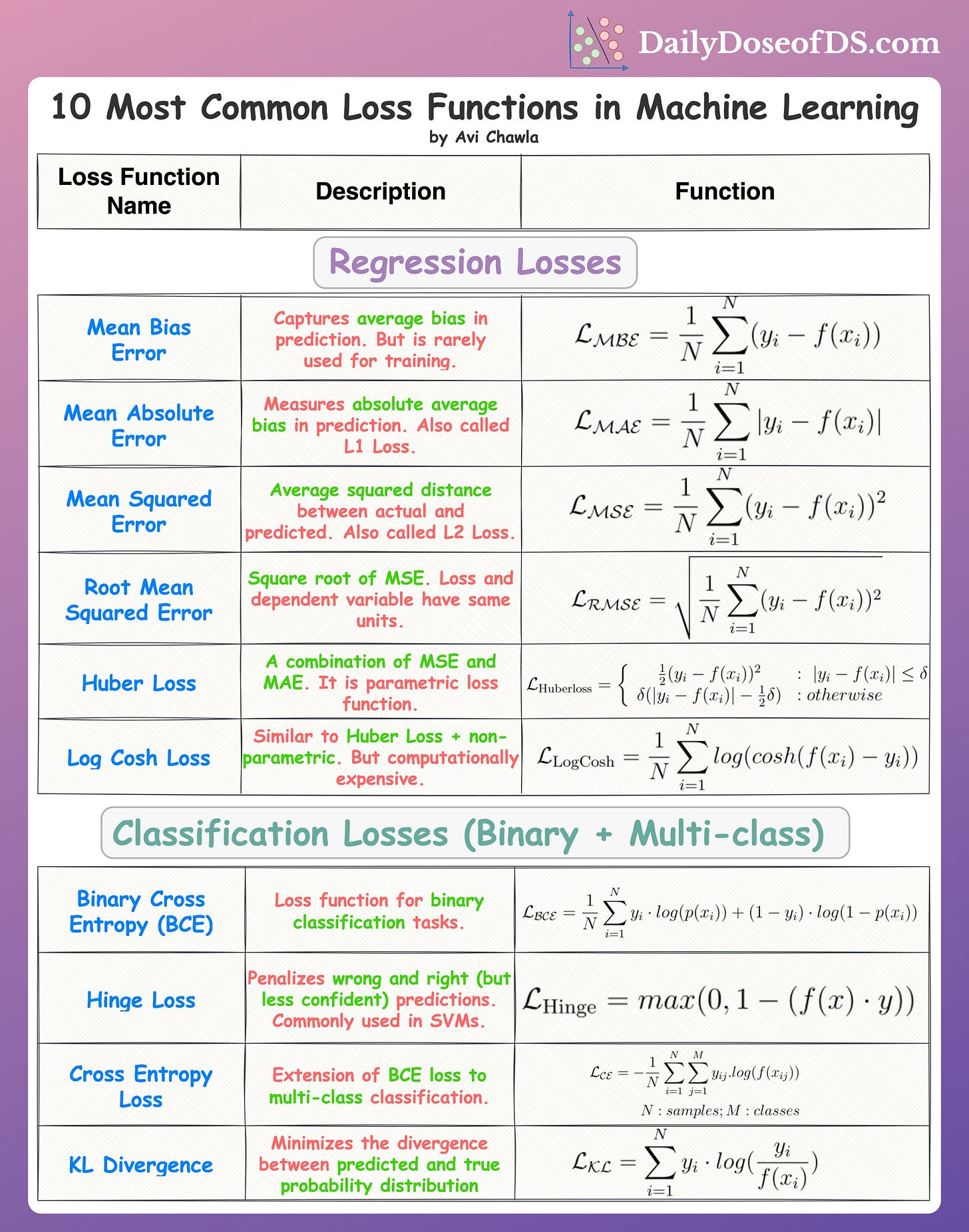
Mean Squared Error (MSE) / L2 Loss: This is the most common loss function for regression. As the name suggests, it calculates the average of the squares of the errors.
By squaring the error, MSE penalizes larger mistakes much more severely than smaller ones. For example, an error of 4 contributes 16 to the loss, while an error of 2 only contributes 4. This makes it a good choice when you want your model to pay special attention to outliers (very wrong predictions).
-
Mean Absolute Error (MAE) / L1 Loss: This function calculates the average of the absolute differences between predictions and actual values.
Unlike MSE, the penalty from MAE grows linearly with the error. An error of 4 contributes 4 to the loss, and an error of 2 contributes 2. This makes MAE more robust to outliers, as it doesn't magnify the impact of single large errors. This is a key architectural choice: if your data has outliers that you think are anomalies and shouldn't dominate the training process, MAE might be a better choice than MSE.
-
Huber Loss: This is a clever hybrid. It behaves like MSE for small errors but like MAE for larger errors. This gives you the best of both worlds: it's less sensitive to outliers than MSE but is still stable around the target value.
Classification Loss Functions
For classification, the task is different. We're not measuring distance to a number; we're measuring how wrong a category prediction is.
- Cross-Entropy Loss / Log Loss: This is the most common loss function for classification tasks. The intuition is that it heavily penalizes predictions that are both wrong and confident.
- Binary Cross-Entropy: Used for two-class problems (e.g., spam or not spam). If the correct answer is 'Not Spam' (label=0) and your model predicts 'Not Spam' with 90% confidence, the loss is small. If it predicts 'Spam' (label=1) with 90% confidence, the loss is very large.
- Categorical Cross-Entropy: Used for multi-class problems (e.g., classifying a UPSC question into 'Polity', 'History', or 'Economics'). It works on the same principle, rewarding confident correct predictions and heavily punishing confident incorrect ones.
For a deeper dive into these specific functions and a few others, the following resource is excellent.
What is Loss Function? - Machine learning
Let's return to the IBM article to explore the specific types of loss functions for regression and classification in more detail.
Please read the sections 'Types of loss functions', 'Regression loss functions' (focus on MSE, MAE, and the description of Huber loss), and 'Classification loss functions' (focus on Cross-entropy). You don't need to memorize the formulas, but understand the core behavior of each function.
The image below serves as a handy reference table for these common loss functions.
3. The Architect's Choice: Why the Loss Function Matters
As an AI product architect, you won't be writing the code for these functions, but you will be involved in the design decisions that determine which one to use. The choice of loss function directly influences the final behavior of your model.
Here are the factors your team will consider, which you should be able to discuss:
- The Problem Type: This is the first and most obvious factor. Is it a regression or classification problem? This immediately narrows the field.
- Sensitivity to Outliers: As we saw, MSE heavily penalizes outliers, while MAE is more robust. If your UPSC AI is predicting mock test scores, do you want a single student who bombed the test to strongly influence the model's predictions for everyone else? This is a discussion about choosing MSE vs. MAE.
- Desired Model Behavior: Some loss functions, like Hinge Loss (mentioned in the IBM article), are designed for specific algorithms like Support Vector Machines to create the widest possible "margin" between classes.
- Computational Properties: A key requirement for a loss function is that it must be differentiable. This is because the training algorithm needs to calculate the gradient (which is based on the derivative) of the loss function to know which "direction" to adjust the model's parameters. This is the crucial link to the next step in the process, optimization.
Loss Functions in Machine Learning Explained | DataCamp
This article from DataCamp provides a great summary of the factors that go into choosing the right loss function, framing it as an essential design decision.
Please read the section 'Choosing the Right Loss Function'. Pay attention to the table summarizing the factors to consider. This directly relates to the architectural decisions you would be a part of.
Test your understanding!
You are leading the design of your UPSC AI companion. Consider the following features and make an architectural choice about the loss function.
- Feature: Predicting a student's score on a 250-mark descriptive Mains paper. Your training data is generally reliable, but contains a few extreme outliers (e.g., scores of 5/250 from students who didn't take the test seriously). You want a model that gives good predictions for the majority of "average" students and isn't skewed by these outliers. Which loss function would be a better choice: MSE or MAE? Why?
- Feature: A binary classifier that determines if a student's answer to a practice question is "Adequate" or "Inadequate". The model predicts a student's answer is "Adequate" with 98% probability, but the human evaluator had marked it "Inadequate". How would a cross-entropy loss function treat this specific error compared to a case where the model was only 55% sure of its wrong answer?
- Feature: A system to suggest a daily study time for a student. You could frame this in two ways:
- Approach A (Regression): Predict the exact number of hours needed (e.g., 3.75 hours).
- Approach B (Classification): Predict the effort category ('Low: <2 hrs', 'Medium: 2-4 hrs', 'High: >4 hrs').
What type of loss function would your engineering team use for Approach A vs. Approach B?
Show answer
- MAE (Mean Absolute Error) would be the better choice. Because MAE is less sensitive to outliers, it would not let the few extreme low scores disproportionately influence the model's training. The goal is to build a model that is accurate for the general population of students, and MAE helps achieve that by treating all errors linearly.
- Cross-entropy loss would penalize the first error (98% confident but wrong) far more heavily than the second error (55% confident and wrong). Its entire design is to punish confident mistakes severely, thereby encouraging the model to become not just accurate, but also well-calibrated in its confidence.
-
- Approach A (Regression): The team would use a regression loss function, like MSE or MAE.
- Approach B (Classification): The team would use a classification loss function, specifically Categorical Cross-Entropy, because there are more than two discrete classes ('Low', 'Medium', 'High').
Conclusion
Today we've uncovered the engine that drives machine learning. You now understand what a loss function is and its dual role in evaluating and optimizing a model.
Here are the key takeaways for you as an AI architect:
- A loss function quantifies the error between a model's prediction and the ground truth. The goal of training is to minimize this loss.
- Loss functions are chosen based on the task: regression loss functions (like MSE, MAE) measure the distance to a correct value, while classification loss functions (like Cross-Entropy) penalize incorrect category assignments, especially confident ones.
- The choice of loss function is a critical design decision that impacts how the model behaves, particularly its sensitivity to outliers.
- Crucially, the loss function provides the necessary signal for optimization by being differentiable.
In our next lesson, we will explore exactly how the model uses this signal. We'll demystify the optimization process itself by learning about gradient descent, the algorithm that takes the error calculated by the loss function and uses it to iteratively improve the model.