Hello! Welcome back to your course on the foundations of AI.
In our first lesson, we explored the three main "teaching styles" for AI: supervised, unsupervised, and reinforcement learning. We established that supervised learning, which uses labeled data like an "answer key," is a cornerstone of many practical AI systems.
Today, we'll dive deeper into this paradigm. This lesson focuses on the learning outcome: Compare classification versus regression tasks with concrete examples. These are the two primary types of problems solved with supervised learning. Understanding their distinction is fundamental for you as an AI architect. When you conceptualize a feature for your EdTech platform, one of the first questions will be: "Are we trying to predict a category or a number?" This lesson will equip you to answer that question confidently.
1. The Core Distinction: Categories vs. Numbers
At its heart, the difference between classification and regression is straightforward:
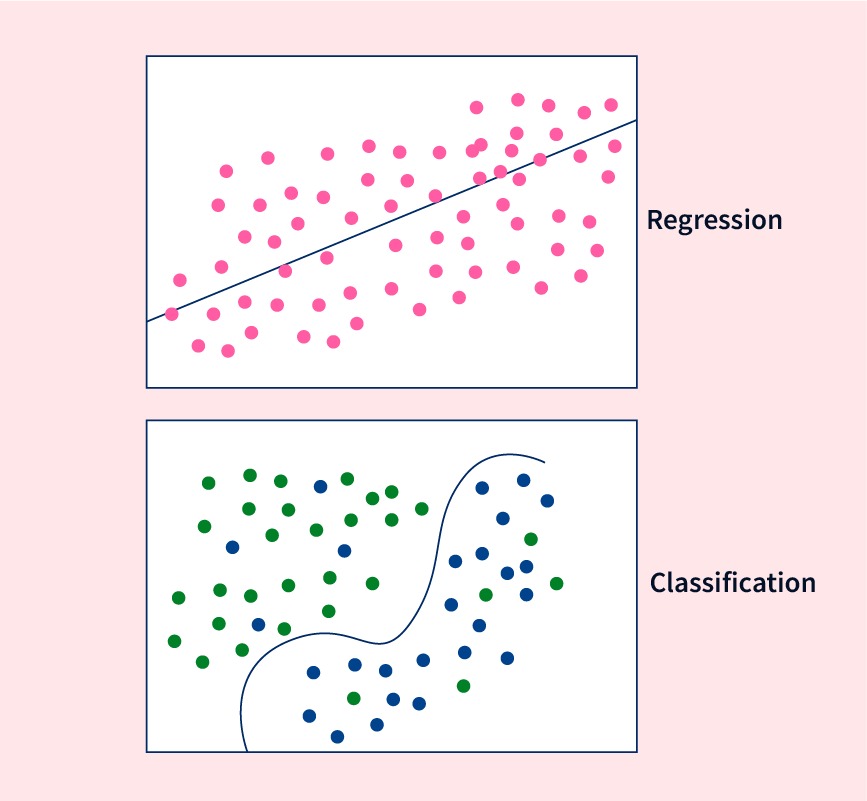
- Classification predicts a discrete category or class label. It answers questions like "Which one?" or "Is it A or B?".
- Regression predicts a continuous numerical value. It answers questions like "How much?" or "How many?".
This simple visual captures the essence of this difference.
To build on this intuition, let's turn to a well-structured article that lays out the foundations for both.
The following article from IBM, 'Classification vs Regression', provides clear definitions and an excellent 'intuition-driven example' to help solidify the difference between these two tasks.
Please read the introduction (up to 'The latest AI News + Insights') and the section titled 'Intuitive divide: Classification versus regression'. Focus on how the article defines each task and the real-world examples it provides, particularly the hospital scenario.
As the article highlights, the choice between classification and regression is about the nature of the question you're asking. Let's use the hospital example from the reading, as it's a powerful analogy:
- If you want to predict how many days a patient will stay, you are predicting a number. This is a regression problem. The output could be 3, 5, 10.5, etc.
- If you want to predict whether a patient will need ICU admission, you are predicting a category ('Yes' or 'No'). This is a classification problem.
The article also introduces a finer point within classification:
- Nominal Classification: The categories have no inherent order (e.g., predicting a patient's blood type: A, B, AB, O).
- Ordinal Classification: The categories have a meaningful order (e.g., predicting disease stage: 'Early', 'Moderate', 'Severe').
This distinction is crucial when designing systems for your UPSC companion. For example, classifying a question's subject ('Polity', 'History') is nominal. Classifying a student's performance as 'Needs Improvement', 'Good', or 'Excellent' would be ordinal.
2. A Deeper Comparison with Examples
Now, let's explore some more concrete examples and touch upon how we measure success differently in each task. The next resource provides clear, distinct lists and explanations.
Classification and Regression Problems in Machine learning
This article, 'Classification and Regression Problems in Machine Learning' by Ravish Kumar, offers another perspective with clear examples and a useful discussion on how performance is measured in each case.
Please read the sections 'Regression Problems' and 'Classification Problems'. Pay close attention to the examples provided for each and the 'common error/cost functions' listed. You don't need to memorize the formulas, just grasp the conceptual difference.
Let's synthesize what we've learned from both resources.
| Feature | Regression | Classification |
|---|---|---|
| Goal | Predict a continuous numerical value. | Predict a discrete class label. |
| Output Type | Quantitative (a number). | Qualitative (a category). |
| Example Questions | How much will this house sell for? What will the temperature be tomorrow? | Is this email spam or not? Which dog breed is in this photo? |
| UPSC AI Example | Predicting the exact score a student will achieve on a mock test (e.g., 87.5). | Classifying a previous year's question into a subject (e.g., 'Polity', 'Economics'). |
| Measuring Success | How close is the prediction to the actual value? (e.g., Mean Squared Error). | Was the prediction correct? (e.g., Accuracy). |
Why Different Measures of Success?
The Medium article brings up a critical point: you can't use the same yardstick to measure success for both tasks. For regression, an error is about distance. Predicting a house price of $490,000 when it's actually $500,000 is a small error.
For classification, it's about being right or wrong. The article's "pregnant man" analogy is a powerful illustration of why simply measuring the "distance" of a probability doesn't work for classification. A model that confidently predicts a man is pregnant (a probability of 0.9) is more "wrong" and should be penalized more heavily than a model that is uncertain (a probability of 0.51). This is why classification uses different metrics, which we will explore more in the next lesson on loss functions.
3. A Problem, Two Approaches
As an architect, you'll find that sometimes a problem can be framed as either a classification or a regression task. Your decision here has significant implications for the model's behavior and the final user experience.
The article you just read has an excellent example of this.
Classification and Regression Problems in Machine learning
Let's revisit the Medium article to look at a fascinating case study: predicting a self-driving car's steering angle. This shows how a single problem can be tackled in two different ways.
Please read the section 'Can we solve the same problem using regression as well as classification techniques?'. Focus on how the author transforms a continuous problem into a categorical one.
This is a fantastic example of architectural thinking. Let's break it down:
- Problem: Predict the steering angle of a car, which can be any value between -50° and +50°.
- Regression Approach: Design a model that outputs a precise, continuous number (e.g., 20.7° or -15.2°). This offers high precision.
- Classification Approach: Discretize the output. You "bin" the continuous range of angles into a set of discrete classes. For example:
- Class 1: "Sharp Left" (-50° to -30°)
- Class 2: "Slight Left" (-30° to -10°)
- Class 3: "Straight" (-10° to +10°)
- ...and so on.
The model now predicts which "bin" the angle falls into. This simplifies the problem for the model and can sometimes be more robust if extreme precision isn't necessary.
Thinking about your UPSC AI, you might face a similar choice. Should your AI predict the exact number of hours a student needs to study a topic (regression), or should it classify their required effort as 'Low', 'Medium', or 'High' (classification)? The latter might be more practical and user-friendly.
Test your understanding!
For your AI EdTech company, you are brainstorming several new features. For each feature below, determine whether it is a classification or a regression task.
- A system that looks at a student's practice essay and assigns it a score from 0 to 100.
- A tool that reads a news article and determines if it is relevant to the UPSC 'International Relations', 'Economy', or 'Environment' syllabus.
- A feature that predicts the probability of a student clearing the UPSC Prelims exam, outputting a value between 0% and 100%.
- A system that categorizes a student's query into one of the following types: 'Doubt about a concept', 'Request for a resource', or 'Technical issue'.
Show answer
- Regression. The output is a specific numerical score on a continuous scale (e.g., 73.5, 88.0).
- Classification. The output is one of a few discrete categories ('International Relations', 'Economy', 'Environment'). This is a multi-class classification problem.
- Regression. Although expressed as a percentage, probability is a continuous value between 0 and 1. The model is predicting a specific point on that scale (e.g., 0.67, which translates to 67%). This is a common point of confusion, but predicting probability is a regression task. However, if you then use that probability to make a binary decision (e.g., "Likely to clear" vs. "Unlikely to clear" based on a 50% threshold), the final decision is a classification. The underlying prediction is regression.
- Classification. The output is a discrete label from a predefined set of categories.
Conclusion
In this lesson, we dissected the two main branches of supervised learning. You now have a clear framework for distinguishing between them, which is a vital skill for any AI product leader.
Here are the key takeaways:
- Regression is for predicting continuous quantities ("How much?").
- Classification is for predicting discrete labels ("Which one?").
- The choice between them depends on how you frame the problem, and sometimes a single problem can be framed in both ways.
- Each task requires different evaluation metrics to measure success—distance-based for regression, and correctness-based for classification.
In our next lesson, we will build directly on this foundation. We've mentioned that models learn by minimizing their mistakes, whether it's the distance from a correct number or the penalty for a wrong category. We will now formally define loss functions, the mathematical engines that quantify this "mistake" and guide a model's learning process.