Hello! Welcome to the final lesson of our first module, "Foundations of Machine Learning."
In our last lesson, we explored the critical concepts of overfitting and underfitting. We established that the key to diagnosing these problems is to compare a model's performance on data it has seen during training versus new, unseen data. But how do we do this in a structured, reliable way?
This lesson answers that question. Our learning outcome is to describe the purpose and mechanics of train-test-validation data splits for model evaluation. This isn't just a technical procedure; it's the scientific method applied to machine learning. It's the core practice that ensures we are building models that can genuinely generalize, not just memorize.
For you, as the architect of a sophisticated AI system like a UPSC companion, mastering this concept is non-negotiable. It's the framework that provides an honest assessment of your model's capabilities, preventing you from deploying an AI that seems brilliant during development but fails in the hands of a real user.
1. The Need for an Unbiased Evaluation
Imagine you're developing your UPSC curriculum generator. You give it a set of 1,000 history topics to structure. It produces a perfect curriculum. Success?
Not necessarily. If you then ask it to structure the same 1,000 topics again, it will likely perform perfectly. But what happens when you give it 200 new topics from Political Science? This is the real test.
Testing a model on the same data it was trained on is like giving a student a practice exam and then making the final exam identical. Their score on the final wouldn't prove they learned the subject, only that they could memorize the answers. This is why we must test our models on data they have never seen before. This brings us to the most basic data split.
2. The First Split: Training and Test Sets
The simplest way to create a "seen" and "unseen" dataset is to split your original data into two parts:
- Training Set: The majority of the data (e.g., ~80%), used to teach the model. The model sees the inputs and the correct outputs and adjusts its internal parameters to find patterns. This is the model's "textbook and study material."
- Test Set: A smaller, held-out portion of the data (e.g., ~20%). This data is kept completely separate during training. It serves as the "final exam" to give a single, unbiased measure of the model's performance on unseen data.
This is a good start, but it introduces a subtle but critical problem.
3. The Flaw in the Two-Set System: Contaminating the Final Exam
During the development of a model, you and your team need to make many decisions:
- "Which model architecture should we use? Model A or Model B?"
- "How complex should the model be?"
- "How long should we train the model for?"
These are known as hyperparameters—settings that you choose before the training process begins. To make these decisions, you need to evaluate which choices lead to the best performance.
If you only have a training and a test set, you might be tempted to use the test set to make these decisions. For example:
- Train Model A on the training set. Evaluate its score on the test set.
- Train Model B on the training set. Evaluate its score on the test set.
- You see that Model B got a higher score, so you choose it as your final model.
The problem? You've used the test set to "tune" your model choice. Information from the test set has now leaked into your model design process. The test set is no longer a truly "unseen" final exam; it has become part of the study process. Your final evaluation will be overly optimistic, and you've inadvertently overfitted your design choices to the test set.
To solve this, we introduce a third dataset.
4. The Gold Standard: Training, Validation, and Test Sets
The industry-standard solution is to divide your data into three distinct subsets. This methodology provides a robust framework for both model development and final evaluation.
To understand the distinct role of each set, please read the following article.
Training Set vs Validation Set vs Test Set
The article "Training Set vs Validation Set vs Test Set" from Codecademy provides excellent, clear definitions for each of the three datasets. It uses a consistent example of a spam classifier that we can easily map to your own project goals.
Please read the sections defining the 'Training set', 'Validation set', and 'Test set'. Pay close attention to the purpose of each. Then, review the summary table in the section 'Training set vs. validation set vs. test set'.
Let's consolidate these definitions using our own analogy: preparing for the UPSC exam.
-
Training Set (The Textbooks): This is the largest part of your data (e.g., 60-80%). The model uses this to learn the core patterns and relationships. This is equivalent to a student studying standard textbooks like NCERTs and reference books to learn the fundamental concepts of history, polity, etc.
-
Validation Set (The Mock Exams): This is a separate chunk of data (e.g., 10-20%). It's used periodically during the development process to tune the model's hyperparameters and make design choices. For a student, this is like taking a series of mock exams. Based on their performance, they might change their study strategy (e.g., "I'm weak in Modern History, I need to focus there," or "My current note-taking method isn't working").
-
Test Set (The Final UPSC Exam): This is the final, untouched piece of data (e.g., 10-20%). It is used only once, after all development and tuning is complete, to get a final, unbiased measure of the model's performance. For the student, this is the actual UPSC Prelims or Mains exam. Their performance here is the ultimate measure of their knowledge.
The entire workflow is about using the validation set to pick the best model/strategy before subjecting that single best choice to a final, fair evaluation.
The following resource from Google's Machine Learning Crash Course provides a fantastic visual workflow of this process.
Dividing the original dataset | Machine Learning
This page, "Dividing the original dataset," explains the rationale for the three-set split and includes a clear workflow diagram that summarizes the entire process.
Read the section 'Training, validation, and test sets' and study the workflow diagram (labeled Figure 10 in the text). Focus on the iterative loop between training and validation, and how the test set is used only at the very end.
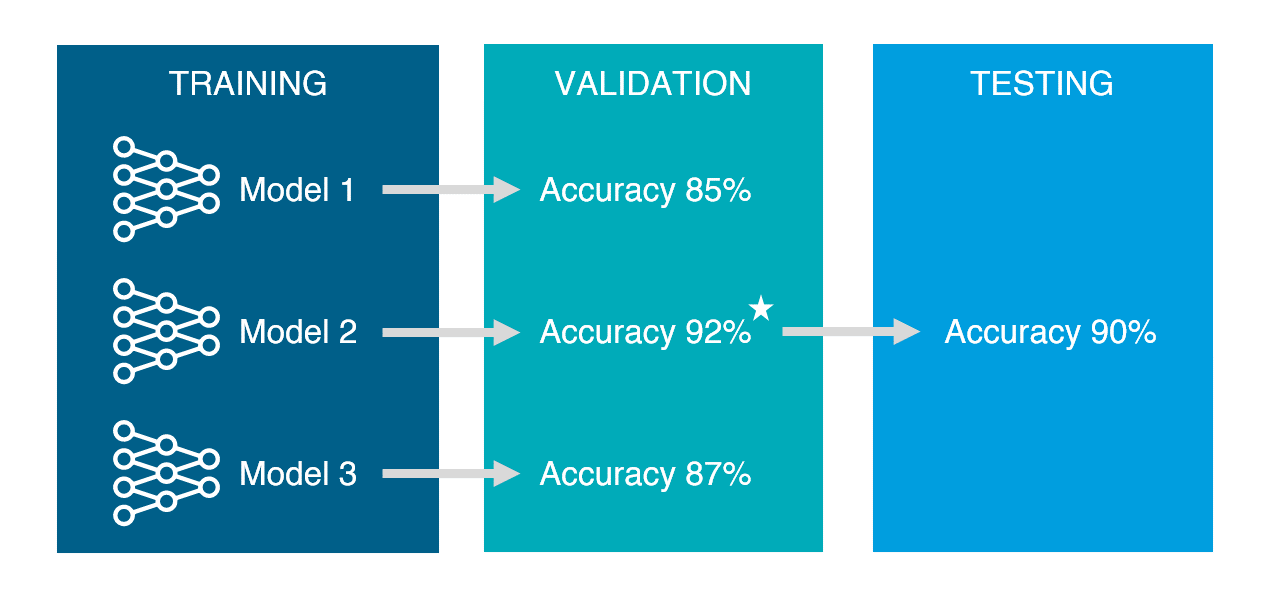
This workflow—train, validate, tweak, repeat, and then finally test—is central to applied machine learning. The image below shows this in action, where a team evaluates multiple models and uses the validation set to select the winner for final testing.
5. The Mechanics: How to Split Data Correctly
As an architect, you need to ensure your team follows best practices when creating these splits. A flawed split can invalidate your entire evaluation process.
Typical Ratios:
Common splits are 60% training, 20% validation, 20% testing, or 70/15/15. There's no single magic number. For very large datasets (millions of examples), the validation and test sets can be a much smaller percentage (e.g., 98/1/1) because even 1% constitutes a very large number of examples. The key is that the validation and test sets must be large enough to be statistically representative.
Key Principles for a High-Quality Split:
-
Shuffle the Data: Before splitting, always randomly shuffle the entire dataset. If your data is ordered in some way (e.g., by date or topic), failing to shuffle could lead to your training set containing only old data and your test set containing only new data, which would not be a fair evaluation.
-
Stratified Sampling: When dealing with classification problems, it's crucial that the class proportions are maintained across all three sets. For example, if your UPSC question dataset is 15% "Polity" and 85% other subjects, each of your train, validation, and test sets should also have roughly 15% "Polity" questions. This is called stratified sampling, and it prevents a situation where, by bad luck, one of your sets has no examples of a particular class.
-
Prevent Data Leakage: This is the cardinal rule. No data from the validation or test sets should ever be used to train the model. A common way this rule is broken is by having duplicate examples across the sets. For instance, if the same question appears in both the training set and the test set, your model's test score will be artificially inflated. Your data preparation pipeline must rigorously de-duplicate data before splitting.
Training Set vs Validation Set vs Test Set
The Codecademy and Google articles both offer practical advice on these mechanics.
Quickly read the section 'How to split machine learning data' and the 'Frequently asked questions' for a good summary of these practical points.
Test your understanding!
You have a dataset of 10,000 historical UPSC essay prompts. You want to build a model that classifies them by theme (e.g., "Philosophy," "Geopolitics," "Technology"). Your team has developed two competing model architectures, Model-Alpha and Model-Beta.
As the project architect, describe the exact, step-by-step instructions you would give your team to determine which model is better and to get a trustworthy final performance score. Explain why each step is necessary.
Show answer
Here are the instructions you would provide:
-
Data Preparation: "First, ensure the dataset of 10,000 prompts is clean and de-duplicated. Then, randomly shuffle the entire dataset."
- Why: Shuffling prevents any ordering bias from affecting the splits.
-
Data Splitting: "Next, split the data into three sets using stratified sampling: a 70% training set (7,000 prompts), a 15% validation set (1,500 prompts), and a 15% test set (1,500 prompts)."
- Why: We need three sets to separate training, hyperparameter tuning, and final evaluation. Stratified sampling ensures that the proportion of themes (e.g., "Philosophy") is consistent across all sets, leading to a fair evaluation.
-
Model Training: "Train both Model-Alpha and Model-Beta on the training set only."
- Why: The models must learn the underlying patterns from the same base of knowledge.
-
Model Selection: "Evaluate the performance (e.g., accuracy) of both trained models on the validation set. The model that scores higher on this set is our chosen model. For this exercise, let's say Model-Alpha wins."
- Why: The validation set acts as a fair, common benchmark to compare the models' generalization ability for the purpose of model selection. We must not use the test set for this, or we'll introduce bias.
-
Final Evaluation: "Take the winning model (Model-Alpha) and evaluate it one time on the test set. The score you get from this is the final performance metric you will report."
- Why: The test set has been completely untouched throughout this entire process. This final score is our most honest and reliable estimate of how Model-Alpha will perform on new, unseen essay prompts in the real world.
By following this process, we ensure that we select the best model based on a fair competition (the validation set) and then get an unbiased estimate of its true performance (on the test set).
Conclusion
This lesson concludes our foundational module. You now understand the rigorous process for evaluating machine learning models, which is essential for moving from a promising prototype to a reliable production system.
Key Takeaways:
- Purpose of Splitting: To get an unbiased estimate of how a model will perform on new, unseen data (i.e., its ability to generalize).
- Training Set: The data the model learns from.
- Validation Set: The data used to tune model hyperparameters and make design choices (e.g., selecting between different architectures). It's the "mock exam."
- Test Set: Held-out data used only once at the very end to provide a final, unbiased performance report. It's the "final exam."
- Mechanics: Proper evaluation requires shuffling data, using stratified sampling for classification, and preventing any data leakage between the sets.
We've now covered the high-level paradigms of ML, the goals and challenges (loss, bias-variance, overfitting), and the framework for evaluation. With this solid foundation, you are ready to start looking inside the models themselves.
In our next module, "Neural Networks: From Perceptrons to RNNs," we will begin our journey into the architectures that power modern AI. We'll start with the most fundamental building block of them all: the artificial neuron, or perceptron.