In our last lesson, we explored the Generalized Assignment Problem (GAP), framing the allocation of your available time as a centralized planning challenge to maximize satisfaction. This required a complete overview of all options and constraints to find an optimal, static schedule. Today, we shift perspective to a more decentralized and dynamic approach as we address the learning outcome: Apply the Auction Algorithm to dynamically allocate premium photoshoot slots to the highest-impact outfit-pose combinations.
The Auction Algorithm, developed by Dimitri Bertsekas, conceptualizes the assignment problem not as a single, complex optimization but as a competitive market. Instead of a central planner, individual agents "bid" for resources, and prices adjust based on demand until a stable, efficient assignment emerges. This is a powerful model for dynamic allocation where priorities can shift, making it an excellent tool for assigning valuable and limited photoshoot opportunities.
The Auction Framework: Bidders, Items, and Prices
The algorithm's elegance lies in its intuitive economic analogy. Imagine we have a set of "persons" who want to be assigned to a set of "objects." Each person derives a specific benefit from being matched with a particular object. The goal is to create a one-to-one matching that maximizes the total benefit for everyone.
[PDF] Auction Algorithms - MIT
This document by the algorithm's creator, Dimitri Bertsekas, provides a clear and authoritative introduction. We'll start with the foundational concepts.
First, read the brief introductory paragraphs about the algorithm. Then, move to the next section and read the part that introduces the market metaphor, covering the concepts of price and value.
As the reading explains, the core idea is to introduce prices () for each object j. A person i evaluates an object not just by its raw benefit () but by its net value or profit: . Logically, each person wants to be assigned to the object that offers them the highest profit. When every person is assigned to an object that maximizes their profit, the system is in equilibrium, and it turns out this assignment is optimal.
The Auction Algorithm is an iterative process designed to reach this equilibrium.
The Bidding Process: From Naive to Robust
Let's model our photoshoot scenario:
- Persons (Bidders): The high-impact outfit-pose combinations you want to shoot. For example:
Lace Bodysuit + Reclining PoseSilk Robe + Backlit SilhouetteVintage Garter + Power Stance
- Objects (Items): The premium, limited photoshoot time slots. For example:
Golden Hour(soft, warm light)High Noon(harsh, dramatic shadows)Twilight(cool, moody light)
- Benefit (): The estimated "sexiness" score of shooting combination
iin time slotj. This is a matrix you would define based on your aesthetic goals. A silhouette pose has high benefit at twilight, while a detailed lingerie set might have high benefit with controlled studio lighting (which we can consider a "slot").
The algorithm proceeds in rounds where unassigned "persons" (outfit-poses) bid for "objects" (slots).
A Simple (but Flawed) Auction
A "naive" version of the algorithm works like this:
- An unassigned person
ifinds the objectjthat offers the highest profit, . - It also identifies the second-best profit, .
- The person then "bids" for the best object, increasing its price by the difference: . This bid makes the best object just as attractive as the second-best, capturing all the surplus profit.
- Person
iis tentatively assigned to objectj, and the previous owner ofj(if any) becomes unassigned.
This process seems logical, but it has a critical flaw. What if an outfit-pose combination has an equal preference for two time slots (e.g., Golden Hour and Twilight both yield a sexiness score of 90, and their prices are currently equal)? The bidding increment would be zero. Two different outfits might then compete for these two slots, swapping them back and forth indefinitely without ever raising the price, causing the algorithm to cycle forever.
The ε-Auction: Guaranteeing Progress
To solve this, we introduce a small positive constant, , which represents a minimum bid increment. This is analogous to real-world auctions where you must bid at least some minimum amount over the current price.
The bidding increment is now defined as:
This ensures that every successful bid increases an object's price by at least . Since prices are always increasing, they can't cycle, and the algorithm is guaranteed to terminate.
This modified process is the heart of the Auction Algorithm. Let's visualize how the bidding increment is calculated.
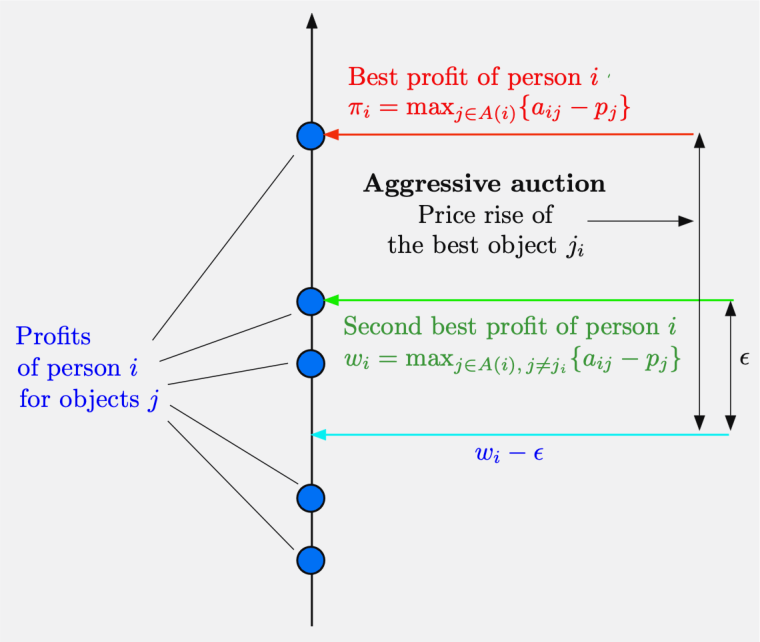
Now, let's see how this small change prevents the algorithm from getting stuck.

Optimality and Practical Application
The introduction of has a fascinating consequence for the solution's quality. The final assignment is not necessarily perfectly optimal, but it satisfies a condition called -Complementary Slackness. This means every assigned person's profit is within of the best possible profit they could have achieved.
The key insight is that the total benefit of the final assignment is guaranteed to be within of the true maximum benefit, where n is the number of persons.
This leads to a powerful result for problems with integer benefits. If our "sexiness" scores are integers (or can be scaled to be), and we choose , then the total deviation will be less than 1. Since the total benefit must be an integer, being "less than 1 away from optimal" means it must be exactly optimal.
[PDF] Auction algorithms for network flow problems: A tutorial introduction
This tutorial provides a detailed explanation of the algorithm's mechanics and its optimality properties.
Please read the section titled "ε-Complementary Slackness and the Auction Algorithm" (ε-CS and Auction). Pay close attention to the argument in Proposition 2, which formally states why choosing \epsilon < 1/n for integer benefits guarantees an optimal solution. This is the theoretical foundation for applying the algorithm with confidence.
Running the Photoshoot Auction
Let's walk through a simplified execution for your photoshoot:
-
Setup: Define your
noutfit-pose combinations ("persons") andntime slots ("objects"). Create then x nmatrix of integer sexiness scores . Choose such that (e.g., if , choose ). Initialize all slot prices and start with no assignments. -
Bidding Round:
- Pick an unassigned outfit-pose, say
Outfit 1: Lace Bodysuit. - Calculate its profit for each slot:
profit_j = a_1j - p_j. - Find the best slot
j*(highest profit ) and the second-best slot (second-highest profit ). - The bid for slot
j*is . - Update the price: .
- Assign
Outfit 1toSlot j*.
- Pick an unassigned outfit-pose, say
-
Iteration:
- Now, pick another unassigned combination,
Outfit 2: Silk Robe. It runs the same calculation. - Suppose
Outfit 2also findsSlot j*to be its most profitable option, even at the new, higher price. It places a new bid. - The price increases again.
Outfit 2is now assigned toSlot j*. Outfit 1becomes unassigned and is now available to bid in a future round.
- Now, pick another unassigned combination,
-
Termination: This process continues. As prices rise for the most desirable slots, they become less attractive, and eventually, other, cheaper slots become the best option for some outfits. The auction ends when every outfit-pose combination is assigned to a unique time slot. Because we chose , this final assignment is guaranteed to maximize the total sexiness score.
A practical performance enhancement is -scaling. Instead of using a tiny from the start, you can run the algorithm first with a large to get a rough assignment quickly. Then, you decrease and run it again, using the prices from the previous phase as a starting point. This iterative refinement is often much faster than a single run with a very small .
Conclusion
Today, we've explored the Auction Algorithm, a dynamic and intuitive method for solving the assignment problem. By mimicking a competitive market, it provides a powerful, decentralized alternative to the centralized methods we've previously discussed.
Key Takeaways:
- Decentralized Approach: The Auction Algorithm solves the assignment problem by having "persons" (outfit-poses) iteratively bid for "objects" (time slots) based on profit ().
- The Role of : A small bid increment, , is essential to prevent infinite cycles and guarantee the algorithm terminates by forcing prices to rise with each bid.
- Guaranteed Optimality: For problems with integer benefits, setting ensures that the final assignment is not just close to optimal, but exactly optimal.
- Dynamic Allocation: The algorithm naturally handles competition for scarce resources, making it ideal for dynamically assigning premium photoshoot slots to the highest-impact looks.
In our next lesson, we will shift our focus from assigning tasks to specific resources to sequencing them over time. We will begin by comparing the Shortest Processing Time (SPT) and First-In, First-Out (FIFO) rules to see how different sequencing priorities can dramatically affect workflow efficiency, a crucial aspect of managing the flow of a photoshoot session.