Welcome back. In our last lesson, we critically examined the assumptions of the M/M/1 queueing model, learning that its real power lies in understanding how system variability impacts performance. We saw that reducing the variance of a process can be as effective as speeding it up.
This week, we pivot from managing flows to managing resources. You are likely familiar with the Pareto principle—the idea that roughly 80% of effects come from 20% of the causes. As an optimizer, you have almost certainly applied this intuition in various contexts. Today, we will formalize this principle using a classic inventory management tool.
Your learning outcome is to: Apply ABC Analysis to categorize lingerie pieces by their impact on photoshoot sexiness to prioritize wardrobe investment and to prioritize intimacy activities by their impact on the hotwife's satisfaction.
This lesson will guide you through the mechanics of ABC analysis and, more importantly, how to adapt this quantitative tool to prioritize assets and activities based on subjective, multi-faceted goals.
The Principle of "Vital Few and Trivial Many"
At its heart, ABC analysis is a method of categorization that separates the "vital few" from the "trivial many." It prevents the inefficiency of treating every item in an inventory with the same level of scrutiny. Instead of managing thousands of items, you can focus your most intensive efforts on the few that truly drive value.
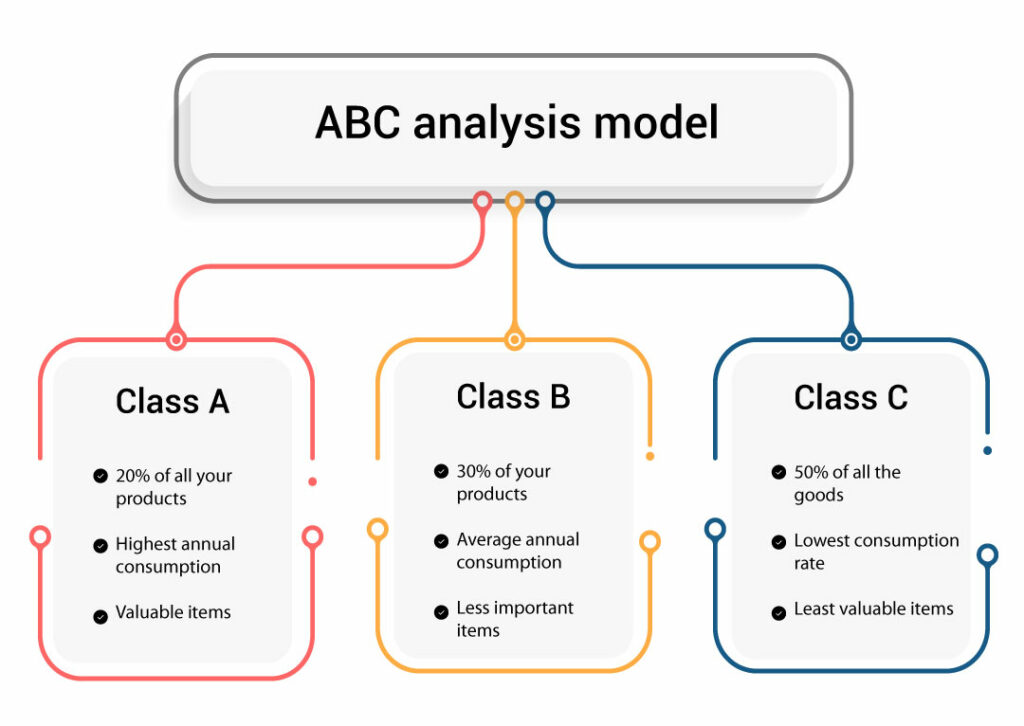
The standard classification, rooted in financial inventory management, is as follows:
- Class A: The top ~20% of items that account for ~80% of the total value.
- Class B: The next ~30% of items, accounting for ~15% of the value.
- Class C: The remaining ~50% of items, accounting for only ~5% of the value.
These percentages are flexible, but the underlying principle of value concentration remains. To understand how this stems directly from Pareto's observation, please review the following text.
ABC Inventory Analysis: The Complete Guide to Strategic ...
This guide from Bizowie provides a clear explanation of how the Pareto Principle forms the foundation of ABC analysis.
Read the introduction and the section titled The Pareto Principle and Inventory Management. Focus on how this principle counters the suboptimal approaches of either over-analyzing everything or under-analyzing critical items.
The Mechanics of ABC Analysis
Before we can adapt the model to your specific scenarios, it's essential to understand its standard, quantitative application. The process is a straightforward data analysis exercise, which will be very familiar to you given your background in statistics.
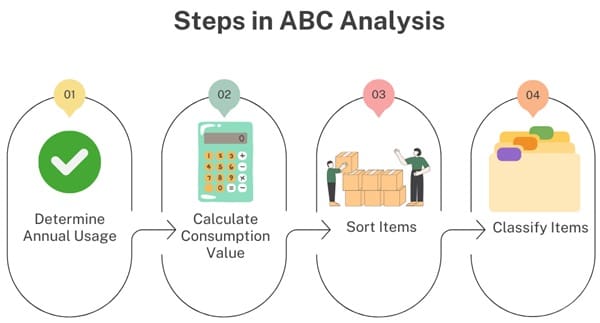
The core steps are:
- Determine Annual Usage: For each item, find how many units are used, sold, or consumed over a year.
- Calculate Consumption Value: Multiply the annual usage of each item by its unit cost. This gives you the annual monetary value for each item.
- Sort Items: Rank the items in descending order based on their calculated consumption value.
- Classify Items: Calculate the cumulative percentage of total value as you go down the list. Use this cumulative percentage to define the cutoffs for Class A, B, and C.
To see these steps executed with a concrete example, please study the following material.
ABC Inventory Analysis: The Complete Guide to Strategic ...
This guide provides a step-by-step walkthrough of the calculations and includes a clear table demonstrating the process.
Read the section How to Perform ABC Inventory Analysis. Then, carefully review the table and calculations in the ABC Analysis Example to solidify your understanding of the mechanics.
Application 1: Prioritizing the Photoshoot Wardrobe
Now, let's translate this financial tool to the world of aesthetics and impact. Our goal is to categorize your lingerie wardrobe to maximize the "sexiness" of the photoshoot. The "inventory items" are the individual lingerie pieces. The challenge is defining "consumption value." Here, value is not monetary but is instead a measure of an item's contribution to the final artistic goal.
A simple, single criterion like a subjective "sexiness score" might not be sufficient. As a causal analyst, you know that outcomes are often driven by multiple factors. We need a multi-criteria approach.
Step 1: Define Items and Criteria
First, list your inventory items (e.g., 'Black lace bodysuit', 'Red satin bra/panty set', 'Sheer white robe'). Next, define a set of value-driving criteria. For example:
- Aesthetic Impact (AI): A score from 1-10 based on audience feedback or your own artistic judgment.
- Versatility (V): How many different poses, lighting setups, or looks can this piece be used for? (e.g., a score from 1-5).
- "Wow" Factor / Criticality (C): Does this piece have the power to be a "show-stopper"? This is a binary (1/0) or 1-3 scale indicating if it's a linchpin for a specific high-concept shot.
- Frequency of Use (F): How many times has this piece been selected for a final shot in past sessions?
Step 2: Calculate "Impact Value"
With these criteria, you can construct a composite "Impact Value" for each piece. A simple weighted sum is a good starting point. You, as the decision-maker, would assign weights based on your strategic priorities.
For instance, if Aesthetic Impact is paramount, its weight would be the highest.
Step 3 & 4: Sort and Classify
Once you calculate the Impact Value for every lingerie piece, the rest of the process is purely mechanical. You sort the items in descending order of their Impact Value and apply the 80/15/5 cumulative percentage cutoffs to create your A, B, and C classes.
Step 5: Define Managerial Policies
Classification is useless without action. The power of ABC analysis comes from applying different "management policies" to each class.
- Class A (The "Hero" Pieces): These are your vital few.
- Investment: Prioritize spending on duplicates, professional cleaning, and custom alterations.
- Shoot Planning: Build entire concepts around these pieces. Schedule them for times when the model's energy and lighting are at their peak.
- Care: Store them with the utmost care to prevent wear and tear.
- Class B (The "Supporting Cast"): These are reliable, but not stars.
- Investment: Standard budget for maintenance and replacement.
- Shoot Planning: Use them to flesh out the photoshoot and create variety between the "hero" looks.
- Care: Standard care procedures.
- Class C (The "Niche" or "Filler" Pieces): Your trivial many.
- Investment: Minimal to zero. Consider not replacing them if they wear out.
- Shoot Planning: Use them only if a very specific concept calls for it, or to quickly add shots at the end of a session.
- Care: Minimal effort. Don't waste prime shoot time or significant budget on them.
Application 2: Prioritizing Hotwife Intimacy Activities
The same logic can be applied to an intangible "inventory" of intimacy activities to optimize the hotwife's satisfaction.
Step 1: Define Items and Criteria
The "items" are the different types of encounters or intimacy-related activities.
- Items: 'Weekend getaway', 'Spontaneous weeknight encounter', 'Public/risky play', 'Exploring a specific shared fantasy', 'A planned 'date night' with the bull'.
- Criteria: The factors that contribute to the hotwife's satisfaction.
- Satisfaction Score (S): A subjective rating (1-10) from past experiences.
- Emotional Connection (EC): To what degree does this activity deepen the bond and trust? (1-10).
- Novelty/Excitement (N): How thrilling or new is this activity? (1-10).
- Planning Effort (P): A "cost" metric. How much time and energy does this activity require to arrange? (1-10, where 1 is low effort).
Step 2: Calculate "Satisfaction Value"
Here, we can create a benefit-cost style ratio, which is an elegant way to capture efficiency—something you specialize in.
This formula prioritizes activities that deliver high satisfaction, connection, and excitement for a relatively low planning cost.
Step 3 & 4: Sort and Classify
Calculate this value for each activity type, sort them, and define your A, B, and C classes.
Step 5: Define Managerial Policies
- Class A (Core Satisfiers): These activities are the foundation of satisfaction.
- Policy: Proactively schedule and protect time for these. Invest the most emotional energy and planning effort here. They are non-negotiable for long-term fulfillment.
- Class B (Routine Pleasures): These maintain connection and provide consistent enjoyment.
- Policy: Integrate these into the regular rhythm of life. They require moderate planning and are important but can be rescheduled with less impact than Class A activities.
- Class C (Occasional/High-Effort Novelties): These might be high-effort, situation-specific, or lower-impact activities.
- Policy: Pursue these opportunistically when time and energy are abundant. Do not let the inability to do these create stress. They are "nice-to-haves," not essentials.
The Power of Multi-Criteria Analysis
Our adaptation of ABC analysis for these non-traditional applications hinges on moving beyond a single, simple metric. This is a recognized extension of the classic model.
ABC Inventory Analysis: The Complete Guide to Strategic ...
This section discusses advanced variations that align perfectly with our approach.
Please read the section on Advanced ABC Analysis Variations. Note the list of potential criteria, such as Criticality and Profit Margin, which are analogous to our "Wow Factor" and "Satisfaction Score."
Your background in operations research and statistics provides you with a rich toolkit for defining these multi-criteria value functions. The simple weighted sum is just a starting point. You could explore non-linear relationships, interaction effects between criteria, or even use clustering algorithms (like k-means, as explored in some advanced research) to discover the A, B, and C categories from the data itself. The crucial part is that the logic of prioritization remains the same.
Conclusion
Today, we've taken a classic operations tool, ABC analysis, and demonstrated its flexibility and power. By abstracting its core function—applying the Pareto principle to focus effort—we can move it from the warehouse floor to the photo studio and into the complex domain of personal relationships.
Key Takeaways:
- ABC Analysis operationalizes the 80/20 rule, allowing you to focus management attention on the "vital few" items that deliver the most value.
- The standard process involves calculating a consumption value, sorting, and classifying based on cumulative value percentages.
- The model's real power lies in its adaptability. By defining relevant "items" and a custom, multi-criteria "value" function, it can be used to optimize for subjective goals like "sexiness" or "satisfaction."
- Classification must be followed by differentiated management policies to be effective. Class A items receive the most investment and priority, while Class C items receive the least.
In our next lesson, we will address the logical next question. Now that we've identified which items are most important, we need to decide how much to procure and how often. We will explore the Economic Order Quantity (EOQ) model to find the optimal balance between holding costs and ordering costs, for both physical lingerie inventory and intangible "batches" of intimacy.