Welcome back. In our last lesson, we delved into the Economic Production Quantity (EPQ) model, applying it to optimize the batch creation of custom outfits for a photoshoot. This approach, like its cousin EOQ, is fundamentally about planning and batching—calculating an optimal quantity to produce in advance based on forecasted demand and costs.
Today, we pivot from a philosophy of planning to one of radical responsiveness. We will explore the principles of Just-in-Time (JIT), a cornerstone of lean methodology. Instead of optimizing batch sizes, JIT seeks to eliminate them altogether, along with the "inventory" they represent. Your learning outcome for this lesson is to adapt Just-in-Time (JIT) principles to design a responsive framework for spontaneous encounter opportunities between the hotwife and her bull.
This will require us to translate concepts from the factory floor—like pull systems, setup times, and flow—into the intangible and dynamic context of human desire and availability. We will move beyond simply managing a queue of needs to creating a system that meets those needs precisely when they arise.
The Core Shift: From "Push" to "Pull"
The foundational difference between traditional planning and JIT lies in the shift from a "push" to a "pull" system.
- A Push System operates on forecasts. You produce goods and push them into the market, hoping demand will materialize. In our intimacy context, this is like rigidly scheduling encounters ("every Friday night") based on a forecast of desire. This can lead to waste: forced encounters when desire is low, or a buildup of "inventory" (unmet needs) when desire flares up at other times.
- A Pull System operates on actual, real-time demand. An order from a customer pulls the product through the production process. Nothing is made until it is needed.
This short video from Fishbowl provides a clear and simple visual distinction between these two philosophies.
Manufacturing: Push or Pull? - Whiteboard Wednesday
This video offers a concise overview of push versus pull manufacturing.
First, watch the description of the push system, noticing the emphasis on storage and piled-up inventory. Then, watch the explanation of the pull system, where production is initiated by a customer order.
In the context of the hotwife and her bull, the "customer order" is the spontaneous emergence of desire from either partner. A JIT framework, therefore, doesn't schedule encounters; it creates the conditions for an encounter to happen fluidly and quickly in response to that signal of desire.
JIT Philosophy: Eliminating the "Inventory" of Desire
Just-in-Time is defined by its core goal: to eliminate waste by producing and delivering only what is needed, in the exact quantity, and at the right time.
Just-in-Time (JIT): Agility and Efficiency in the Supply Chain
This article from Kaizen.com introduces the fundamental philosophy of JIT.
Read the introductory sections, from the beginning down to the heading "The origins of JIT." Focus on the definition in the section What is Just-in-Time? and its goal of eliminating non-value-added activities.
To apply this, we must first define our "inventory." In this intangible domain, inventory is unfulfilled desire or unmet need. The longer this inventory "sits on the shelf," the higher the "holding cost" in the form of frustration or emotional distance. While EOQ and EPQ sought to manage this inventory in optimal batches, JIT aims to eliminate it by creating a system so responsive that significant inventory never accumulates.
This philosophy is a key pillar in the broader "House of Lean" framework, which structures various principles toward the ultimate goal of "Customer Focus"—or in our case, mutual satisfaction.
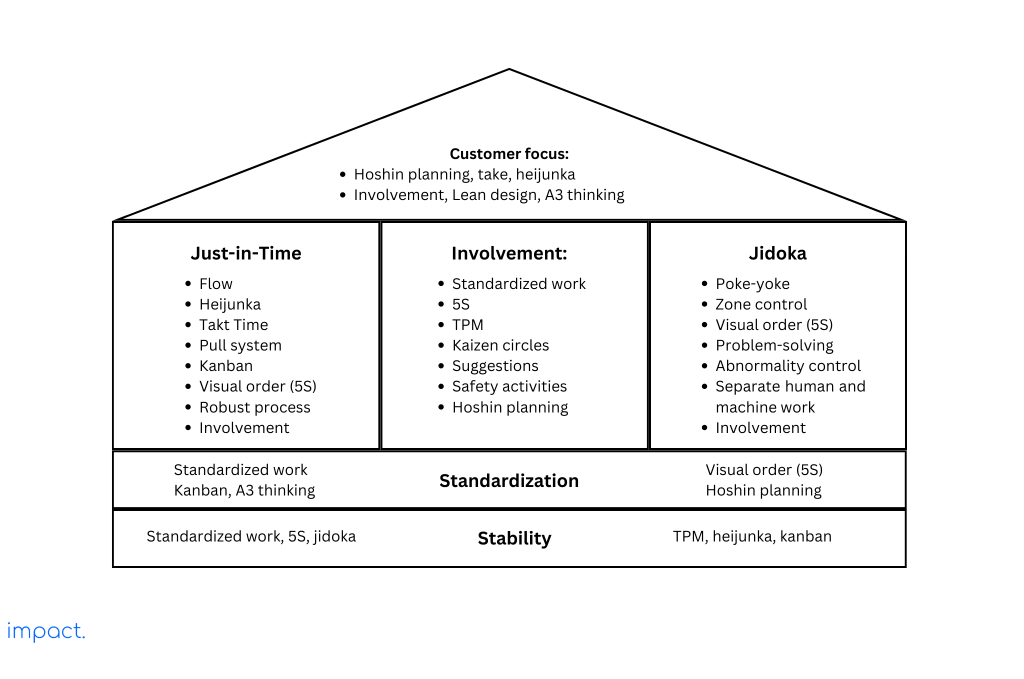
Designing a Responsive Framework for Intimacy
To build our JIT framework, we will adapt several core operational principles. Your background in operations research will be invaluable here, as we are essentially designing a real-time, event-driven system for a stochastic process (the arrival of desire).
1. The Pull System and the "Kanban" Signal
In manufacturing, a "pull system" is often managed using Kanban cards. When a downstream process needs a part, it sends a Kanban to the upstream process, authorizing it to produce and send exactly one container of that part.
For our intimacy framework, we must design an analogous pull signal.
- The Pull: The spontaneous desire for an encounter.
- The Kanban: A pre-agreed, unambiguous, low-effort signal that one partner uses to "pull" the other into an encounter. This is not a request that opens a long negotiation; it's a signal that initiates a pre-defined process.
Examples of an intimacy "Kanban" could be:
- A specific emoji sent via text.
- A shared calendar event with a specific title.
- A code word.
The system might have a rule that only one "Kanban" can be in circulation at a time. Once a signal is sent, a new one cannot be sent by either party until the resulting encounter is completed (or the signal is explicitly cancelled). This prevents system overload and manages expectations. As defined in the Kaizen.com article, the pull system ensures that an action (production) only begins when requested.
Just-in-Time (JIT): Agility and Efficiency in the Supply Chain
This resource provides a clear definition of a pull system.
Find the FAQ section at the end of the article and read the answer to the question What is a Pull System?
2. Setup Time Reduction (SMED)
For a pull system to be responsive, the "setup time" must be minimal. In manufacturing, Single-Minute Exchange of Die (SMED) is a methodology for drastically reducing the time it takes to change over a machine from one product to another. A long changeover forces large batches; a short changeover enables JIT.
This hilarious but insightful video from Lean Smarts about a donut shop is one of the best explanations of SMED you will ever see.
Quick Changeover (SMED) at the Lean Donut Shop
This video, "Quick Changeover (SMED) at the Lean Donut Shop," perfectly illustrates the power of reducing setup time.
Watch the entire video. Notice how the process is broken down. The original changeover is slow and inefficient. The key insight is to separate activities into internal vs. external—things that must be done when the machine is stopped versus things that can be prepared while it's still running. The result is dramatic.
The core of SMED is converting "internal" setup activities into "external" ones.
- Internal Setup: Tasks that can only be done after the pull signal is received (i.e., when the "machine is stopped").
- External Setup: Tasks that can be prepared in advance, before the pull signal arrives (i.e., "while the machine is still running").
Applying SMED to Spontaneous Encounters:
The "setup time" is the delay between the Kanban signal and the start of the encounter. Our goal is to minimize this delay.
-
Internal Setup (to be minimized):
- Travel to the meeting location.
- Final mental and emotional synchronization just before the encounter.
-
External Setup (to be maximized):
- Logistical Prep: Having a "go-bag" with essentials ready. Deciding on potential locations in advance.
- Practical Prep: Maintaining a baseline of personal grooming, so less specific preparation is needed.
- Scheduling Prep: This is crucial and links to the next principle. It involves pre-clearing potential time blocks.
- Emotional Prep: Maintaining consistent communication and connection, so that less "warm-up" time is needed to achieve intimacy.
By externalizing these setup tasks, the system becomes capable of responding to a "pull" signal in minutes or hours, not days.
3. Managing Variability and Maintaining Spare Capacity
JIT is often misconstrued as running with zero slack. In reality, a responsive system must have slack. Quick Response Manufacturing (QRM), a strategy that extends JIT principles to high-variability environments, explicitly advocates for maintaining spare capacity.
HOW QUICK RESPONSE MANUFACTURING (QRM) PRINCIPLES ...
This article from the QRM Institute discusses how to build agility, which is directly relevant to our goal of responsiveness.
Read the sections titled Manage variability and Cross-train employees. Note the counter-intuitive advice to operate resources at 75-85% utilization, not 100%.
Application to the Intimacy Framework:
The "resource" here is the available time and energy of the hotwife and her bull.
- The Mistake: Scheduling their personal and professional lives to 100% capacity. This leaves zero slack to absorb a "pull" signal. If a spontaneous desire arises, there is no capacity to act on it, and the JIT system fails.
- The JIT Approach: Deliberately maintain 15-25% spare capacity in their schedules. This means consciously leaving blocks of time unstructured and unplanned. This "slack" is not waste; it is the essential resource that enables spontaneity and agility.
Furthermore, the idea of "cross-trained employees" translates to a relationship where both partners are skilled and empowered to initiate, respond, and adapt activities, enhancing the system's flexibility.
Conclusion
In this lesson, we have moved from the batch-oriented logic of EOQ/EPQ to the flow-oriented philosophy of Just-in-Time. We've designed a responsive framework for spontaneous encounters by adapting core JIT principles to an intangible, human domain.
Key Takeaways:
- JIT is a Pull System: It responds to real-time signals of demand (desire), rather than operating on forecasts (rigid schedules).
- The Goal is to Eliminate "Inventory": In this context, inventory is unfulfilled desire. A responsive system prevents this inventory from accumulating.
- Setup Time Reduction (SMED) is Critical: By externalizing preparation (logistical, practical, emotional), the delay between the desire signal and the encounter can be drastically shortened, enabling true spontaneity.
- Spare Capacity Enables Agility: A responsive system requires slack. Intentionally leaving 15-25% of one's schedule unstructured is not waste; it is the resource that fuels the JIT system.
In our next lesson, we will shift gears again. Having explored various inventory and production philosophies, we will turn to a different class of optimization problems: Transportation and Allocation Models. You will learn how to use methods like the North-West Corner Rule and Vogel's Approximation Method to generate initial solutions for allocating a fixed resource (like photoshoot time) across various competing activities (outfit-pose combinations).