Bonjour!
In our last few lessons, we've focused on gathering key customer details. We've learned how to ask for a customer's name and how to understand phone numbers and long reference codes. But what happens when a customer has a name that's difficult to understand or provides a complex alphanumeric code? Simply asking them to repeat it might not be enough.
Today's lesson directly addresses this critical situation. Our goal is to learn how to request the spelling of a name or code and confirm it by reading it back. Mastering this skill is essential for accuracy in any customer service role, ensuring you capture data correctly and appear professional and competent.
We will cover:
- The key phrases to politely ask a customer to spell something.
- How to use the French phonetic alphabet to avoid errors.
- How to read back the information to confirm it's correct.
1. How to Politely Ask for Spelling
In a professional context, you need a polite and clear way to ask for spelling. There are a few standard phrases that are perfect for this. Since your goal is practical conversation, we will focus on the most common and useful ones.
25 phrases for PHONING in FRENCH
The web page '25 phrases for PHONING in FRENCH' provides a direct and very common way to ask for spelling. Let's look at this key phrase.
Scroll down to the phrase '# Est-ce que vous pouvez l’épeler, s’il vous plait ?'. Read the phrase, its translation, and the example provided.
The phrase Est-ce que vous pouvez l'épeler, s'il vous plaît ? (Can you spell it, please?) is a perfect, all-purpose question. The l' stands for the thing you want spelled (e.g., "le nom," "le code").
Another very polite and common alternative uses the conditional tense, which makes the request sound softer:
Pourriez-vous épeler votre nom, s'il vous plaît ?(Could you spell your name, please?)Pourriez-vous m'épeler le code de référence ?(Could you spell the reference code for me?)
😃💬 Comment commencer une conversation en français et parler avec les Français ?
This next video, though in Arabic, highlights the same conversational need. The speaker explains that when a name is complex, you must ask for the spelling.
Watch from 03:54 to 04:42. You will understand the context from the Arabic narration. Listen closely to the two French phrases the speaker provides for asking someone to spell a word. They are excellent alternatives to the one we just learned.
Now you have a small toolkit of phrases to make this request professionally.
2. The Key to Clarity: The Phonetic Alphabet
Now that you've asked the customer to spell, you need to understand them. Over a phone line, many letters can sound similar (e.g., B and P, or G and J). To avoid any mistakes, call center professionals use a phonetic alphabet. Instead of just saying "A", you say "A comme Anatole" (A as in Anatole).
This is similar to the "Alpha, Bravo, Charlie..." system used in English.
Here is a visual example of a French phonetic alphabet that uses common French names.
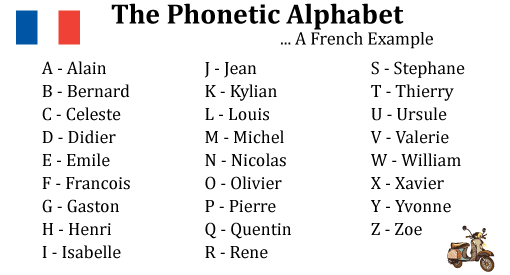
While there are several versions, the most standard one uses a specific list of words. For professional use, it's best to learn this international list.
Let's study the official phonetic alphabet used in professional telecommunications. This resource, 'Téléphoner en français,' provides a comprehensive table.
Find the section titled 'ALPHABET TELEPHONIQUE INTERNATIONAL' on pages 24-25 of the PDF. This table shows the letter, its pronunciation, the international standard word (like 'Alfa', 'Bravo'), and a French equivalent (like 'Anatole', 'Berthe'). Focus on the 'Français' column, as these are the names you are most likely to hear and use.
How to use it:
- When listening: A customer might say, "Mon nom est J-A-D-O-T. J comme Joseph, A comme Anatole, D comme Désiré..."
- When confirming: You would read it back the same way: "D'accord, donc J comme Joseph, A comme Anatole..."
This method removes all ambiguity and is a hallmark of a professional agent.
The same resource also explains how to pronounce common symbols you might find in an email address or reference code.
Let's quickly look at how to say common symbols, which is just as important as letters for capturing information like email addresses.
On page 26, look at the table 'LA PRONONCIATION DES NOMBRES & SYMBOLES'. Pay special attention to '@' (arobas), '-' (trait d'union), and '.' (point, though here shown as 'virgule' for decimal, in an email it's 'point').
3. Confirming the Spelling: Closing the Loop
After the customer has spelled the name or code, your final step is to read it back to them to confirm you have it right. This shows you were listening carefully and ensures your data is 100% accurate.
Here is a typical conversational flow:
- Agent:
Quel est votre nom de famille, s'il vous plaît ?(What is your last name, please?) - Customer:
Kyröjärvi. - Agent:
Pardon, je n'ai pas bien compris. Pourriez-vous épeler votre nom, s'il vous plaît ?(Sorry, I didn't understand. Could you spell your name, please?) - Customer:
Bien sûr. K comme Kléber, Y comme Yvonne, R comme Raoul, O comme Oscar, J comme Joseph, A comme Anatole, R comme Raoul, V comme Victor, I comme Irma. - Agent:
Merci. Je confirme : K-Y-R-O-J-A-R-V-I. C'est correct ?(Thank you. I confirm: K-Y-R-O-J-A-R-V-I. Is that correct?) - Customer:
Oui, c'est correct.
Test your understanding!
A customer tells you their reference number is "CH-95B". You want to confirm it by reading it back using the phonetic alphabet. How would you say it? (Use the French names from the "Téléphoner en français" PDF).
Show answer
You would say: "C comme Célestin, H comme Henri, trait d'union, neuf, cinq, B comme Berthe."
4. Listening Practice
Now it's time to train your ear. In the following video, an instructor will spell out ten French words. Your task is to listen to the letters and write down the full word. This is excellent practice for the "receiving" part of the conversation.
French lesson: spelling exercise
Let's practice our listening skills with this spelling exercise from the 'Language City' channel. The goal is to recognize the letters of the French alphabet when spoken.
Grab a pen and paper. First, watch from the beginning to 00:24 for the introduction. Then, from 00:24 to the end, the instructor will spell 10 words. Write down each word as you hear it spelled. Pause the video if you need to. The answers are revealed after each word is spelled.
Don't worry if you find this difficult at first! The sounds of some French letters can be tricky. The more you practice, the easier it will become.
Conclusion
Excellent work! You now have the tools and phrases to handle one of the most common and important challenges in a call center: accurately recording spelled-out information.
Key Takeaways:
- To ask for spelling, use polite phrases like
Pourriez-vous épeler, s'il vous plaît ?orEst-ce que vous pouvez l'épeler ? - To avoid confusion over the phone, use the French phonetic alphabet (e.g.,
A comme Anatole,B comme Berthe). - Always confirm the spelling by reading it back to the customer to ensure accuracy. Phrases like
Je confirme... C'est correct ?are perfect for this.
Preview of the Next Lesson:
Today, we learned a very specific and polite way to request information (spelling). In the next lesson, we will broaden this skill by learning more general polite phrases for requesting information, such as Pourriez-vous me donner...? (Could you give me...?). This will expand your ability to politely and professionally gather all the necessary details from a customer.
À bientôt