Bonjour! Welcome to your next lesson.
In our last session, we focused on how to be an active investigator by asking clarifying questions. You learned how to use open-ended questions like Quel est le problème ? and yes/no questions with Est-ce que... to gather the information needed to solve a customer's issue.
But what happens when the customer responds, and you can't understand their answer? Perhaps they are speaking too quickly, the line has a bad connection, or they use a word you don't know. This is a very common situation, especially when learning a new language. Today's lesson will equip you with the essential professional phrases to handle this gracefully. Our goal is to learn how to politely ask a customer to repeat information or speak more slowly. Mastering these phrases will give you the confidence to manage any conversation, no matter how fast it's going.
1. The First Step: Stating You Don't Understand
Before you ask someone to repeat themselves, it's polite to first signal that you haven't understood. Simply saying "Repeat" can sound demanding. Starting with a polite apology or explanation makes your request much more professional.
Let's look at a few key phrases for this.
10 French Fluency Shortcuts: Understanding Fast Spoken ...
The article '10 French Fluency Shortcuts' provides several polite ways to express that you haven't understood. We will focus on the formal options suitable for your call center role.
Please read the following two sections in the article: Start at the heading '6 – What to say when you don’t understand French?'. Focus on the 'Formal “correct” French' part. Note the phrase Je n’ai pas compris. Continue to the heading '8 -What to say when you didn’t hear something they said in French?'. Note the formal phrase Excusez-moi, je n’ai pas entendu..
From the article, you've seen two very useful phrases:
Je n'ai pas compris.(I didn't understand.) - Use this when you heard the words but didn't understand the meaning.Je n'ai pas entendu.(I didn't hear.) - Use this when you couldn't physically hear the words, perhaps due to a bad connection.
For extra politeness, you should always start with an apology or an introductory phrase. Here are the most professional ways to do this:
Excusez-moi, je n'ai pas bien compris.(Excuse me, I didn't quite understand.)Je suis désolé(e), je n'ai pas bien entendu.(I'm sorry, I didn't hear you well.)
In a call center, the reason you can't hear might be technical. Here are some simple phrases to explain the situation:
Ça coupe.- The line is cutting out.Le son est haché.- The sound is choppy.Ça grésille.- There's static/crackling.
For example, you could say: Excusez-moi, ça coupe un peu. Je n'ai pas bien entendu. (Excuse me, the line is cutting out a bit. I didn't hear you well.)
2. Asking for Repetition
Once you've indicated that you didn't understand, you can ask the customer to repeat themselves. It's crucial to use a polite and formal structure.
The most standard way to ask for repetition is:
Pouvez-vous répéter, s'il vous plaît ?(Can you repeat, please?)
This phrase is perfectly correct and widely used. However, in a professional call center environment, there are even more polished alternatives.
Let's watch a very short video that offers an excellent, professional phrase.
Centre d'appel: comment bien s'exprimer au téléphone? #callcenter
The video 'Centre d'appel: comment bien s'exprimer au téléphone?' provides tips for call center agents. We will watch a brief clip that gives a highly professional alternative to asking 'what?'.
Watch from 00:53 to 01:05. The video suggests avoiding 'quoi' (what) and offers a more elegant phrase.
The video gives us this fantastic phrase:
Pourriez-vous reprendre pour moi, s'il vous plaît ?(Could you say that again for me, please?)
Notice the use of pourriez-vous. This is the conditional form of pouvoir (to be able to). It is considered more formal and polite than pouvez-vous. While both are correct, using pourriez-vous demonstrates a higher level of professional courtesy.
3. Asking Someone to Speak More Slowly
Sometimes the problem isn't that you can't hear, but that the customer is speaking too quickly. This is very common when someone is frustrated or simply a fast talker. Asking them to slow down is perfectly acceptable if done politely.

The key phrase for this situation is:
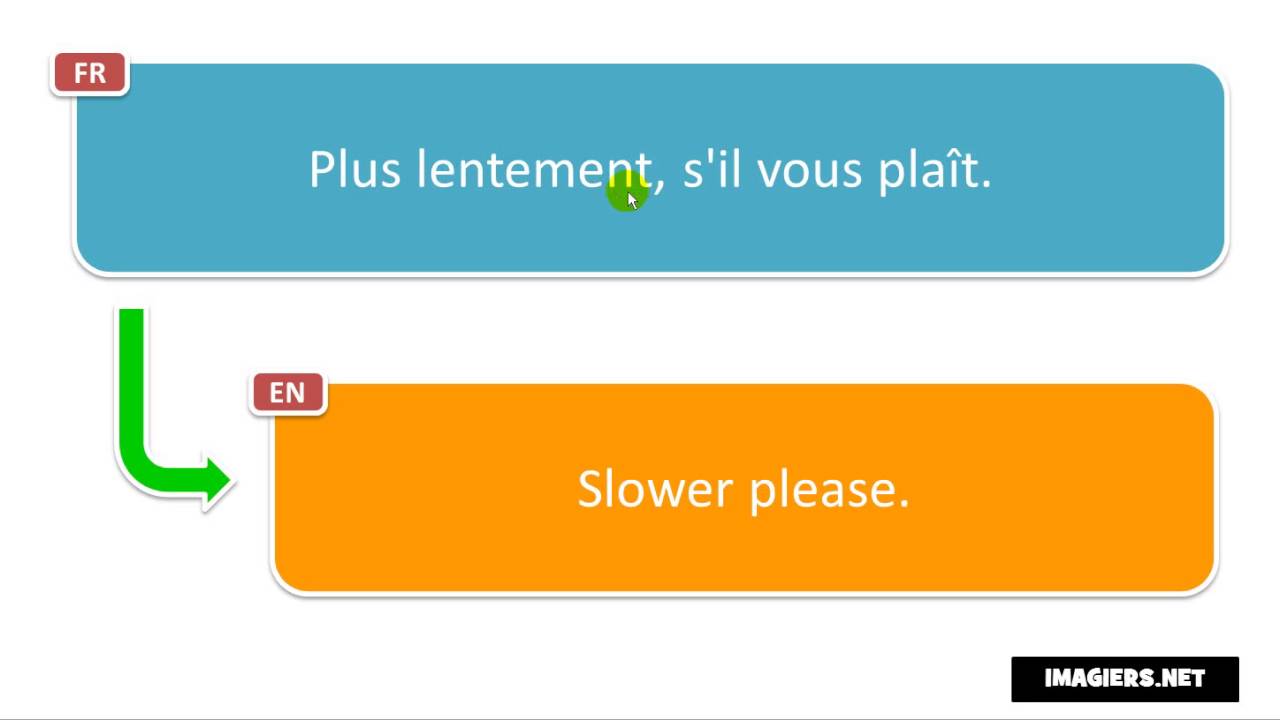
Pourriez-vous parler plus lentement, s'il vous plaît ?(Could you speak more slowly, please?)
Let's look at this phrase and a few others in a helpful guide.
25 phrases for PHONING in FRENCH
The article '25 phrases for PHONING in FRENCH' lists essential phone conversation phrases. We'll look at the ones for asking someone to repeat or slow down.
Please find and read the following two phrases in the article: Pouvez-vous répéter, s'il vous plaît ? Pourriez-vous parler plus lentement, s'il vous plaît ? Pay attention to the example sentences provided.
You can combine these phrases to be very clear and polite. For example:
Je suis désolé, je ne suis pas sûr(e) d'avoir bien compris. Pourriez-vous parler un peu plus lentement, s'il vous plaît ?(I'm sorry, I'm not sure I understood correctly. Could you speak a little more slowly, please?)
Test your understanding!
Imagine a customer calls and quickly says, "Bonjour,monnumérodeclientestle784512etmoninternetnefonctionnepas." You couldn't catch the client number. What is the most polite and effective thing you could say?
Show answer
An excellent response would be: Excusez-moi, je n'ai pas bien compris le numéro. Pourriez-vous répéter plus lentement, s'il vous plaît ? (Excuse me, I didn't quite understand the number. Could you repeat it more slowly, please?)
4. Practice and Summary in Context
Now, let's watch a final video that summarizes these situations. As a native Arabic speaker, you may find the explanations particularly helpful as the instructor uses Arabic to clarify the French phrases.
😄📞 Comment parler au téléphone en français ? | Conversation française
The video 'Comment parler au téléphone en français ?' is presented by a French teacher who explains the phrases in Arabic. This will serve as a great review of what we've covered.
Watch the section from 07:24 to 09:29. The instructor covers what to say when you can't hear well, when the sound is cutting out, and when the person is speaking too fast. Listen to his pronunciation of the key phrases.
This video nicely ties together all the scenarios we've discussed.
Finally, what if a customer repeats a word (like a name or a reference code) and you still can't understand it? The ultimate fallback is to ask them to spell it. You've already learned the alphabet, so this is a tool you can use!
The phrase is: Pourriez-vous l'épeler, s'il vous plaît ? (Could you spell it, please?)
Conclusion
Fantastic work today. You now have a professional toolkit of phrases to manage conversations where you don't immediately understand the customer. This is a vital skill that builds confidence and ensures you always get the correct information.
Key Takeaways:
- Always be polite. Start with
Excusez-moi...orJe suis désolé(e).... - To ask for repetition, use:
Pouvez-vous répéter, s'il vous plaît ?or the even more formalPourriez-vous reprendre pour moi, s'il vous plaît ? - To ask someone to speak slower, use:
Pourriez-vous parler plus lentement, s'il vous plaît ? - If you still don't understand a specific word after repetition, ask:
Pourriez-vous l'épeler, s'il vous plaît ?
Preview of the Next Lesson:
Now that you have the tools to make sure you understand the customer's information correctly, what's next? In our next lesson, you will learn how to paraphrase the customer's issue to confirm your understanding. This involves saying something like, "Si je comprends bien, le problème est que..." (If I understand correctly, the problem is that...). This proves you were listening and ensures you are both on the same page before you start solving the problem.
À bientôt