Bonjour! In our last lesson, we learned to use the essential verbs être and avoir. You practiced using their vous forms (vous êtes, vous avez), which are crucial for polite conversation.
Today, we will build directly on that foundation. This lesson focuses entirely on the concept of formal address in French. Your goal is to master the learning outcome: Address callers using the formal 'vous' pronoun consistently. In a professional setting like a call center, this isn't just a grammar rule—it's the foundation of respect and good customer service.
We will cover why vous is so important, see it used in realistic phone calls, and practice making sure you use it correctly every time you speak to a customer.
The Golden Rule of Professional French: Always Use Vous
In English, "you" can be used for anyone: a friend, a boss, a child, or a customer. French is different. It has two words for "you":
tu(informal "you"): Used with friends, family, children, and people you know very well.vous(formal "you"): Used with strangers, older people, authority figures, and in all professional and service contexts.
For your job in a call center, the rule is simple: you will always use vous with a customer. Using tu would be considered unprofessional and disrespectful.
This article gives a clear and direct explanation of this crucial distinction.
Essential Phrases for the French Workplace
Please read the following sections from the article 'Essential Phrases for the French Workplace' by italki. It gets straight to the point about using 'vous' in a business environment.
Read the 'Key takeaways', the section 'Professional titles and formality' (especially the 'Formal vs informal “you”' table), the 'Protip' box, and the FAQ at the end. Focus on the clear advice given for professional situations.
As the article emphasizes, the safest and most professional approach is to always start and stay with vous.
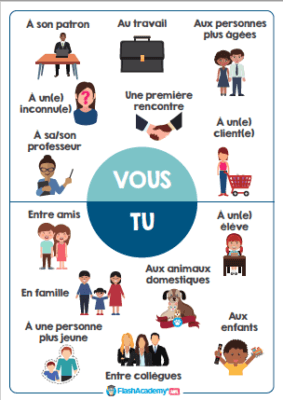
This infographic provides a great visual summary of when to use vous versus tu. For your work, you will operate entirely within the top half of this chart.
Hearing Vous in a Call Center Dialogue
Now that you know the rule, let's hear it in action. The following video features a dialogue between a customer and a technical support agent. It's a perfect example of the kind of conversation you will have.
Learn How to Make Complaints in French | Practical French Conversation Skills
Watch this first dialogue from the video 'Learn How to Make Complaints in French'. Pay close attention to how both the agent and the customer use 'vous' throughout the entire conversation.
Watch the clip from the beginning until 03:10. Listen for phrases like 'pouvez-vous', 'avez-vous', and 'cela vous convient'. Notice that every question and statement directed at the other person uses 'vous'.
Did you notice these key phrases from the agent?
...pouvez-vous décrire exactement le problème que vous rencontrez ?(...can you describe the problem you are encountering?)Avez-vous déjà redémarré votre modem ?(Have you already restarted your modem?)...pouvez-vous me donner votre numéro de contrat ?(...can you give me your contract number?)...quand seriez-vous disponible ?(...when would you be available?)Est-ce que cela vous convient ?(Does that work for you?)
Every single time, the agent addresses the customer with vous. This is the standard you will need to meet.
The Difference Between Tu and Vous Explained
To be certain you understand the difference, let's explore a resource that explicitly discusses the distinction. While the text of this lesson is a simple dialogue, the audio discussion that follows it provides a perfect, clear explanation in a conversational format.
Self Introduction and Basic Greetings in Formal French
This resource from FrenchPod101 includes a short dialogue, but the most valuable part for us is the audio transcript that follows. It contains a direct conversation about when to use 'tu' versus 'vous'.
Please read the transcript section labeled 'POST CONVERSATION BANTER'. Focus on the part that begins with the question, 'Comment vous vous appelez?'. The speakers, Eric and Virginie, clearly explain the social and professional rules for using 'tu' and 'vous'.
Key Summary from the discussion:
Comment vous vous appelez?is the formal way to ask "What is your name?"Comment tu t'appelles?is the informal, friendly way.vousis used for people you don't know, for hierarchy (like a boss), and in all formal situations.tuis for friends, friends of friends, or people of the same age in a casual context.
Mixing them up is a common error for learners. As the article you read earlier pointed out, you should never mix tu and vous when speaking to the same person. For your job, consistency with vous is key.
Test your understanding!
Imagine a customer says to you, “J'ai un problème.” (I have a problem.)
How should you respond to ask them "What is your problem?" in a professional way?
A) Quel est ton problème ?
B) Quel est votre problème ?
Show answer
B) Quel est votre problème ?
This is the correct choice. You must use the formal possessive adjective votre (your), which corresponds to vous. Ton corresponds to the informal tu and would be inappropriate.
Putting It All Together: Practice for the Call Center
Let's practice converting informal sentences to the formal, professional sentences you will use. Remember from the last lesson the conjugations for être (tu es -> vous êtes) and avoir (tu as -> vous avez).
Exercise: Convert the following informal (tu) questions into formal (vous) questions.
Tu as une référence ?(Do you have a reference?)Tu es sûr ?(Are you sure?)Tu peux répéter ?(Can you repeat?)
Show answers
Vous avez une référence ?Vous êtes sûr(e) ?Vous pouvez répéter ?or, even more politely,Pourriez-vous répéter ?
Consistently using vous and its related forms (votre, vous-même, etc.) will make you sound professional and respectful from the very first word.
Conclusion
You've done an excellent job focusing on this vital aspect of professional French. It may seem like a small detail, but using vous correctly is a sign of respect and cultural awareness that is essential for your role.
Key Takeaways:
- In a professional context, especially with customers, always use the formal pronoun
vous. - Using the informal
tuwith a customer is considered a serious mistake. - Consistency is key. All verbs, pronouns, and adjectives must agree with
vous(e.g.,vous avez,votre nom). - This rule applies whether you are asking a question (
Avez-vous...?), giving information (Vous êtes...), or making a request (Pouvez-vous...?).
Preview of the Next Lesson:
Now that you have mastered formal address, you're ready to officially open the conversation. In the next lesson, we will learn how to "Ask callers how you can help them using polite expressions with 'pouvoir'." You'll learn the key phrase Comment puis-je vous aider? and other variations, putting your knowledge of vous into immediate, practical use.
À bientôt ! (See you soon!)