Introduction
In our last lesson, we explored the Single-Index Model (SIM), which provided a practical way to simplify portfolio analysis by relating a stock's returns to a single market factor. The key takeaway was the decomposition of total risk into a diversifiable, firm-specific component (unsystematic risk) and a non-diversifiable, market-related component (systematic risk), measured by beta ().
This lesson builds directly on that foundation as we introduce the Capital Asset Pricing Model (CAPM), one of the cornerstones of modern finance. While the SIM is a statistical model describing historical returns, the CAPM is an equilibrium model that attempts to predict the expected return an asset should offer, given its risk. To achieve this predictive power, the model rests on a specific set of idealised conditions. Therefore, our goal in this lesson is to state and understand the crucial assumptions of the CAPM. Grasping these assumptions is essential, as they define the theoretical "perfect world" in which the model's famous conclusions hold true.
The Purpose of Assumptions in Financial Modeling
Before diving into the list of assumptions, it's helpful to understand why we need them. As a statistician, you know that building a model often involves making simplifying assumptions to isolate the relationship of interest. For example, in linear regression, we assume independence of errors and homoscedasticity to ensure the desirable properties of our estimators.
Similarly, the CAPM uses a set of strong assumptions to strip away the "noise" of the real world—things like transaction costs, taxes, and differences in opinion—to isolate a pure relationship between systematic risk and expected return. While we know these assumptions are not perfectly true in reality, they allow us to build a powerful theoretical framework. The practical value of the model then depends on how well its predictions hold up, despite the simplified starting point.
The Core Assumptions of CAPM
The assumptions of the CAPM can be broadly grouped into two categories: those concerning investor behaviour and those concerning the structure of the market. Let's start with a video that provides an excellent overview of several key assumptions.
Capital Asset Pricing Model Assumptions
This video from Edspira offers a clear and concise introduction to the main assumptions underlying the CAPM.
Please watch the following segments carefully: The initial assumptions cover frictionless markets (no taxes or transaction costs) and investors as price takers. This section explains two critical concepts: the ability to borrow and lend at a single risk-free rate, and the idea of "homogeneous expectations," where all investors share the same outlook. Pay close attention to this part, which explains what an "efficient portfolio" is using a simple numerical example. This links back to our work on portfolio theory and is a cornerstone of the CAPM.
The video gives us a solid starting point. Now, let's organise these ideas and add a bit more detail, drawing from our other resources.
1. Assumptions About Investor Behaviour
This group of assumptions defines an idealised "rational investor."
- Investors are Rational and Risk-Averse: They aim to maximise their economic utility. When presented with two portfolios offering the same expected return, they will always choose the one with lower risk (lower variance). This is the fundamental driver of seeking compensation for taking on risk.
- Investors Hold Diversified Portfolios: This is a crucial link from our last lesson. The model assumes that investors have already eliminated all unsystematic (firm-specific) risk through diversification. As a result, the only risk they need to be compensated for bearing is the systematic risk that remains. This is why beta () becomes the only relevant measure of risk for an individual asset within the CAPM framework.
- Homogeneous Expectations: All investors have access to the same information and interpret it in the same way. This means every investor arrives at the same estimates for expected returns, variances, and covariances for all assets. In such a world, there is no disagreement about which portfolio is the "best" risky portfolio.
- Investors Plan for a Single Holding Period: All investment decisions are made with the same, single time horizon in mind (e.g., one year). This simplifies the comparison of returns across different assets.
2. Assumptions About the Market
This group of assumptions defines a "perfect" market where assets can be traded freely and efficiently.
- Investors Can Borrow and Lend Unlimited Amounts at a Single Risk-Free Rate: There is a single, risk-free interest rate available to all investors for both borrowing (leveraging their portfolio) and lending (investing in the risk-free asset).
- Markets are Frictionless and Perfectly Competitive:
- There are no taxes or transaction costs (e.g., brokerage fees).
- All assets are perfectly divisible (you can buy any fraction of a share) and perfectly liquid (can be bought or sold instantly at the market price).
- Information is freely and instantly available to everyone.
- There are many buyers and sellers, so no single investor can influence market prices (they are "price takers").
The following article from ACCA Global provides a well-structured summary of these points and begins to touch on their real-world validity.
The capital asset pricing model – part 3 | ACCA Global
This article clearly lays out the standard assumptions and provides brief explanations for each.
Please read the entire section titled CAPM assumptions. Pay particular attention to how it groups the ideas of no taxes, perfect information, and rational investors under the umbrella of a "Perfect capital market."
Synthesising the Assumptions
We have now covered the key assumptions from multiple angles. While different sources may word them slightly differently or group them in various ways, the core ideas remain the same. The image below provides a clean, tabular summary of the most critical assumptions.
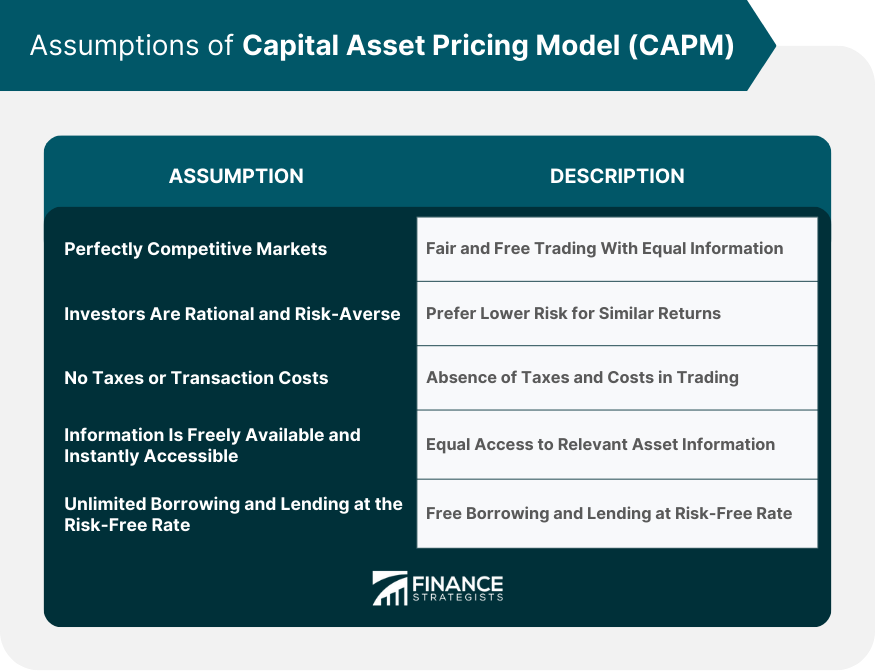
To round out our understanding, let's look at one more resource that frames these assumptions slightly differently, emphasising that the model assumes investors have already fully diversified away unsystematic risk.
What is the Capital Asset Pricing Model (CAPM)?
This article from Netsuite lists the assumptions and includes a brief critique of each.
Focus on the section titled CAPM Assumptions and Problems. Notice the final point it makes: "It assumes that investors can, or already did, diversify their portfolios... to eliminate unsystematic risk." This explicitly states the consequence of the diversification assumption we discussed earlier.
What Do These Assumptions Collectively Achieve?
Individually, each assumption seems like an unrealistic simplification. However, taken together, they lead to a powerful conclusion: in a CAPM world, all investors will hold the exact same portfolio of risky assets. This portfolio is the one that includes every single risky asset in the market, weighted by its market value. We call this the market portfolio.
Since everyone agrees on the inputs (homogeneous expectations) and faces the same opportunities (perfect markets, same risk-free rate), everyone independently arrives at the same solution for the optimal risky portfolio. Investors then adjust their overall risk exposure simply by deciding how much to allocate between this single market portfolio and the risk-free asset.
This is the logical leap that allows us to price assets. If everyone holds the same market portfolio, then the risk premium required for any individual stock must depend only on how much it contributes to the total risk of the market portfolio. As we know from the SIM, that contribution is measured by its beta.
Conclusion
In this lesson, we have systematically detailed the idealised conditions upon which the Capital Asset Pricing Model is built. These are not just trivial details; they are the logical pillars that support the entire theory.
Key Takeaways:
- CAPM is an equilibrium model built on a set of strong simplifying assumptions about investor behaviour and market structure.
- Investor assumptions: Investors are rational, risk-averse, hold diversified portfolios, and share homogeneous expectations over a single period.
- Market assumptions: Markets are frictionless (no taxes/costs), perfectly competitive, and allow for unlimited borrowing and lending at a single risk-free rate.
- The most important consequence of these assumptions is that only systematic risk, measured by beta (), matters for determining an asset's expected return, as all firm-specific risk is assumed to be diversified away.
- Collectively, these assumptions lead to the conclusion that all investors will hold a combination of the risk-free asset and a single "market portfolio" of all risky assets.
With this foundation in place, we are now ready to derive the CAPM's central prediction. In our next lesson, we will introduce the Security Market Line (SML), the famous equation that formalises the relationship between an asset's beta and its required rate of return. We will then see how to use this equation to perform practical calculations, such as finding the expected return for a stock and determining if it is fairly priced.